
 © Emma Bert / Marathons.com
Supershoes: when performance becomes a luxury product
As running and supershoes have exploded in popularity, shoe prices have soared. The democratisation of running has turned these performance-focused models into must-have items, whatever a runner’s level. Between scarcity marketing and the pursuit of speed, brands continue to innovate, with racing shoes that are sometimes eye-wateringly expensive and often far from durable.
A €1.5 billion running market in 2025, including €800 million for shoes alone. These figures from the Running Observatory illustrate the sector’s remarkable growth. The search for marginal gains is no longer an elite-only concern. Amateur runners are paying close attention too. According to the Running Observatory, 40% of respondents believe shoes play a major role in the pursuit of better performance. In this context, brands are developing increasingly technical models.
 © adidas
The Vaporfly 4%, the first supershoe
Nike’s Vaporfly 4%, launched in 2016 and released commercially in 2017, sparked a revolution, but the shoe was initially reserved for elite athletes. Ten years on, getting hold of a pair of supershoes has become almost routine. Following in the swoosh’s footsteps, every major running brand has developed its own carbon-plated model. adidas, ASICS, Hoka and Puma are now firmly in the mix.
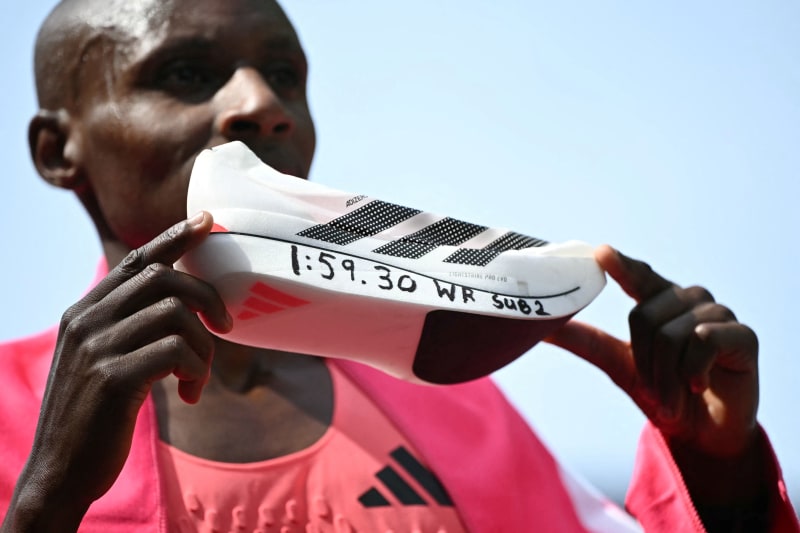
Nike no longer rules the international podiums unchallenged. adidas made headlines with Sebastian Sawe, who ran a stratospheric 1:59:30 at the London Marathon. Behind the first man to run that fast over the classic distance, Yomif Kejelcha, also an adidas athlete, impressed with his 1:59:40. They had one thing in common: both were wearing the German brand’s latest model, the Adizero Adios Pro Evo 3.
In this context, the shoe becomes directly associated with historic performances. If a model helps champions break world records or win the sport’s most prestigious races, it is bound to attract attention. Amateur runners are increasingly keen to buy the same products as the elite. Brands have understood this perfectly. The era of exclusive shoes such as the Vaporfly 4% is over. Brands now sell the models worn by the best athletes in the world, available with a few clicks or straight from the shop floor.
High prices no longer seem to be a deterrent. The public wants the equipment used by the sport’s biggest stars. Major brands are no longer selling just shoes, but seconds gained, records, innovation and a certain status. A racing model also embodies prestige, innovation and the brand’s wider universe.
Scarcity creates desire
In this crowded market, where standing out is becoming increasingly difficult, some brands have adopted another strategy: releasing exclusive shoes in very limited numbers. And, above all, at prices that would have seemed unimaginable just a few years ago. adidas, with the Adizero Adios Pro Evo, is the perfect example.
At €500 for a racing shoe, it is quite simply one of the most expensive models on the market. Enough to spark desire, curiosity and frustration. In a sector where almost every pair is now accessible, the price itself becomes a barrier, turning certain models into objects of desire. It is also a way to strengthen the brand image. Running is becoming premium and gradually adopting some of luxury’s codes: queues, rare colourways, storytelling, teasing and limited editions.
adidas is playing on emotion and exclusivity. Some shoes are almost collector’s items, a mechanism borrowed directly from the worlds of luxury and streetwear. Consumers are no longer buying a pair solely to run fast, but also to own the model everyone is talking about.
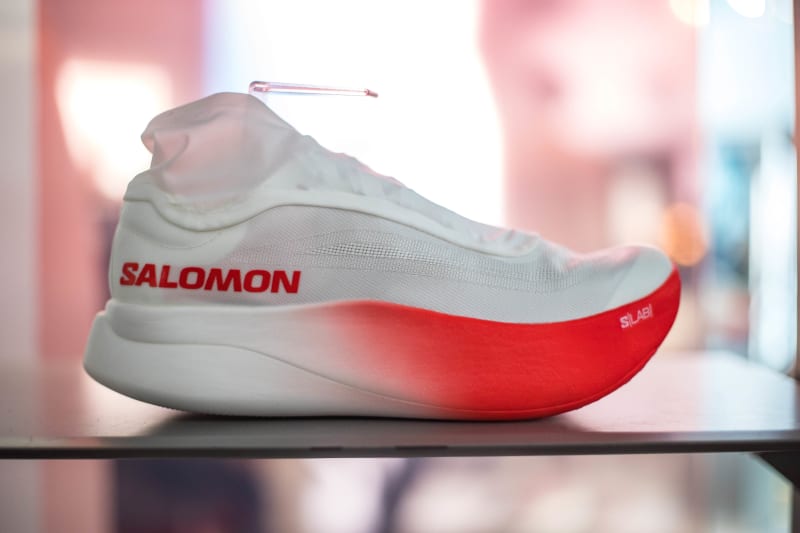
A new type of consumer is emerging: the gear enthusiast, eager to explore the promises of the latest innovations, such as the Salomon Phantasm 3, released at the start of the year. Modern supershoes also offer runners of every level a psychological advantage. When someone believes they have the best technology in the world beneath their feet, it can push them to run faster.
Yet the pair Sawe wore to break a legendary record has very limited durability. Designed above all to run fast, very fast, it prioritises low weight and maximum energy return. To save a few grams and optimise the bounce, brands use highly responsive PEBA foams that compress quickly. Outsoles are pared back to reduce weight, while rubber coverage is kept to a minimum. Brands favour performance over longevity.
This logic is also explained by the demands of high performance. The materials involved are complex, expensive to produce and the result of extensive research. The primary goal remains efficiency on the run, rather than durability over several hundred kilometres.
In that context, the Adizero Adios Pro Evo looks almost like a limited-use shoe, released in small volumes, which further reinforces its image as a rare and prestigious product.
 © Emma Bert / MARATHONS.COM
When ultra-performance becomes the brand’s shop window
For the past decade, brands have been locked in a fierce battle to produce the fastest shoe, the one capable of breaking records once considered untouchable. Research and development have become crucial for running brands. Rising prices are also explained by the integration of new materials and technologies. A brand’s flagship model has become a showcase for innovation.
There is therefore a clear marketing strategy at work, because amateurs want to own the same shoes as the world’s best. Performance ends up being associated with a high price. When Nike launched the Vaporfly 4% and then the Vaporfly Next%, a huge proportion of the field adopted those models. Today, the market is more diverse because competitors have set themselves apart with increasingly sophisticated shoes worn by winning athletes.
Every launch becomes a battle for image and legitimacy. Products once reserved for the elite have become powerful marketing tools, heavily promoted through brand messaging, social media, influencers and platforms such as Strava. Desire is constantly fuelled by testing, records and events organised by the industry’s giants.
The art of marketing is turning a desire into a need. Wearing an Adios Pro Evo or an Alphafly sends a signal. It is a way to display your level or your membership of a group, a culture built around performance. The shoe becomes an identity marker, almost like an iPhone or a fashionable pair of sneakers.
In this environment, offering €500 shoes also makes models selling for around €300 seem more acceptable, while positioning the brand in the premium segment. As demand rises, prices are pushed upwards. Entry-level models have increased by tens, even hundreds, of euros. Ten years ago, a high-end racing shoe rarely cost more than €180. Now it can cost €500. That is what makes the sector far more profitable.
Marketing or technology?
One of the market’s biggest challenges lies in balancing innovation with marketing strategy. At these prices, buying a supershoe can seem almost essential if you want to set a personal best. Since every brand now sells premium models, these prices are becoming the norm for some consumers. For many runners, not wearing supershoes in an important race almost feels like starting with a handicap.
But this price surge is not driven by marketing alone. Supershoes genuinely improve performance through complex technologies and years of research. The materials are expensive, development takes time and innovation is constant. Part of the price is therefore justified by that technological investment.
That leaves a broader question: durability. In this race for performance, brands are betting on shoes that are ever lighter, more aggressive and more efficient, and often, inevitably, less hard-wearing. Some models are virtually consumable products, quickly made obsolete by new versions. It is a questionable logic at a time when the industry is highlighting environmental concerns and product durability.
Whatever the case, these innovations are helping times tumble, from the world’s elite to amateur runners. Supershoes have transformed the running market, both in terms of performance and marketing.