

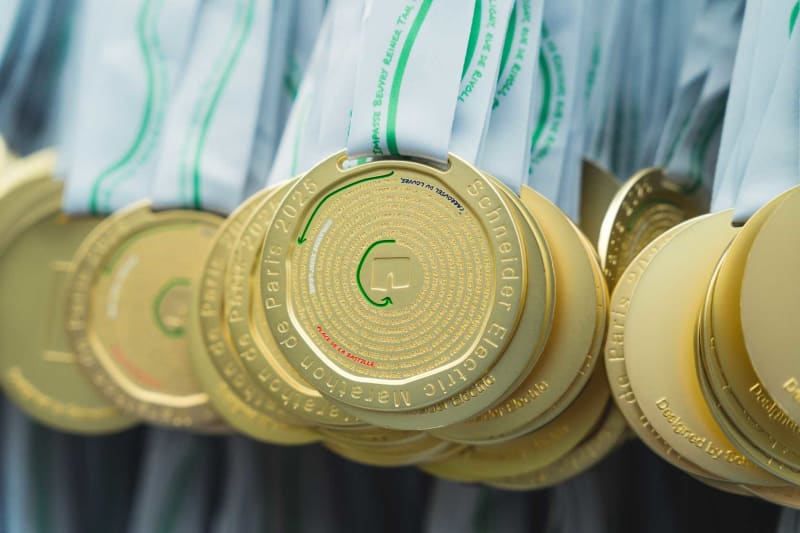
The finisher medal divides runners. For some, it tells the story of an athlete who achieved something and savors a meaningful reward. For others, it ends up gathering dust in a drawer while carrying a hefty environmental cost. No wonder it remains a talking point.
Table of contents
Finisher in a marathon or a 5K: same principle. When it comes down to it, the distance matters little compared with the achievement of simply reaching the finish line, whether without walking or within a set time. The medal handed to finishers by volunteers at the finish represents a powerful symbol above all: making it to the end. It rewards the effort invested in pursuing a goal, whether that goal was fully achieved or not.
Ultimately, it is the attempt more than the result itself that is being celebrated. But do you really feel entitled to receive the medal when the goal has not been reached? Have you truly earned it? On the one hand, yes: completing an event deserves recognition, especially when the initial ambition was simply to finish. On the other, it can seem outdated to runners who line up for races every weekend. In that case, is it not superfluous? Even more so at a time when its energy and environmental cost is under scrutiny. Put into context, is the medal still really a must-have?
 © ASO
© ASOWhen the medal means something
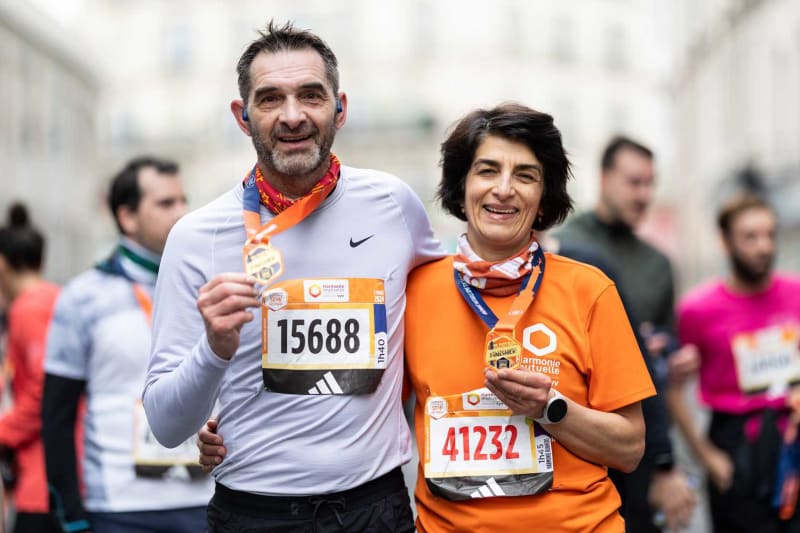
For some finishers, the medal is proof of a successful race. Above all, it means crossing the finish line, regardless of what it took to get there. Lénnie completed the Toulouse 5K. The pride she felt at pushing herself was immense. The emotion was palpable, and her self-esteem had rarely been so strong. The medal then becomes a powerful symbol. “I keep it safe as a reminder, she says. I was starting from zero, and I trained for two months to do it.” The thirty-something carefully keeps her few medals, including the oldest ones, so she never forgets. “When I was six, I ran a cross-country race and I still have that very first medal,” she says with a smile. Displayed on a small shelf, it has become part of her apartment’s decor. Lénnie is not the only one who enjoys receiving this little trophy and putting it somewhere special. Nicolas, a regular runner, has also found a way to showcase his: “I have a display cabinet opposite my bed where my finisher medals are kept safe from dust.”
For others, the medal is more of a memory aid, a tangible reminder of an event or performance that made an impression. “When I break a record, I enjoy having the medal engraved with the date and my new time, explains Vincent, who feels particularly attached to the physical memory of a race that meant a great deal to him.
But that attachment is not universal. Some runners take a more nuanced view of the value of these medals. “I understand why receiving one matters for a first race or an event that really means something to us, acknowledges Nathalie, a runner in her sixties. But for an ‘ordinary’ finisher, I’m not sure it’s something we need.” Pascal shares that view, though more critically, seeing an element of showing off and prestige: “I wonder whether they sometimes serve to satisfy the ego of certain participants” Not every runner attaches the same symbolic value to a medal. It can represent pride, a memory or motivation, but its real purpose continues to raise questions.
The downside of the medal
Some simply suggest giving runners the choice of receiving a medal when they register. If medals end up gathering dust in cupboards or taking up space in closets, it is because they do not necessarily serve a purpose in themselves. This is particularly true for regular runners, who collect race bibs and medals until the latter pile up on lamp arms. They may be easier to store than trophies, which can take up entire shelves, but the result is the same.
It’s still difficult to get rid of the medal altogether, but we’ll get there.
Some race organizers have already adopted a more minimalist approach, banning “goodies” and therefore medals. The first reason is financial. “Getting rid of them could save organizers money, points out Pauline, a regular participant in the Annecy Marathon, who appreciated being able to choose the medal’s material in 2020, wood or metal.
 © ASO
© ASOThe second reason is the environmental impact. Metal medals carry a heavy carbon footprint, around 0.8 kg of CO₂ each, and alternatives are emerging. Hervé Pardailhé-Galabrun, founder of EcoTrail Organisation, says: “I’m trying to eliminate goodies from all our races. It’s still difficult to get rid of the medal altogether, but we’ll get there. We started with wooden medals, which use very little energy: 0.0367 kg of CO₂” The EcoTrail Paris organizer has a point: the carbon footprint of a wooden medal is generally much lower than that of a metal one, especially when the wood comes from sustainably managed forests. Unlike metal, producing it does not involve energy-intensive foundries or smelting, and the wood can even store carbon captured by the tree as it grows.
Along the same lines, Adrien Tarenne, creator of the Ekiden de Montgeron, supported by the ES Montgeron club and the town, has introduced several measures to move towards a zero-waste event: homemade refreshments, no plastic bottles, local products handed out in reusable jute bags, including honey, pasta and syrup, locally made wooden medals, a clothing reuse center, dry toilets and no flyers: “Whatever the size of our organization, adopting an environmentally responsible approach is essential today, confirms the race director.
So should every race-related item, medals, T-shirts and the like, disappear, or should we keep only some of them? T-shirts, for example, have a more practical use: training or taking part in various outdoor activities. They can clearly replace a future purchase.
More articles

Investigation: The new running addicts: why they start… and never stop
Running was never your thing. Then one day you started, and now you’re a regular finisher. But have you ever wondered why you run so much?
Wed, September 9, 2026

BlablaRun Club brings runners together on the streets of Nancy
Every Tuesday, BlablaRun Club brings Nancy runners together at Place Stanislas, with three pace groups to choose from.
Wed, September 9, 2026

10K of Magical Aid Stations: the race where every sip makes your head spin
The Food Runners Club’s 10K of Magical Aid Stations returns for a festive sixth edition, where drinks, community and fun matter more than the clock.
Wed, September 9, 2026