
Skin Under Fire: How Your Body Becomes Something to Manage, Anticipate, and Protect
Published on Wed, August 5, 2026
Burning nipples, a war zone between the thighs, wrecked feet. Every runner ends up drawing, the hard way, their own map of sensitive areas. But why do certain spots give out again and again? What’s really happening under the skin when you rack up thousands upon thousands of strides? With insights from Dr Stéphanie Leclerc-Mercier, a Paris-based dermatologist who also works at INSEP and founded the association Dans la Peau des Sportifs, we set out to understand the mechanics so you can stay one step ahead of them.
Table of contents
- Sweat: an accomplice that speeds things up
- Feet: the first front line
- Nipples, the emblem of a preventable injury
- Inner thighs: a category of its own
- Armpits and lower back
- Why some runners suffer more than others
- What actually works (and what doesn’t)
- During the race: what if it’s already too late?
- The golden rule: test everything beforehand
Running is a sport built on repetition. A 42 km marathon adds up to somewhere between 35,000 and 40,000 steps. That’s how many times the same patches of skin get compressed, stretched, and rubbed against fabric, seams, or another skin surface. At that volume, even tough skin eventually gives. There’s an entire field devoted to this: tribology, the study of friction forces between two surfaces in contact. Applied to the human body, it helps explain why lesions show up where they do, and not elsewhere. Dr Stéphanie Leclerc-Mercier separates two very different mechanisms. The first is superficial friction: fabric, a seam, a strap gradually abrading the epidermis over the miles. “ It’s a superficial abrasion of the epidermis that removes the top layers and exposes the upper dermis,” she explains. It hurts, it stings, and it’s what English speakers call chafing.” Redness, burning, and irritation in the groin or armpits fall into this first category.
The second mechanism goes deeper, and can be far more disabling. On the feet especially, the skin gets trapped between the outside world (sock, insole) and internal bony structures. When the movement repeats thousands of times, the different skin layers stop moving as one. The epidermis grips the sock, while the bones keep tracking forward. That mismatch creates internal shear forces that eventually cause separation at the dermal-epidermal junction: a blister. A study by Lipman and colleagues (2016) on 128 runners confirms that 50{929902e1ae24fbd41363c9a1c32dfbb627114431c099f6444c46d2492cf1e17f} of blisters form on the toes and 23{929902e1ae24fbd41363c9a1c32dfbb627114431c099f6444c46d2492cf1e17f} on the heel, precisely where shear forces are highest due to foot anatomy and repeated ground contact.
Sweat: an accomplice that speeds things up
You might assume sweat acts as a lubricant, a thin layer of water between skin and fabric that helps everything slide. Wrong. “ If you want it to glide, you need oil. Sweat contains salt, and salt is exactly what skin doesn’t need constantly,” Dr Leclerc-Mercier says, who’s also very active on Instagram as @the_outdoor_dermato. In practice, sweat makes friction worse in two ways. First, mechanically: wet skin grips fabric more than dry skin, increasing friction rather than reducing it. Second, chemically: sweat salt irritates the epidermis directly, creating an osmotic effect that weakens skin cells until they rupture. “ Salt, sweat, friction: it’s an explosive cocktail,” the dermatologist sums up.
Heat amplifies the whole thing. High temperatures, ambient humidity, skin maceration: summer races combine every aggravating factor. Winter events aren’t spared either because in the cold, nipples retract and become more prominent, which makes them more exposed to fabric rubbing.
Feet: the first front line
It’s the most documented, most studied area and, paradoxically, often the one runners manage with the least discipline. Blisters are one of the leading reasons for dropping out over long distances, a number that should be enough to put foot prep back at the center of any runner’s routine. The root cause is almost always gear. A shoe with a toe box that’s too tight or too roomy, socks with seams in the wrong place, or the classic mistake: a model you usually wear, but in a new version that isn’t broken in yet. “ I run in Adizero 7s and I bought the 8s thinking they’re the same. But they’re not: not the same foams, not necessarily the same upper fit,” Dr Leclerc-Mercier says. Guaranteed consequences at the finish line.
“Toughening” the feet, a common practice among distance runners, can help by thickening the epidermis and making it more resistant to shear forces. But too much does the opposite: overly thick callus ends up rubbing the deeper layers and creates deep blisters that are especially painful. Which is why a visit to a podiatrist ahead of a key race can be useful not to get insoles, but to debride and fine-tune areas of hyperkeratosis.
The classic mistake is the race T-shirt. You pick up your bib and the event shirt with it, and on Sunday you wear it without ever washing or testing it. That’s a jackpot for runner’s nipples.
Nipples, the emblem of a preventable injury
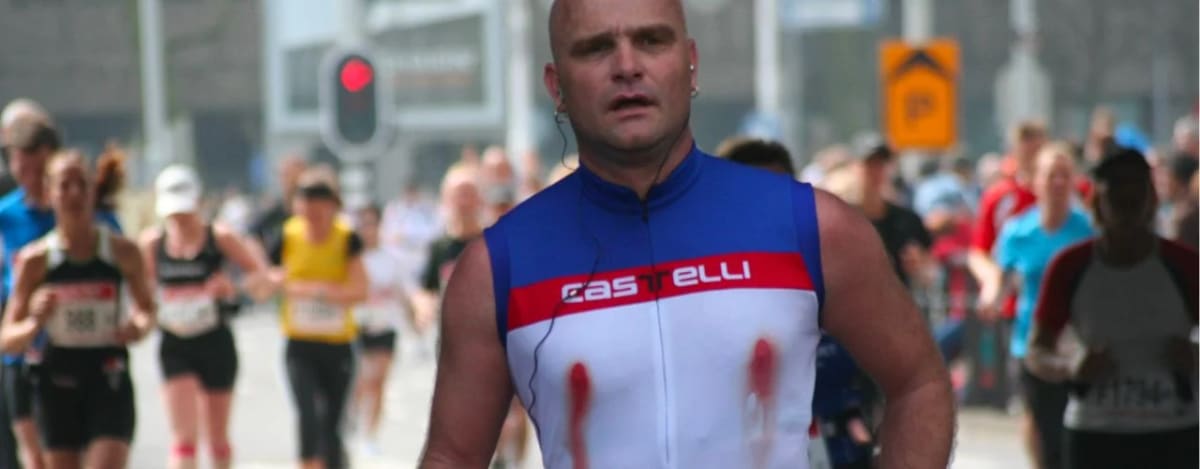
“Jogger’s nipple” or “runner’s nipple” in the literature has become the go-to image of the suffering marathoner. Studies show that nearly 36{929902e1ae24fbd41363c9a1c32dfbb627114431c099f6444c46d2492cf1e17f} of runners logging more than 65 km a week experience it. At mass-participation races, blood-stained shirts across the chest aren’t rare. Nipple vulnerability comes down to anatomy and, in men, a lack of natural protection. Unlike other areas, nipples sit directly against fabric with no cushioning. In cool weather they become erect and more prominent, so they take more rubbing. In the heat, sweat accelerates abrasion.
The dermatologist is blunt about the cause: “ The classic mistake is the race T-shirt,” she says. You pick up your bib and the event shirt with it, and on Sunday you wear it without ever washing or testing it. That’s a jackpot for runner’s nipples.” Barrier creams or kinesiology tape applied before the start are still the most effective fixes.
Inner thighs: a category of its own
A double whammy of mechanical rubbing and maceration, the inner thigh area has two of the three aggravating factors present all the time. The shearing motion of thigh-on-thigh contact with every stride creates continuous abrasion, amplified by heat and moisture that build up in this closed-off zone.
Dr Leclerc-Mercier systematically recommends shorts-style compression for any long distance, even if it means wearing them under loose shorts or a skirt. “ With compression shorts, there’s much less friction,” says the founder of the association Dans la Peau des Sportifs (@danslapeau_dessportifs), dedicated to prevention, education, and research on athletes’ skin issues. With short shorts and the built-in liner, it rubs a lot more.” A barrier cream before the start is the second line of defense as long as you reapply regularly, because it typically won’t last more than one to two hours.
Armpits and lower back
Less talked about but regularly seen in consults, armpits are a high-friction area: your arms swing like a pendulum, and for the upper body that motion is what your stride is for your legs. A top with thick seams or seams in the wrong place is enough to turn a long run into a session of torture.
When I see someone whose T-shirt rides up while they’re running, I always warn them
The lower back deserves extra attention for runners using a run belt or a backpack. A shirt that rides up under your gear exposes a strip of thin skin, not used to repeated contact, to the cumulative damage of the miles. “ When I see someone whose T-shirt rides up while they’re running, I always warn them,” Dr Leclerc-Mercier says. Same logic for runners using wired earphones around the neck: once sweat gets involved, the cable can become a surprisingly nasty source of irritation.
Why some runners suffer more than others
The question comes up all the time, and the answer is more nuanced than you’d think. Contrary to popular belief, body size is only a secondary factor. “ Bigger thighs will rub a bit more, sure. But overall, the two most decisive factors are sweat and repetition: duration, distance, and intensity,” the dermatologist explains.
That said, some skin fragility is genetic. Some people naturally have a weaker dermal-epidermal junction, with anchoring structures that are simply less resistant to shear forces. Those profiles develop blisters disproportionately compared to others in the same conditions, and sometimes you only discover it the hard way during your first long race.
What actually works (and what doesn’t)
So how do you find what works? The idea behind barrier creams is straightforward: lay down a greasy film on the skin to prevent direct contact between salty sweat and the epidermis. “ I compare them to a little shield,” Dr Leclerc-Mercier says. But their lifespan is limited over long distances, which means carrying some with you or having it in your crew bag to reapply along the way. In ultras, some runners pack small single-use sachets so they can top up the application.
I was shocked to see top trail athletes finish races with their feet in an awful state. A podiatrist appointment beforehand is non-negotiable for me
Foot taping is debated. Runners use it heavily on high-risk spots, but the scientific literature doesn’t credit it with proven effectiveness in preventing blisters. Worse, poorly applied tape that peels mid-race can create brand-new hot spots where it bunches up. On nipples, on the other hand, it remains one of the most reliable solutions when properly applied and suited to the effort. Once popular, the double-sock trick hasn’t shown effectiveness in the available studies. The trend faded, probably because the results weren’t there. A well-chosen technical sock, with as few seams as possible and thickness matched to your foot, is still the best option.
Few runners think about it in their build-up. Yet a consult a few weeks before race day matters not just for insoles, but to debride hyperkeratosis, spot potential friction points, and prepare the skin for the load. It can completely change how a race feels. “ I was shocked to see top trail athletes finish races with their feet in an awful state. A podiatrist appointment beforehand is non-negotiable for me,” Dr Leclerc-Mercier says.
During the race: what if it’s already too late?
In a marathon or half, the honest answer is often to grit your teeth and keep moving. Few runners stop to treat irritation when a time goal is on the line. But over long distances, and even more so in trail, the right move with a developing blister is to act at the first signs rather than waiting until it wrecks your race. The survival kit for a trail pack: small round-tip scissors, a disinfectant wipe, and hydrocolloid dressings. They create a protective cushion over the injured area without sticking to the wound, unlike standard bandages that can tear skin off when removed. Held in place with a light adhesive strip so they don’t roll under effort, they’ve saved plenty of finishes.
For chest or inner-thigh irritation, the window is tighter. For men, taking your shirt off can be an option where rules allow it. Otherwise, having crew access to backup barrier cream and a second pair of dry socks can make all the difference, even in long events where you’re tempted not to stop at all.
The golden rule: test everything beforehand
Dr Leclerc-Mercier comes back to this in every conversation: “ There’s no magic recipe. The best way to avoid it happening is to keep it from happening.” Prevention boils down to one disarmingly simple principle: never wear anything unfamiliar on race day. No new shoes, no new shirt, no new socks. Ideally, you test every item of your kit on long training runs before you sign off on it for competition.
For marathon runners, she boils it down to three tips: test your full outfit on long runs until you find the combo that causes zero issues, apply a barrier or anti-chafe cream to known hot spots before the start, and see a podiatrist a few weeks out. No mystery, no miracle gadget. Just anticipation, method, and the habit of never underestimating what thousands of strides can do to three millimeters of skin.