
Move to Make a Difference: An Evening Rethinking Health in Valenciennes
On Tuesday, November 18, the Cité des Congrès in Valenciennes hosted an evening exploring the links between physical activity, the environment and health. Built around a screening of the film 100 Marathons from the Heart, the event brought together local figures to debate sport’s role in the ecological and health transition. Eco-adventurer Nicolas Vandenelsken, the evening’s central guest, shared his experience and his take on the “One Health” concept.
At a time when physical activity is recognised as a major public-health tool and a practical driver of the ecological transition, the evening organised on Tuesday, November 18, in Valenciennes by Uni-Vert Sport brought together an audience keen to understand how sport can help transform the way we live. Films, participatory workshops and a panel discussion filled a packed programme rooted in local realities, with contributions from professionals in sport, research and environmental activism. At the heart of the discussions was the experience of Nicolas Vandenelsken, whose 100 marathons in 100 days became a way to question the links between human health, ecosystem health and sporting practices.
Looking back at the November 18 event in Valenciennes
From 5:30 p.m., the first participants gathered for fun workshops and a photo quiz titled 100 Marathons Seen from the Sky, an introduction to the world of eco-adventurer Nicolas Vandenelsken. At 7 p.m., the film-and-discussion evening officially got under way, followed 15 minutes later by a screening of 100 Marathons from the Heart, directed by Jérôme Habasque. The documentary follows the 100 marathons in 100 days challenge and the inner journey that came with it. Immersive footage, daily encounters and aerial views shape a story that puts the human dimension of the project front and centre. The “Move to Make a Difference” panel, scheduled for 7:45 p.m., was the evening’s highlight.
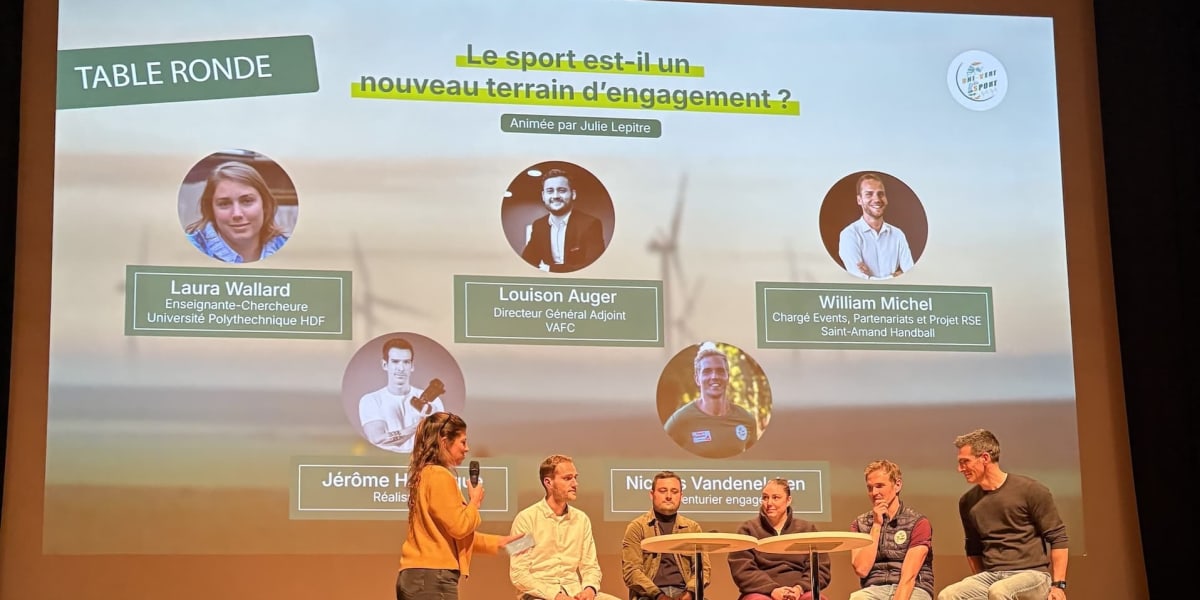
The panel featured:
➜ Louison Auger, deputy general manager of VAFC (football, National), who came to present the club’s CSR strategy unveiled on Tuesday, December 18.
➜ William Michel, CSR project manager at Saint-Amand Handball, a professional women’s first-division club
➜ Laura Wallard, lecturer and researcher at the Université Polytechnique Hauts-de-France
➜ Jérôme Habasque, director of 100 Marathons from the Heart
➜ Nicolas Vandenelsken, eco-adventurer
The speakers discussed sport’s place in society, how professional clubs are now structuring their CSR initiatives, and how sporting projects can become tools for education and mobilisation. Representatives from the VAFC and Saint-Amand Handball outlined their local initiatives, including active travel, inclusion, internal policy development and environmental commitments.
Scientist Laura Wallard provided a scientific perspective on research into physical activity, travel behaviour and their measured impact on public health. She notably pointed out that walking and cycling are now accessible ways to reduce chronic disease and improve population wellbeing, a finding supported by recent data from Santé Publique France. The evening continued at 9 p.m. with refreshments and informal discussions, giving participants, volunteers, local stakeholders and spectators the chance to keep the conversation going. At 9:45 p.m., a screening of Our Record brought the event to a close.
Nicolas Vandenelsken: a journey shaped by 100 marathons in 100 days
The presence of Nicolas Vandenelsken was the thread running through the evening. A native of Vieux-Condé (59), he became known for completing 100 marathons in 100 days in 2022. It was a physical, logistical and mental experience that went far beyond sporting performance. His approach is to turn adventure into an educational tool, raising awareness and mobilising people around environmental and public-health issues. “This is the second screening of the film since the summer, Nicolas Vandenelsken explains. The content surprises audiences a little because, judging by the title, they expect a film purely about performance. But Jérôme Habasque and Mathieu Foubert, the two directors, did a really good job of focusing on our relationship with nature. Taking care of ourselves means taking care of nature. It’s a journey I experienced personally.”
During the panel and in informal conversations, he returned to the motivations behind the project: showing that sport can be an accessible, unifying way to get involved. The daily 42.195 km was conceived as a pretext for creating encounters, crossing different territories and demonstrating in practical terms that a change in lifestyle, here through active travel, can take place over the long term without turning into a feat reserved for elite athletes. The film 100 Marathons from the Heart, screened early in the evening, documents that approach. It follows the daily rhythm of the challenge, conversations with local residents, moments of fatigue and the solutions found to keep the adventure going for 100 consecutive days. Director Jérôme Habasque focuses on the project’s emotional dimension: the landscapes, chance encounters and deliberate simplicity underpinning the entire experience. Nicolas Vandenelsken frames his work through the “One Health” concept, based on the idea that human health, animal health and ecosystem health are interdependent.
By choosing running as a means of transport, favouring proximity and highlighting the benefits of our connection with nature, he brings that principle to life. In his view, investing in active travel, natural spaces and outdoor sport offers a collective response to today’s health challenges: prevention, lower healthcare costs, quality of life and stronger local cohesion. According to Nicolas, the November 18 event achieved its aims.
The aim of an event like this isn’t simply to convince the already convinced. It’s about engaging with every audience, including people who are less attuned to the climate issue. We absolutely have to move beyond the triangle of inaction, where citizens wait for public authorities, public authorities wait for businesses, and businesses wait for citizens… Encounters like this are designed to bring everyone together and create a genuine exchange. Having private companies among the partners was also a positive thing. It pushes them to act and rethink some of their choices…
Health, active travel and local engagement
The Valenciennes event took place against a backdrop of scientific data confirming physical activity’s major role in public health. According to a report published by ADEME in September 2025, physical activity linked to daily journeys on foot could prevent thousands of deaths each year in France. The estimate includes the effects of walking on the prevention of cardiovascular disease, cancer, diabetes and respiratory conditions. Local data also points to considerable room for improvement: 76% of people in France live within 4 km of a range of essential facilities, including a supermarket, secondary school, doctor, pharmacy, gym and library. In theory, this proximity could make active travel easier if infrastructure and habits moved in the same direction.
The same ADEME report indicates that, if today’s best practices were rolled out more widely, walking’s modal share could reach 31% (up from 24% today), while cycling could reach 8% (up from 3%). These projections illustrate the health and environmental potential of public policies focused on active travel. Research published by Santé Publique France in 2024 reinforces the point: walking or cycling for an additional 10 minutes a day could reduce mortality by 3% to 6% in major cities.
For Nicolas Vandenelsken, the good practices that are gradually gaining ground need to keep being promoted: “Everyone has to find their own way. I worked in the sports industry for several years, notably on the Tour de France. It was a real passion. Then, at a certain point, I started questioning its meaning. In 2019, probably not far from burnout, I signed a mutual termination agreement. That was followed by a period of searching. I experienced obesity and then anorexia, so finding personal balance became important to me. I founded Uni-Vert Sport in 2021 with the aim of promoting a better relationship between our bodies and nature. Some days are hard, but like everyone else I try to hold on to the positive things I see. MAIF is a good example of a company trying to change the environment around it. More recently, it introduced eco-conditionality bonuses, which is interesting. The VEJA brand is also doing positive things. As consumers and citizens, we need to encourage them to make the right choices.”
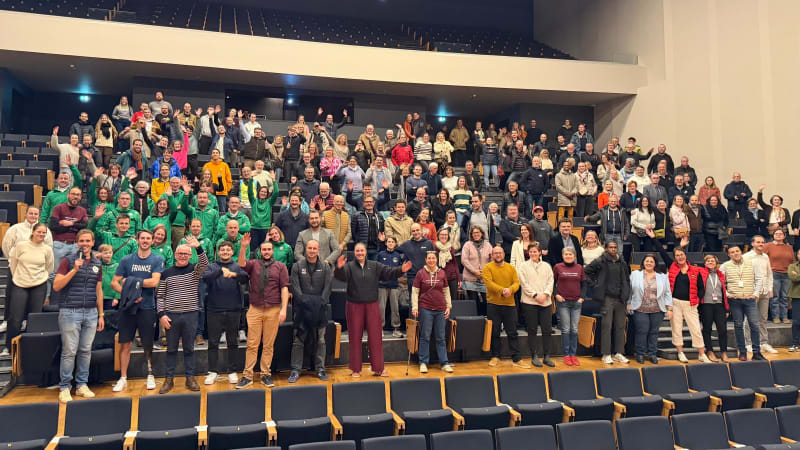 © Jérôme Habasque
To find out more, discover Uni-Vert Sport, founded by Nicolas Vandenelsken
Uni-Vert Sport, which organised the event, works at the intersection of sport, health and the ecological transition. Since 2021, the organisation has developed projects designed to work with local communities on new narratives that enable everyone to engage with wider health issues. Based in Hauts-de-France but active throughout France, it uses sporting and civic adventures to get residents, institutions, clubs and local authorities moving. Over the past few months, Marathons.com has had the chance to speak with three active members of the organisation: Olivier Maria, Pierre Destailleur and Nicolas Vandenelsken during this event in Valenciennes. All three are pictured together below!
More articles

Run with Your Old Man: the run club bringing generations together
Eden Yaïche’s intergenerational run club brings runners together with a parent or relative for shared miles, memories and plenty of laughs.
Thu, September 10, 2026

Running Therapy Takes Psychology Out of the Office
Running with your therapist brings movement, the outdoors and body awareness into the therapeutic process.
Thu, September 10, 2026

Ultra Back To Life: when ultratrail meets ecological regeneration
Ultra Back To Life combined ultra-endurance with biodiversity projects and environmental education in a new model for sporting events.
Wed, September 9, 2026