
From November 28 to 30, in Saint-Siméon-de-Bressieux, Ultra Back To Life (UBTL), led by Abundita and its founder Clément Chapel, offered a new way to think about sporting performance. Combining ultra-endurance, hands-on biodiversity projects and environmental education for young people, the event broke new ground. And it looks promising.
Major sporting events are regularly questioned over their environmental impact, as we have seen with recent editions of UTMB, the Tour de France and Formula 1. No elite sport is exempt, and running is no exception. It was against this backdrop of growing reflection on our collective environmental impact that UBTL, Ultra Back To Life, was born. The first edition, held in late November 2025, set out to make a race a vehicle for regeneration rather than a source of degradation. It was an entirely original format, designed to give more than it takes from the host territory. The result? More than 500 trees were planted over the weekend by the participants, who did not stop there.
A different way to think about ultratrail
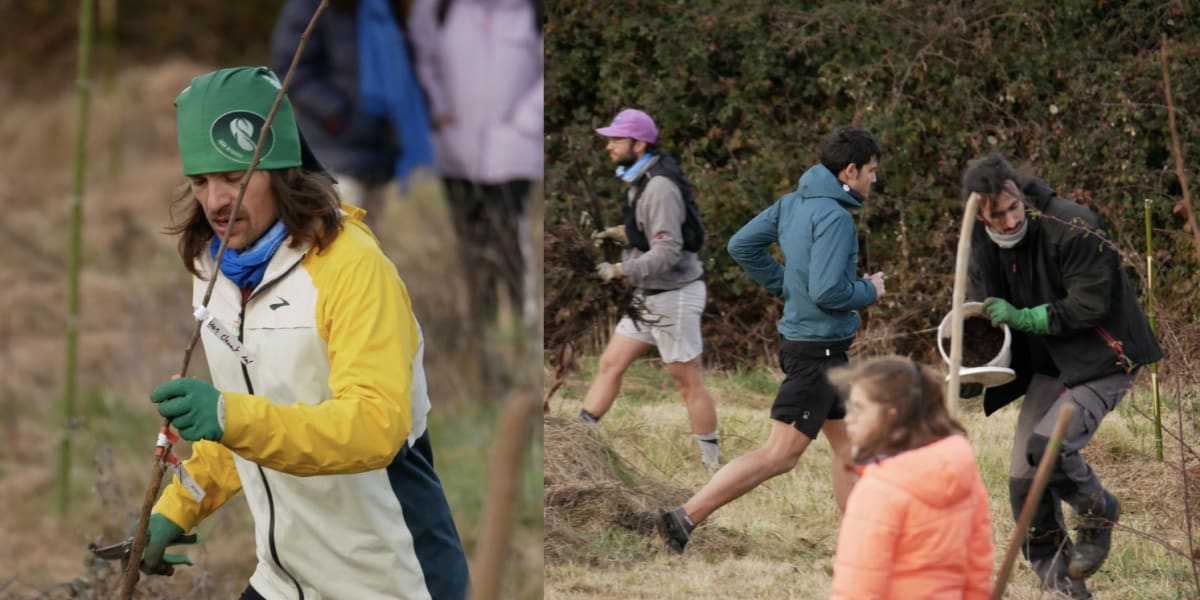
For 48 hours, the athletes gathered in Saint-Siméon-de-Bressieux, Isère, including a few names already familiar to regular marathons.com readers, alternated between ultra-endurance running and hands-on projects for the living world. Tree planting, natural habitat creation, pollution cleanup, educational sessions and awareness workshops were all part of the programme. At the heart of the format devised by Clément Chapel and his fellow organisers were two symbolic teams, the Green Lung, representing the forest, and the Blue Lung, representing the ocean. They went head to head in a competition where sporting performance was not the only measure of success.
A few days after the race, the competition was not over. Clément, a delighted organiser, was still hard at work: « We’re still finalising the waste count. I don’t know who won the race. It’s slowly taking shape, and it’s going to be close ». The winner of the inaugural edition? Corentin Michel, who cycled to the race from Lyon, 65 km away. He covered 201 km during the event, but more importantly planted 27 trees and collected several kilos of waste.
To establish the standings, UBTL introduced a unique points system built around four dimensions:
➔ Sporting performance
➔ The team’s carbon footprint
➔ Biodiversity initiatives
➔ Educational contribution
For the organiser, the race was a resounding success, thanks first and foremost to the commitment of the volunteers, the involvement of Saint-Siméon-de-Bressieux’s municipal services and the enthusiasm of the runners: « the results are very positive, and the weekend was fantastic. Every runner experienced the most epic race of their life. I think they were all fired up. Four hundred schoolchildren took part in activities, along with high-school students, the town hall, its technical services, 50 volunteers, 50 runners and perhaps 100 curious onlookers over the course of the weekend. Altogether, we brought nearly 1,000 people together for the event. You can’t put a price on that. There was also a great deal of social diversity, which is precious in its own right and a sign of success for us. The race leaves a rich legacy. It’s time to take stock of what we achieved. Personally, I worked on it for a year ».
At 2 p.m. on Friday, November 28, nearly 300 schoolchildren symbolically opened the event with a charity relay in aid of Action Against Hunger before handing over to the ultrarunners. Several recognised figures from the socially and environmentally conscious trail scene, including Nicolas Vandenelsken and Olivier Maria, were there. Xavier Thévenard also voiced his support for the initiative.
The results are very positive, and the weekend was fantastic. Every runner experienced the most epic race of their life.
An initiative rooted in its creator’s journey
UBTL came into being because its creator, through the Abundita association, has a clear vision: using sport to drive change. The goal here is not simply to reduce an event’s environmental impact, but to actively help restore ecosystems. Where did this ambition come from for Clément Chapel, who holds a degree in sports tourism management?
« Sport has always driven me. When I was young, I thought I would grow up, grab my football bag and go and play for Girondins de Bordeaux (laughs). I got involved in environmental sport six years ago, after becoming aware of environmental impact and waste management. I started running and picking up litter. Eventually, I launched the Ploggathon association, a blend of plogging (editor’s note: a concept from Sweden combining sport and environmental action) and marathon. Through that adventure, I discovered the human element. I had never imagined the power it could have, with so many wonderful people getting behind the project. Once I had experienced that, I couldn’t let it go. Today, we have to take action to change things, and sport can be a driving force. With the association, we broke the world plogging record several times in an effort to bring the issue into the spotlight. »
Ploggathon has since given way to Abundita, which has taken up the baton while adding further layers of action: « Simply cleaning things up was not enough for us, so we moved on to the next stage: cleanup, pollution removal and tree planting, with the aim of creating community orchards and fruiting hedgerows in schools. Then, last year, I took part in the World Plogging Championships, and that gave me ideas for the UBTL format. We brought together people who connected with the idea, and that’s how the race was born. »
Planting, educating, restoring: UBTL’s tangible impact
One of Ultra Back To Life’s defining features is the clarity of its environmental and educational goals. In concrete terms, UBTL 2025 can point to an impressive positive impact:
➔ 525 fruit trees and shrubs planted,
➔ 20 metres of dry-stone hedgerows built,
➔ 1 owl nesting box installed,
➔ 500 tonnes of CO₂ stored permanently,
➔ A learning forest garden created,
➔ 3 ecological ponds created,
➔ 30 kg of waste collected and removed,
➔ 500 children reached through an educational week run with Lycée Professionnel Saint-Exupéry in Saint-Siméon-de-Bressieux from November 24 to 30.
This educational dimension is one of the event’s strongest pillars. By bringing students and teachers together for workshops, discussions and meetings with athletes, UBTL makes environmental issues part of an intergenerational learning process. The presence of 300 schoolchildren at the opening charity race illustrated that commitment. The tree planting and natural habitat projects, meanwhile, were tangible actions rooted in the local area.
The aim is to create benefits that last well beyond race weekend: a restored ecosystem, a strengthened carbon sink and an educational space that local schools can use in the years ahead. By combining these actions with an ultratrail format, UBTL offers an original equation and challenges traditional event models, opening up a new path. « We’re fully aware that regenerative sport won’t replace every race, but it brings something different that we want to promote. There’s much more to it than the stopwatch. With this race, we want to open up possibilities and give people ideas. »
More articles

Run with Your Old Man: the run club bringing generations together
Eden Yaïche’s intergenerational run club brings runners together with a parent or relative for shared miles, memories and plenty of laughs.
Thu, September 10, 2026

Running Therapy Takes Psychology Out of the Office
Running with your therapist brings movement, the outdoors and body awareness into the therapeutic process.
Thu, September 10, 2026
Move to Make a Difference: An Evening Rethinking Health in Valenciennes
In Valenciennes, sport, health and the environment came together for an evening with Nicolas Vandenelsken and the film 100 Marathons from the Heart.
Wed, September 9, 2026