
Sudden death while running: understanding the risks and how to prevent it
Every year, runners collapse mid-race. Sudden cardiac death in sport is rare, but it’s a brutal reminder to get screened, listen to warning signs, and train in line with your health. Here’s what drives it, who’s most at risk, and what prevention really looks like.
✓ Breaking it down with forensic physician and trail runner, champion Charlotte Allain.
On May 9, a 42-year-old runner suffered cardiac arrest at the 38 km mark of the Trail des Forts. He was treated by emergency services and transported to hospital, where he later died. A few weeks after that tragedy, a 50-year-old man lost his life at La Pyrénénne, a race in Paris’s 20th arrondissement, before another 30-year-old runner died on an athletics track in Val-d’Oise. These deaths have shaken the running community, and they come at a particular time, with multiple heatwaves leading to the cancellation of many races and the closure of outdoor facilities.
As emotional as these events are, they also raise a key question: how can athletes, sometimes well-trained and seemingly healthy, suffer cardiac arrest during exercise? Behind the headlines lies a medical reality that’s well known: sudden cardiac death in sport.
Rare but feared, it can be driven by undiagnosed heart conditions, extreme weather, or training and racing that don’t match a runner’s current capacity. A closer look at a phenomenon that underscores why screening and prevention matter.
Sudden cardiac death in sport: rare, but real
According to the World Health Organization (WHO), sudden death is defined as the unexpected death of someone in apparently good health, within an hour of the first symptoms appearing. By nature, it’s unpredictable. That doesn’t mean runners are doomed to train in constant fear. Regular check-ups with your primary care doctor or a cardiologist can help detect certain heart conditions that raise the risk during intense exercise, even if they can never provide an absolute guarantee.
The risk remains moderate. The Fondation Coeur & Recherche estimates sudden death affects around 1 in 1,000 people each year, roughly 60,000 deaths annually in France, though the data are still imprecise. It affects men more often, at three to four times the rate seen in women, with a peak frequency between ages 45 and 75. “ Those doing recreational sport, or returning to exercise after 50, are the most exposed, adds Charlotte Allain, a forensic physician and winner of the 62 km race at the Trail des Forts.
According to a 2021 update published by Marijon and colleagues in Archives des Maladies du Coeur et des Vaisseaux — Pratique, 820 cases of sudden death linked to sports participation were recorded in France over a five-year period. These figures come from the French registry launched in 2005 by the Paris Center of Expertise for Sudden Death (Paris-CEMS), conducted in the general population (60 departments). Factoring in unreported cases, the authors estimate that around 1,000 deaths occur each year in this context, while sudden death in young competitive athletes accounts for no more than 5 % of cases recorded among athletes.
The people most at risk aren’t those with a known condition whose training is medically supervised, but those with an undiagnosed condition.
How can a runner who seems healthy die?
Even with every precaution, nobody can be 100% sure they’ll never fall victim to sudden cardiac death. Because it often strikes during exertion in someone with an unrecognized cardiac issue, it’s tempting to think it should have been diagnosed earlier. But sometimes it’s missed.
Which is a shame, because spotting an abnormality allows for better guidance around training and racing. And it doesn’t necessarily mean a runner can’t toe the line of a trail race or road event. “ The people most at risk aren’t those with a known condition whose training is medically supervised, but those with an undiagnosed condition ,” Charlotte Allain explains.
Certain conditions affecting the coronary arteries (atherosclerotic build-up), the heart’s electrical conduction system (arrhythmias), or the heart muscle itself (hypertrophic cardiomyopathy) can go unnoticed for years before becoming symptomatic during physical exertion. Because the heart is working harder during exercise, these conditions, which Charlotte Allain calls “invisible at rest,” can show themselves when you’re pushing.
In general, runners most exposed are those with cardiovascular risk factors such as age, obesity, smoking, or dyslipidemia/high cholesterol. Family history can also play a role.
Heat: an extra risk factor
Sudden cardiac death, often tied to an undiagnosed heart condition, should be distinguished from exertional heat stroke, also known as exercise-induced hyperthermia. This can occur even without any underlying heart disease. It results from a failure of the body’s thermoregulation during intense muscular work and is promoted, among other things, by hot, humid environments that limit sweating and heat loss.
In some cases, the two can overlap, when a runner with a heart condition is also exposed to extreme heat. It’s impossible to pin down precisely what share is due to pre-existing issues versus external factors such as dehydration or the intensity of the effort. “ Autopsies aren’t systematic, and lab analyses of samples taken during autopsies are even less so. So most of the time, the precise cause of death isn’t identified, and we lack data on sudden cardiac death in athletes ,” stresses the researcher, who investigates sudden deaths through her work. The cause of a death during sports is often multifactorial, combining a possible undiagnosed heart disease, intense or prolonged exercise, and extreme weather conditions.
 © Prevention of sudden cardiac death during sports: An update. E. Marijon and al., Arch Mal Coeur Vaiss Prat 2021.
Prevention: screening and listening to warning signs
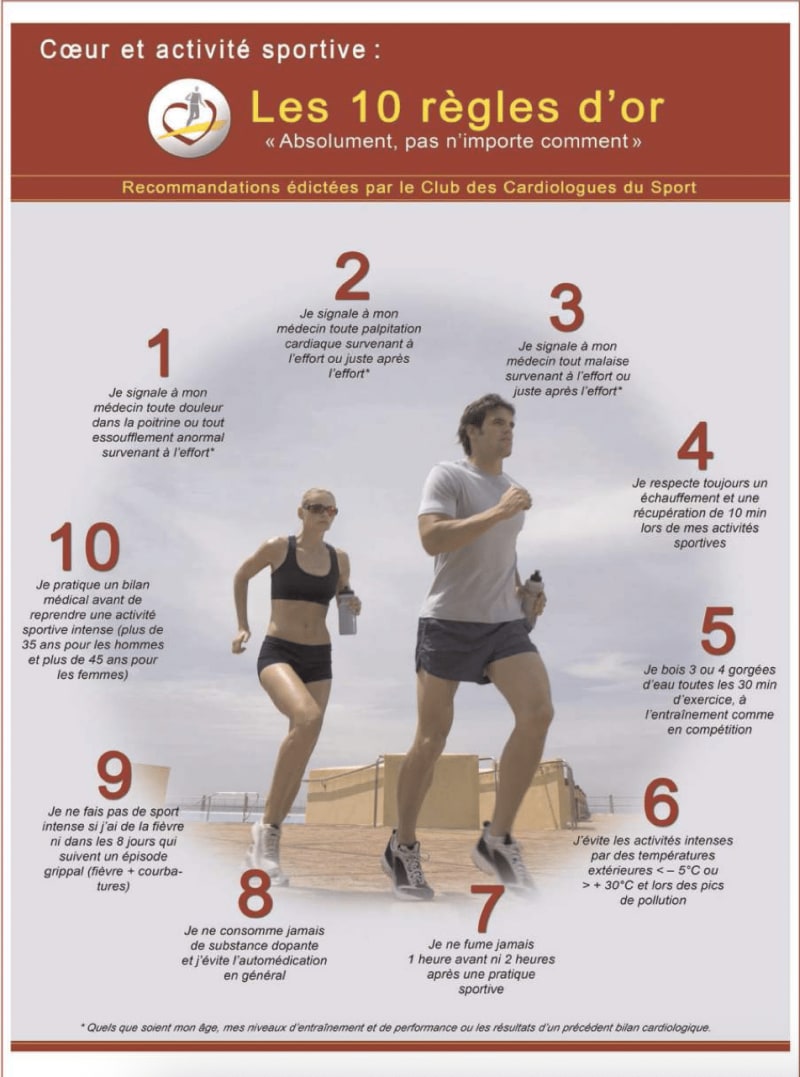
Prevention remains the best way to reduce the risk of sudden death in athletes. Watching videos to get the Pass de Prévention Santé (PPS) obviously isn’t enough. A visit to your family doctor or a cardiologist, with targeted questions and, if needed, an ECG, blood work, or even an exercise stress test, is far more effective for assessing risk.
Certain symptoms should raise a red flag and never be brushed aside: faintness, palpitations, chest pain or tightness, especially if they happen during exercise. Unusual fatigue, both at rest and during training, as well as a recent drop in performance should also prompt a medical check. A close relative who died suddenly, with an established cause or findings pointing to cardiac disease such as myocardial infarction, disease of the heart wall, or rhythm disorders, can also be a warning sign for you. “ When the exact cause of death is determined, it can also make it possible to screen the athlete’s family members, who may have the same condition ,” concludes the Besançon-based trail-running doctor.
More articles

Run with Your Old Man: the run club bringing generations together
Eden Yaïche’s intergenerational run club brings runners together with a parent or relative for shared miles, memories and plenty of laughs.
Thu, September 10, 2026

Running Therapy Takes Psychology Out of the Office
Running with your therapist brings movement, the outdoors and body awareness into the therapeutic process.
Thu, September 10, 2026

Move to Make a Difference: An Evening Rethinking Health in Valenciennes
In Valenciennes, sport, health and the environment came together for an evening with Nicolas Vandenelsken and the film 100 Marathons from the Heart.
Wed, September 9, 2026