

You may have noticed elite athletes joining Team for the Planet across social media in recent weeks. The citizen-led initiative brings athletes together with Vendée Globe sailor Sam Goodchild to “stand up for the climate.” How does it work?
One hundred elite athletes from athletics, skiing, sailing, mountaineering, football, rugby and other sports are taking turns on Instagram to create a huge chain of stories. The aim is to encourage their communities, including businesses, citizens, associations, local authorities and investment funds, to take action against global warming. Each athlete involved puts up an item that holds personal significance, linked to their career or a meaningful experience, inviting their communities to invest in climate action.
Each investment gives participants a chance to win a prize or an experience. The funds raised are used to finance major innovations against global warming. This is not a donation, since Team for the Planet aims to enable participants to recover their money at €1 for every €1 invested, provided the organisation’s cash position allows it.
The project aims to raise money and attract major investors in order to roll out 100 global innovations targeting greenhouse gas emissions. One of the 13 innovations financed and deployed since 2020, for example, generates low-carbon energy from the power of waves, at a cost of €800,000. Over the past five years, €34,133,795 has already been raised.
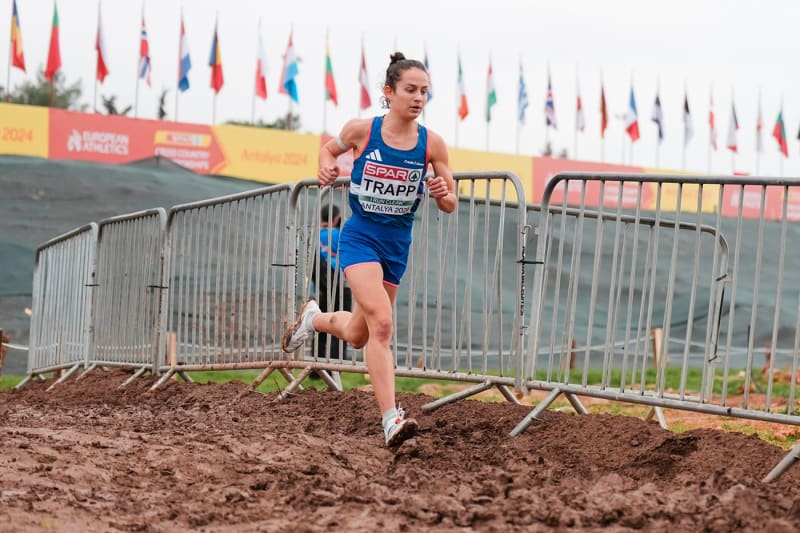 © STADION-ACTU
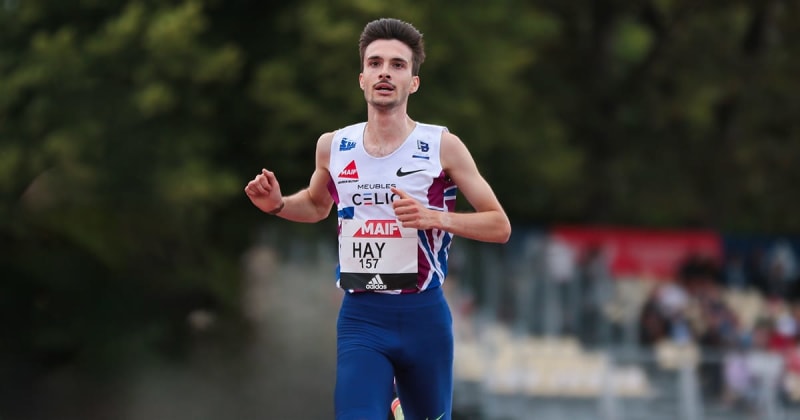
Manon Trapp and Hugo Hay, French athletes taking action
Marathons.COM spoke to two leading figures in French middle- and long-distance running who are supporting the environmental project: Manon Trapp and Hugo Hay.
Manon Trapp, 24, represents Entente Savoie Athlé and is a ten-time French champion across cross country, 3,000m, 5,000m, 10K and 5K. Born in Sèvres, she already has 15 caps for the French team, along with an impressive range of performances from 3,000m to the marathon. The academically minded athlete, who holds a master’s degree in geography, has won three international team medals at the European Cross Country Championships, two bronze and one silver. In December 2023, at the Valencia Marathon in Spain, Jean-François Pontier’s athlete set a marathon best of 2:25:45. She also ran 1:04:04 for 20K in 2024.
Hugo Hay, 27, has performed at a high level since his junior days, as shown by his 19 French team caps. At the Paris 2024 Olympic Games, the 5,000m runner from Deux-Sèvres reached the final and finished 16th. A three-time French Elite 5,000m champion, he is also a cross-country specialist. He has won four European Cross Country Championships team gold medals, as well as two silvers, one individually, and an individual bronze. Born in Bressuire and coached by Tim Moriau in Belgium, he is the 2019 European U23 5,000m silver medallist, a result achieved in Gävle, Sweden. The 5,000m specialist owns a best of 13:02.62 from 2023, along with 7:40.95 for the indoor 3,000m in 2024 and 1:01:43 for the half marathon that same year.
How did you become involved in the Team for the Planet project?
Manon Trapp: I had been following Team for the Planet’s work on social media, and their project involving elite athletes caught my attention. The idea is that for 100 days, 100 athletes offer an item or a unique experience for every share purchase. I volunteered to help promote the project and put up a French team jersey as my contribution.
Hugo Hay: Team for the Planet contacted me by email this summer. I assume they approached athletes who were likely to be engaged with environmental issues and sport. I had never heard of Team for the Planet, so I looked into it after they got in touch to understand what it was about.
What does Team for the Planet represent to you?
Manon Trapp: To me, Team for the Planet is an organisation working on concrete solutions for change. Of course, we need to reduce our consumption and change the way we live. But given humanity’s needs, technological innovation is also essential. Team for the Planet brings together strategic, planet-friendly innovations and entrepreneurs capable of turning them into projects that can transform our daily lives and support the ecological transition. The funds are invested in innovations designed to prevent the emission of millions of tonnes of CO2. I’m also drawn to its participatory model. Ninety-seven percent of its shareholders are citizens and individuals, with businesses accounting for just 3%. That shows everyone can play a role in change. At the same time, companies provide 50% of the funding, which demonstrates the scale of their impact. Bringing economic players and citizens together is a very good way to move things forward.
Hugo Hay : I saw that they were taking real action. That’s great, because concrete action is how we need to make our voices heard. That’s why I agreed to take part. It’s a good way to bring the issue into the spotlight through a wide range of athletes from different sports, each followed by a different community, so the message can reach as many people as possible.
How are your commitment to the environment, your geography studies and your sport connected?
Manon Trapp: I studied geography because I was curious about the world and the issues it faces today. My aim was to work in the environmental field. Running is also a way to connect, through direct experience, with the environment we are part of, and to become aware of our vulnerability and the fragility of the places beneath our feet. I think we inevitably develop a relationship with the paths we use every day, and that can make us want to protect them. Personally, I want to protect what I love: the environment where I train, where I live and to which I belong. Ultimately, that means our planet, because everything is connected and interdependent.
What role do athletes have to play in this cause?
Manon Trapp: Through their reach and influence, athletes can raise public awareness and help change habits. They can serve as inspiring role models in society.
Hugo Hay: Beyond taking small individual steps and changing certain behaviours, athletes are followed by communities, which gives them a platform to highlight causes they believe in, whether that means environmental issues or social justice. Athletes can use that influence to change the behaviour of as many people as possible. The aim can be to raise awareness, but also to encourage communities to donate so genuine action can take place, because money is the key to getting things done. That’s why it matters for us as athletes to pass these messages on.
 © STADION-ACTU
Is it important for you to work with partners who share this commitment? You are both involved in several environmental projects.
Manon Trapp: Yes, because I’m aware of the impact of what I consume, and I choose partnerships that respect both the environment and people. It matters to me to work with individuals and companies that share my values.
I’m an ambassador and volunteer with Mountain Riders, an organisation that provides information, raises awareness and promotes education around the ecological transition in mountain areas. In my spare time, I help create “action sheets” designed to spread positive, transformative practices across mountain regions, particularly in ski resorts.
Hugo Hay: I already work with MAIF, which has oriented its entire sports strategy towards the sport-and-planet approach, seeking to make sports competitions greener and encourage debate about ways to reduce the carbon footprint of major events. I’m pleased to work with companies like that. When I’m looking for sponsors, this is one of the criteria I highlight so I can work with companies that are genuinely committed to environmental issues. It matters to me.
What have you done at your own level to combat global warming?
Manon Trapp: I try to make compromises. For example, for the Seville Marathon, flying is my only realistic option if I want to limit fatigue and give myself the best chance of performing well. But for the return journey, I decided to spend 17 hours on the train and take two days to get home, paying three times what a flight would have cost.
I also chose a local pacemaker rather than a Kenyan one. I prioritise races in France and Europe. In everyday life, of course, I make an effort to reduce my carbon footprint by eating local food, choosing a bike for short trips, extending the life of appliances through repairs and buying second-hand.
Hugo Hay: At my level, I focus on small everyday actions: eating local and seasonal food, sorting waste, driving less, taking the train whenever possible and choosing ethical clothing brands for everyday wear. My biggest step is limiting air travel as much as possible. Last year, I raced most of my competitions in places I could reach by train. I didn’t go to Monte Gordo, the United States or South Africa, choosing training camps accessible by rail instead to reduce my carbon footprint.
The other thing that matters to me is using my voice to help make environmental action structural, with plans put in place and supported by as many people as possible. The aim is to give as many people as possible the opportunity to engage in “real” environmental action and change mindsets, even if that takes time.
Do you have any projects along these lines for the future? How could athletics become greener?
Manon Trapp: After my athletic career, I plan to work in a profession focused on protecting the environment and biodiversity.
Making sport greener is a complex issue because we operate within a globalised sporting system that involves a great deal of travel and generates substantial greenhouse gas emissions. I think we need to acknowledge our impact, reconsider our practices and make choices accordingly. That could mean prioritising local competitions and limiting international ones to those that matter most, while still allowing us to build our careers. It’s about doing less, but better. Whenever possible, we should choose the least polluting option. Everyone has a role to play, including organisers who could offer attractive prices for low-carbon transport and train travel.
More and more organisers are no longer including free merchandise with race entries and are doing away with small water bottles. That is a sign of progress in the right direction. Race organisers could commit to a continuous improvement programme, starting with an assessment and then an action plan to reduce their impact, whether in accommodation, aid stations, transport or other areas. There is also a broader discussion to be had about our priorities and the kind of world we want to live in tomorrow. What level of environmental cost is acceptable for performance and sport in general?
Hugo Hay: I’d like to build on what I’m already trying to do and keep raising my voice to inform my community. Why not take part in working groups focused on making major sporting events greener? There are already ideas worth exploring, such as reducing spectator travel by setting up large fan zones in other countries during major championships.
What are your next targets and key dates for the coming season?
Manon Trapp: The Seville Marathon, where I’d like to run the fastest time I can!
Hugo Hay: I’ve been ill since the end of October and I’m gradually getting back into training. I’m starting from a long way back, so I’ll build up step by step and aim to regain my level and a normal training load within about six weeks. The goal is to race this summer, but I don’t have a clear view of my schedule yet.
