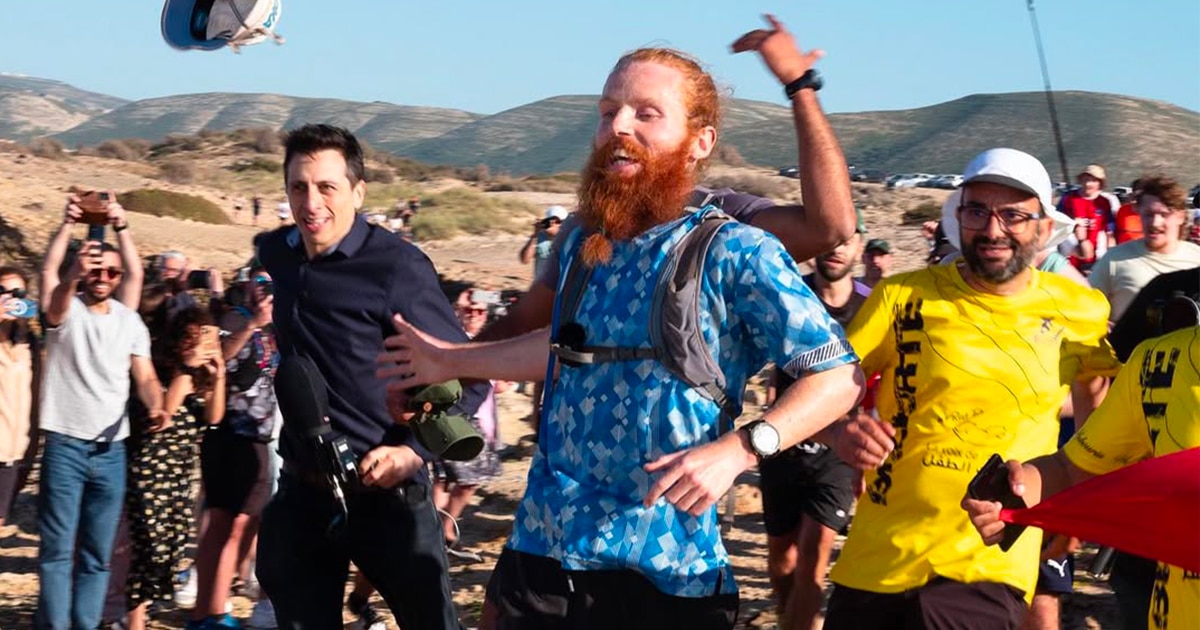
Russ Cook, the British “Forrest Gump” on a mission across Africa for a good cause
In less than a year, Russ Cook traveled 16,200 km on foot, from the south to the north of the African continent. Across 16 different countries, the British adventurer nicknamed the “Hardest Geezer” faced heat, exhaustion, and adversity, pushing the limits of human endurance. An extraordinary achievement that cements his name in the history of extreme challenges.
Some push the limits of the human body, others those of mental endurance. Russ Cook and his red beard did both. This 27-year-old British adventurer made history by becoming the first man to run from the south to the north of Africa, an epic feat of 16,200 km accomplished in less than a year during Project Africa. Let’s look back at an odyssey completed in April, a milestone in the annals of ultra-endurance.
| An extraordinary adventure
It all began on April 22, 2023, when Russ Cook set off from the Cape Agulhas in South Africa with an incredible goal: to reach Cape Angela, in Tunisia, relying solely on the strength of his legs, over 16,000 kilometers away. His plan? To run about 60 kilometers a day, the equivalent of nearly 380 marathons (or 19 million steps for those who love stats), without stopping. At around 60 kilometers per day, the “Hardest Geezer” traversed 16 countries: South Africa, Namibia, Angola, the Democratic Republic of Congo, Cameroon, Nigeria, Niger, Algeria… each with its own challenges such as blistering heat, sandy tracks, impassable roads, and significant security risks. Nothing stopped him.
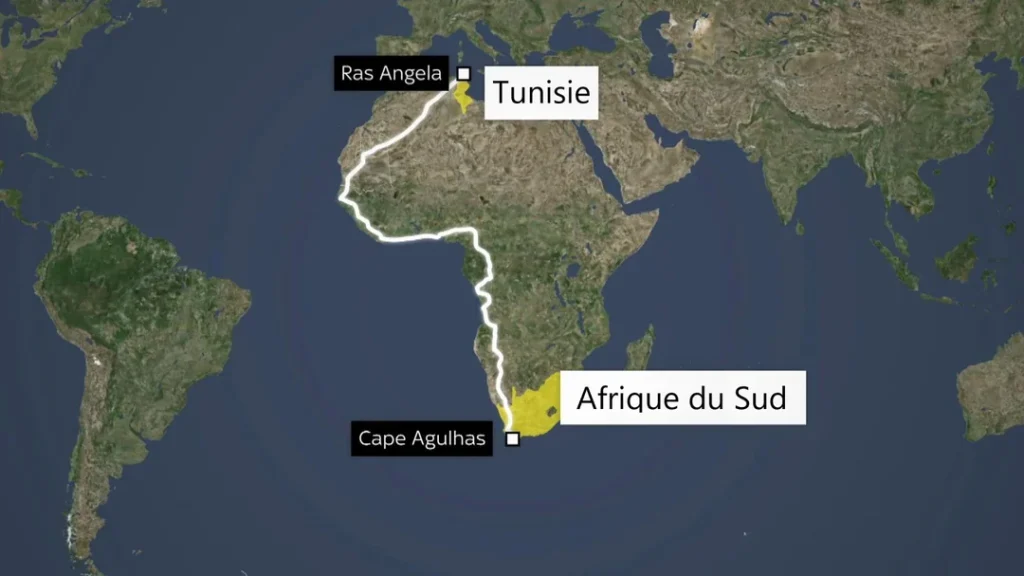
Already known for his extreme feats – including a world record for running a marathon while towing a car in 9h56’ –, the Brit shared his journey with thousands of fans who followed his adventure on social media. At each stage, he narrated the encounters, the struggles, the moments of doubt, but also the beauty of Africa he discovered with every stride.
| A challenge beyond the physical
Running across Africa is not just about endurance. The British Forrest Gump had to deal with extreme fatigue, injuries, logistical problems, and diplomatic incidents. Indeed, in some countries, this lad from West Sussex struggled to obtain visas and constantly had to change his route. Niger and Algeria, plagued by security tensions, were major obstacles. He was briefly detained by armed men before being released. Undeterred, the valiant adventurer pressed on, supported by a logistical team and thousands of fans cheering his exploits online. On several occasions, he considered quitting, but his steely resolve drove him to continue his journey.
On April 7, 2024, after nearly a year of effort (352 days to be precise), he reached his destination: Cape Angela. Cook thus became the first person to run across Africa from its southernmost point to its northernmost point (and the third to traverse Africa after Nicholas Bourne in 1998 and Jesper Olsen in 2008). “I’m just an ordinary guy, so if I can do it, I hope people can apply that to their own lives in whatever way they choose,” he explained after completing a unique African adventure.
His feat went beyond a mere athletic challenge: he raised hundreds of thousands of pounds for charity, inspired thousands of runners, and proved that human endurance could surpass unimaginable limits. Russ Cook raised close to £600,000 (nearly €700,000). Though he fell short of his £1 million target, the money was still donated to the UK charity Running Charity, to support homeless youth.
| And what’s next?
Barely savoring his success, Russ Cook is already contemplating his next challenge. Far from satisfied, he dreams of new, ever-wilder challenges. The latest: a 3,000-kilometer escapade with 30,000 meters of elevation in the New Zealand peaks, starting in March, which is expected to be his ultimate challenge.
What is certain is that with this running enthusiast, impossible never seems to be a limitation.
The first person ever to run the entire length of Africa. Mission complete🫡 pic.twitter.com/PZk5aDCDgH
— Russ Cook (@hardestgeezer) April 7, 2024
 28/02/2026
 27/02/2026
 21/02/2026