
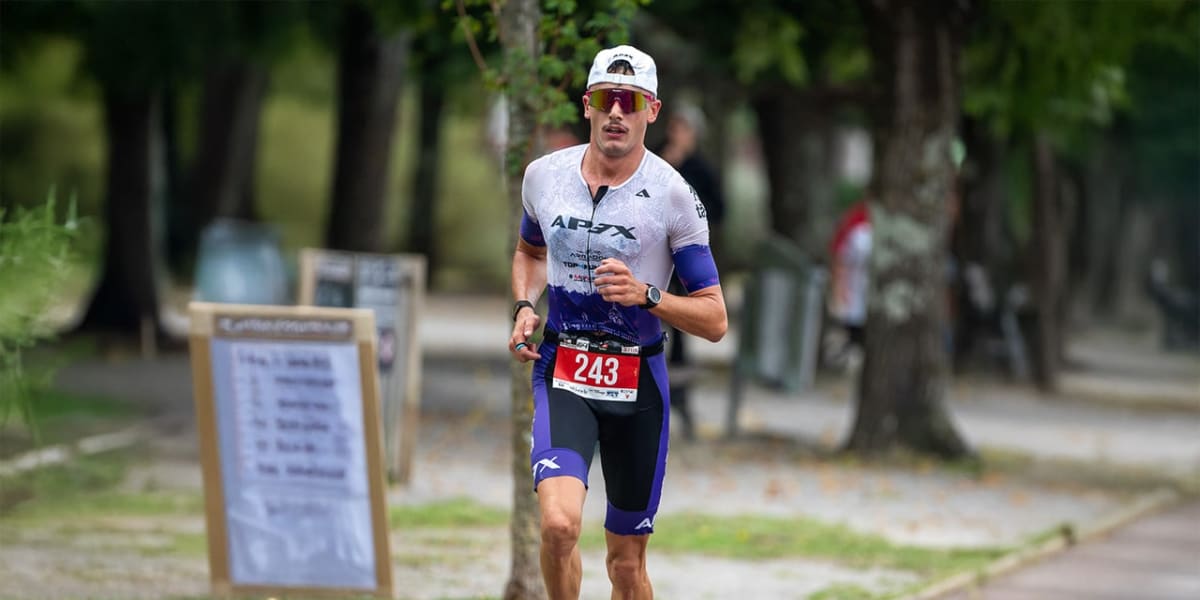
At 23, Thibault Escaich is preparing for a remarkable first Ironman experience. The race gets underway this Saturday, October 18, 2025, in Cascais, Portugal, with one clear and ambitious goal: qualifying for the 2026 Ironman World Championship in Kona, Hawaii. From an improvised start during lockdown to his long Sunday runs, here’s the story of a young Toulouse triathlete combining passion, hard work and resilience.
February 2020, Toulouse. A sports science student, Thibault saw his classes brought to a standstill by lockdown. Between video games and sport, the choice was easy. “ I’ve always been athletic: tennis, swimming, rugby, running… So why not try triathlon? ” That was how he discovered a demanding but fascinating sport built around three complementary disciplines. With a group of friends, he created a dedicated Instagram account: @triathlonthibault, which soon attracted brands interested in his profile. Triathlon became more than a passion; it became a way of life. After completing his sports science degree, he went on to study for a master’s in sports event management at Moss Business School. Today, the triathlete makes a living from his passion through social media, sponsorships and intensive training. On Saturday, October 18, 2025, everything begins in Cascais, Portugal, with one goal in sight: earning a place at next year’s Ironman World Championship in Kona, Hawaii.
Running: the cornerstone of his preparation
For anyone unfamiliar with the sport, triathlon combines swimming, cycling and running. For Thibault, though, running remains the central part of his preparation. “ I feel strongest on the bike, then in the run, with swimming coming last. ” His typical week runs like clockwork: an easy run on Monday, a threshold session on Wednesday and a long run on Sunday, covering 20 to 25 km on flat terrain.
To improve, the aspiring Ironman combines volume with specificity. His carbon-plated shoes are reserved for key sessions, while the rest of his training is done in standard models, so that race-day performance remains an advantage. His approach is carefully planned with his coach and confidant of the past four years, Maxime Astorg. No all-out speed sessions in training. “ The aim is to stay in control and work at easy paces, so I’m ready on race day ” The long Sunday runs help him manage fatigue, an essential skill when it comes to handling the 42.195 km run leg of an Ironman.
Injuries: hardship and resilience
Thibault’s triathlon career could have ended long before this. He has had his share of accidents: collisions with cars, a broken collarbone, a fractured chin… Running was the hardest discipline to resume because of the impact of each footstrike. “ Swimming allowed me to ease back into training. Then I gradually built up the volume, adding speed sessions once the foundations were solid. ” Paradoxically, those accidents strengthened his mental preparation. “ Psychologically, they helped me come back stronger. They forced me to take a step back and consolidate my foundations before increasing the training load. ”
Running credentials and personal bests
Before taking on the Ironman, Thibault Escaich has already shown what he can do on the road:
10K: 32:40 at the 2024 10K des Quais de Bordeaux
Half marathon: 1:10:09 at the Barcelona Half Marathon in 2025
Marathon: 2:43:35 at the Berlin Marathon in 2023
Despite having only one marathon under his belt, the 23-year-old has plenty of experience over the half marathon and 10K distances, with a specific training approach built around volume and threshold work and tailored to the demands of an Ironman.
Preparing for a first Ironman: strategy and endurance
For Cascais, Thibault Escaich is banking on disciplined pacing: settling into around 4:00/km for the marathon and taking in 100 g of carbohydrates per hour through gels every 5 to 6 km. “ The idea is to stay consistent for 40 km and only pick up the pace over the final two ” His training includes two-a-day sessions combining cycling, swimming and running, with weekly volumes reaching 25 hours. Long intervals for threshold work, long Sunday runs for endurance, bike-induced fatigue before easy runs… every detail is designed to replicate Ironman race conditions.
The Ironman demands a lot, but that’s also what makes it beautiful. Every race is a lesson, every stride teaches you something.
The mind as an engine
Beyond technique and fitness, Thibault is relying on mental resilience, inspired by the great Vincent Luis, a four-time mixed relay world champion and multiple World Triathlon Series winner, whose training sessions he sometimes joins. Long runs, pre-fatigue work and bike-run combinations teach him to manage fatigue and stay focused. “ Even when I’m injured or tired, I keep swimming and cycling. Everything complements everything else. ”
His goal? Qualifying for Kona, Hawaii. In the 18–24 age group, the kid from the Garonne needs to finish in the top two. And even if some competitors have more experience, he remains focused on his own performance: “ If other people are better, good for them. Otherwise, I’m going there to win ” With complete confidence.
What comes after Cascais?
The immediate goal is his first Ironman and a place in Kona. But he isn’t ruling out future races: the Barcelona Half Marathon in February to improve his time, potential half-Ironman races to step down in distance and enjoy racing… his schedule remains ambitious and flexible. “ The Ironman demands a lot, but that’s also what makes it beautiful. Every race is a lesson, every stride teaches you something. ”
More articles

Jean Bouin, the trailblazing face of French running
Olympic medalist and pre-war French athletics icon, Marseille’s Jean Bouin set the bar sky-high before being killed at 25 in World War I.
Sun, August 2, 2026

John Tarrant, the “Ghost Runner”
Banned from British athletics, John Tarrant became the “Ghost Runner”: a top-class ultrarunner who kept racing despite the rulebook.
Sun, August 2, 2026

What if starting running later in life was the best way to keep going?
Sat, May 16, 2026