
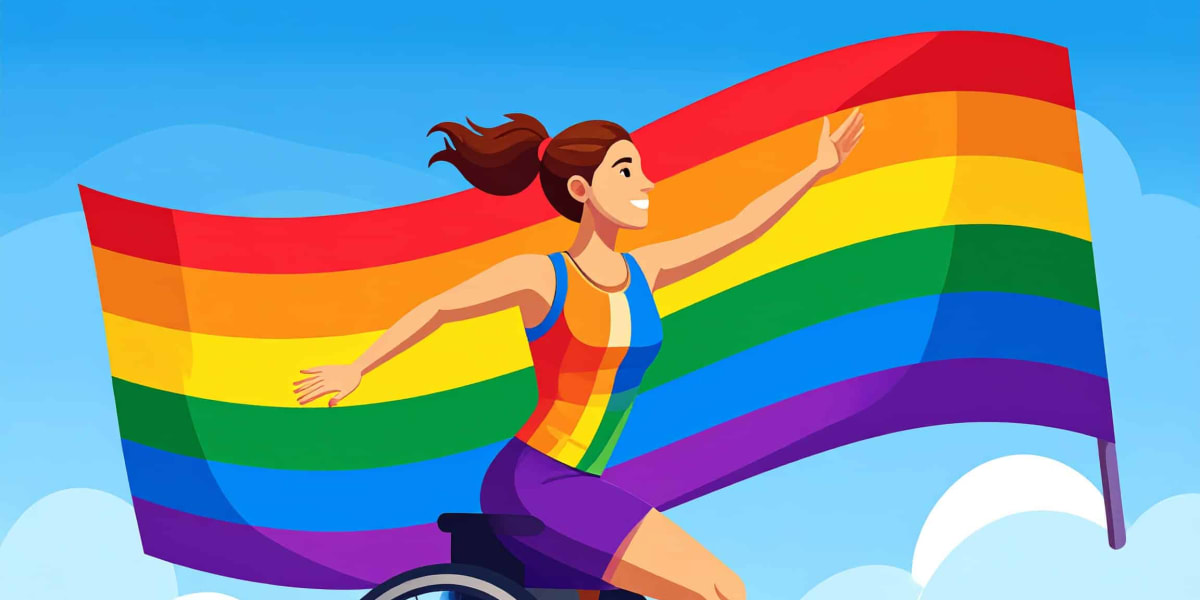
Para athletes, trans and non-binary runners: rethinking the marathon for everyone
If running is universal, why are some people still excluded from so many races? After decades of rigid rules, the sport is slowly trying to open up. But for para athletes, trans and non-binary runners, inclusion remains an ongoing fight.
On paper, the marathon has everything it needs to embody equality. Tarmac, a starting line, a finish line and, between them, the same effort shared by thousands of different bodies. Yet behind that universal image lies a stubborn reality: the iconic 42.195 km event still excludes people. Para athletes are often confined to the Paralympic Games, while transgender and non-binary runners face binary regulations or endless debates about testosterone. And yet running should be enough.
Running does not exist in a bubble. It reflects the tensions and fault lines running through society. Making room for wheelchair athletes, recognising trans identities or opening a non-binary category inevitably challenges established habits. But the more visible these athletes become, the more natural inclusion feels. “The more visible we are, the more easily society will accept us, because it will become normalised,” insists Mélanie Perrin, president of Front Runners de Paris, an LGBTQIA+ runners’ organisation. Some races have understood this. In New York, the marathon introduced an official non-binary category in 2021, won by Cal Calamia, a teacher and trans runner. In San Francisco, Mimi Hensel said after taking part in the race: “It’s not a reason to run, but it’s a way to take part without betraying myself.” These initiatives are still marginal, but they show that inclusion is not a utopian idea. It is possible in practice.
Para sport: the Paralympic momentum struggling to take hold elsewhere
People thought the Paris Paralympic Games would change everything in France. Images of heroic athletes, media coverage, the promise of a lasting legacy… But outside these global showcases, the place given to para athletes in marathons remains limited. Categories sometimes exist, but they are largely symbolic, as if wheelchairs and prostheses were an organisational inconvenience.
A disabled person is an able-bodied person who doesn’t know it. And an able-bodied person is a disabled person who doesn’t know it.
In the United States, Boston and Chicago fully include wheelchair athletes, with dedicated starts and genuine media recognition. In France, despite some progress, much remains to be built. Géraud Paillot, a paraplegic marathon runner who is almost like anyone else, calls for a shift away from viewing people as exceptions and towards building a shared model. “Inclusion means sharing as much of the same course as possible.” The athlete with multiple sclerosis, who has completed several marathons in an exoskeleton, adds: “With almost every challenge I take on, people tell me: ‘That’s not possible.’ And every time, I answer: ‘If you want to help me, tell me how we can make it possible’.” His experience is a reminder that disability should not define a sporting identity, but simply be part of it. “A disabled person is an able-bodied person who doesn’t know it. And an able-bodied person is a disabled person who doesn’t know it,” reflects the man who organised the first charity Mont Saint-Michel marathon in late August with his association Aventure Hustive.
The return of sex testing: a step backwards
But inclusion is not only about disability. Another equally heated battle is shaking up running and athletics more broadly: the fight over gender identity. While some wheelchair athletes still struggle to receive the recognition they deserve, others are questioned, tested and sometimes even excluded in the name of their presumed biology. The debate around trans and intersex athletes has intensified following decisions by World Athletics. Since 2023, some female athletes whose testosterone levels are deemed too high have been required to undergo medical treatment or switch to other distances.
The use of sex testing, banned in France, for the 2025 World Athletics Championships in Tokyo represented a return to the past and was condemned by many. “World Athletics bringing back sex testing is a scandal: we’re going back to the 1960s. It’s transphobia and intersexphobia,” says Hélène Germain, co-president of the Fédération Sportive LGBT+. Halba Diouf, a transgender sprinter, embodies this fight. And it has a long way to go. “Athletics is not an inclusive space today. Many trans athletes quit because they are afraid of being excluded,” she says.
Before I am a transgender athlete, I am an athlete.
Despite achieving the Olympic qualifying standard, the athlete originally from Senegal was only allowed to compete at departmental level. She herself denounces the absurdity of these tests. “Sex testing belonged to the 1960s. It was banned, and now I feel as though we’re going backwards.” Halba Diouf goes further, pointing to the targeted injustice: “In 2025, we’re still carrying out sex tests. But what even is a legitimate body? We constantly focus on women’s bodies. Why never men’s?”
Her testimony sounds like a cry for dignity. “Before I am a transgender athlete, I am an athlete. Full stop.” Despite the suspicion surrounding her, she insists: “My testosterone level is below 0.10 nmol/L, lower than that of a cisgender woman, and yet I’m still suspected.” These policies, which target women alone, deepen the sense of exclusion. “Athletic performance cannot be reduced to a chromosome or a testosterone level. It depends on a whole range of factors: social background, training environment, coach, mental strength and physiology,” Mélanie Perrin points out.
Associations on the front line
With institutions dragging their feet, associations are driving change. The FSGL now brings together 59 associations and nearly 9,000 members across France. “Our number one mission is making sport available to everyone, regardless of gender identity, sexual orientation, ability level, physical condition or state of health,” explain Hélène Germain and Alexandre M. Ansault, the federation’s vice-president. Its work goes beyond recreational sport and extends behind the scenes. “We work with the Ministry of Sport, but also with town halls, federations and other institutions to change attitudes. To change sport, you first need awareness, training and education.”
 © Mélanie Perrin (centre), promoting inclusion and diversity on every course through her Front Runners de Paris association © Regis Dugué
The Saint-Valentin race organised by Front Runners de Paris illustrates this approach in practice. More than 1,200 participants already compete across three categories: men, women and non-binary. “When a race flies a rainbow flag, everyone understands: you’re welcome here,” says Mélanie Perrin. These events are also inspiring others. “TIP, the EuroGames and the Gay Games show that another kind of sport is possible: one where everyone defines themselves and chooses which category to compete in,” continues Hélène Germain, whose events are about far more than podiums.
Sport as a force for change
Géraud Paillot shares that view, while also being quick to point out that he considers himself “a low-level athlete.” There is no quest for glory, just the desire to enjoy himself, keep moving forward, set goals and draw others along in his wake. His challenges speak for themselves: completing a marathon upright in an exoskeleton, organising a collective challenge at Mont Saint-Michel and inspiring people who thought they had said goodbye to physical effort. Far from being a gimmick, technological innovation opens up unexpected horizons. “The exoskeleton lets me do things again, walk with other people and regain confidence in everyday life.” Sharing a run with able-bodied athletes then takes on the feel of a deeply personal victory.
If federations do not adapt, they will eventually lose members. Because society is changing.
Here, resilience is built step by step, by learning to live with vulnerability. “Technology makes it possible to do things, and it will make incredible things possible,” he said with disarming enthusiasm. In his eyes, the marathon is no longer just a race but a universal symbol: a space where the mind reaches the finish line far more reliably than the body. “Without mental preparation, I would never have completed a marathon in the exoskeleton.” A philosophy he sums up in simple but powerful terms: “You have to dream big, you have to believe. I haven’t lost that.”
What does the future hold?
Inclusive marathons barely existed ten years ago. Today, around a dozen events around the world have taken the leap, and the movement is gathering pace. “We plant seeds, and little by little, they grow,” says Hélène Germain. Changing registration categories, rethinking changing rooms, respecting pronouns and recognising para athletes as competitors in their own right… These are simple steps towards a more open future. And if federations are slow to adapt, they will eventually be left behind, Hélène Germain warns. “If federations do not adapt, they will eventually lose members. Because society is changing.”
Ultimately, athletes are asking for nothing revolutionary. They are not demanding special treatment, only the right to run without having to justify themselves. A race bib on their chest, sweat on their forehead, breath coming hard, just like any other marathon runner. The image is simple: a starting line, a finish line and, between them, humanity’s diversity in full expression.
More articles
Marathon de Chablis set to welcome 4,400 runners among the vines
The Marathon de Chablis returns on Saturday, October 24, with races, hikes and a festive atmosphere among the vineyards.
Wed, October 21, 2026

Avignon Marathon makes a winning debut with more than 3,450 runners
More than 3,450 finishers turned out for the successful first edition of the Avignon Marathon on Sunday, September 27, 2026.
Wed, September 30, 2026

Night races: why does everyone want to run while everyone else is asleep?
From Glow Runs to low-key trail races, night running is taking off, offering a more festive experience and a different relationship with the clock.
Thu, September 10, 2026