
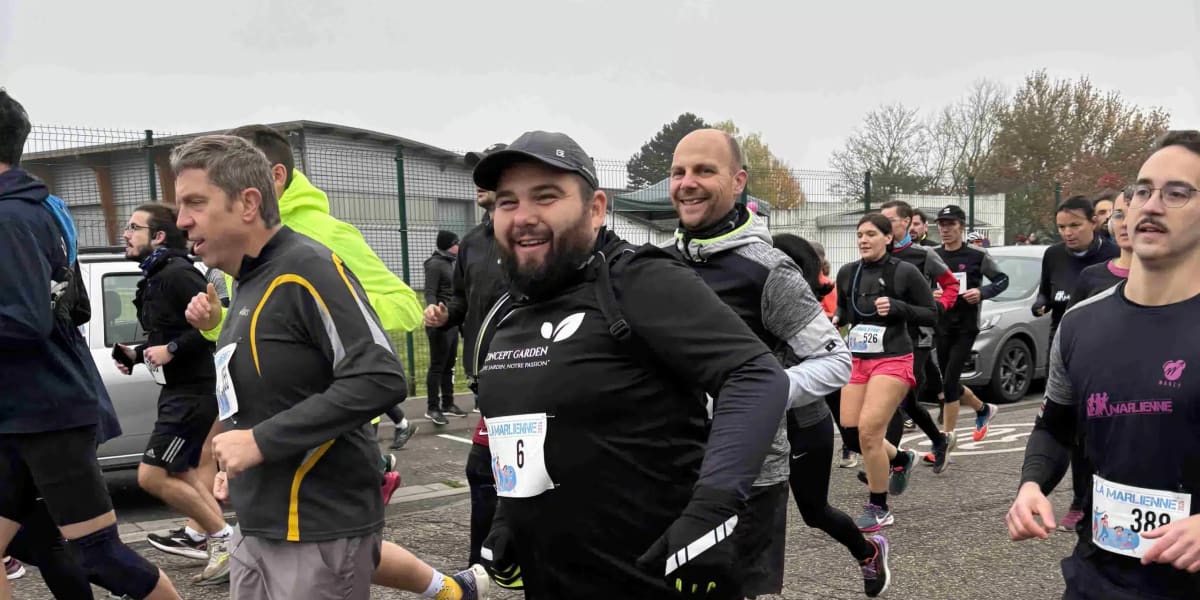
 © Michael Bettocchi
“You’ll always do better than the ones on the couch”: running overweight, the invisible marathon before the start
Published on Wed, August 5, 2026
Before they even think about a finish time, some runners are already racing something else: other people’s eyes. In a sport that loves lean bodies and perfect splits, showing up overweight can take more courage than endurance. At 147 kg, Michael Bettocchi still decided to take on a challenge many called impossible: running a marathon.
On April 8, 2024, Michael Bettocchi gets home from work, turns on the TV, and lands on footage of the Paris Marathon. Thousands of bodies moving down the Champs-Élysées, sweat, bibs, the rush of the finish line. A 38-year-old sales-and-delivery worker from Metz, he turns to his friends and tosses out an idea: “ What if we did one? ” They laugh. He does too, a little. But the thought sticks. A few weeks later, Michael steps on a scale for the first time in years. The number hits: 147 kg. He figured he was around 125, 130. His BMI is close to 47. Morbid obesity, according to medical classifications. Marathon doable, according to him. “ Best decision of my life, the day I told myself: this madness, running a marathon with this body,” says the guy who loves making people laugh.
147 kg at the start, zero excuses at the finish
There are running stories about records, podiums, sub-two hours. And then there’s Michael’s, which is about shoelaces that are hard to tie, a first run of 1.7 km in 14 minutes around his place in Marly, outside Metz, and a two-year target: finish a marathon before turning 40. In the first month, he drops 11 kg. Not because he goes on a diet with an Excel sheet and a calorie app. Because running makes him want to pay attention to what he eats. “ Sport doesn’t make you lose weight by itself, but it pushes you to be more disciplined the rest of the time, he insists. And that’s what makes you lose weight .”
For a year and a half, he strings together short sessions, slowly, very slowly. At kilometer 26 of his first Metz marathon, on October 12, 2025, he hits unknown territory, the farthest he’s ever gone. He still finishes. Without walking. At 107 kg, 40 less than where he started. Two weeks later, his book Mon Marathon comes out on Amazon. Self-published, offbeat, funny. The story of a fat guy who decided to run, and tells it all, no filter and no moral lesson.
Other people’s eyes: the extra weight
Before knees and tendons, there’s something running guides almost never tackle head-on: the mental load of being watched when you line up in a body that doesn’t match the posters for the big races. You don’t need a scientific study to know that pressure is real. You just have to talk to the people living it. Camille, 34, a nurse in Lyon, waited two years before she dared to sign up for her first 10K. “ I trained at 6 a.m. so nobody would see me running, she admits, quietly. I was ashamed of how slow I was, ashamed of my body. Then one day I ran into a group of runners who cheered me on without even knowing me. That’s when something shifted.”
Michael talks about it with a bluntness you don’t hear often in this world. Early on, he’d spot other overweight runners. Not to judge them, more like an unspoken solidarity. “ We’re in the same boat,” he says. The guy from Metz also watched everyone else’s performances, compared himself to 70 kg dudes chewing up miles, without ever factoring in that the comparison made zero sense. “ I ran my marathon in 5 hours at 108 kg. That variable matters, he adds. But I’ve got guys telling me: you’re better than me, because you’re adding so many minutes per kilo.”
The haters, so to speak, I barely have any. And honestly, they end up putting fuel in the tank
He’s heard the cheap shots. A few comments on Facebook after he appeared on France 3 Lorraine. Someone online wrote under a video of his Paris Marathon that “you can tell he doesn’t run fast enough.” His best friend replied for him and set things straight. Michael didn’t answer. “ The haters, so to speak, I barely have any, he says. And honestly, they end up putting fuel in the tank .” What struck him most was the opposite: how almost systematically supportive the running world can be. The guy he met while checking out the Metz course who told him: “ You’ll always do better than the ones on the couch.” A line that stayed with him all the way to the finish.
Sofiane, 27, remembers something he heard at the start of a half marathon. “ A guy behind me muttered to his buddy, ‘Is he going to finish this?’ I made it a point to pass him at kilometer 18, says the young accountant from Bordeaux. I didn’t say a word when I went by. My time did the talking.” He smiles telling it, but admits the jab sat in his head for several kilometers. “ The thing with comments is they always land at the worst possible moment.”
Running heavy: the real medical questions
Beyond the stares, there’s the other question, more concrete. Is running with significant excess weight dangerous for your body? The answer is nuanced, and often badly put. With every stride, your joints absorb an impact equal to two to three times your body weight. For someone at 147 kg, that load is huge. That’s not nothing. But it’s not a reason to scrap the idea before you even lace up.
Scientific studies show that running doesn’t automatically increase the risk of osteoarthritis, even for people who are overweight. Research published in the Journal of Orthopaedic & Sports Physical Therapy suggests that regular runners, including those with a high BMI, often have a lower osteoarthritis risk than sedentary people. Running helps strengthen the muscles that support the joints and boosts synovial fluid production, which is essential for cartilage.
What really changes everything is progression. Ramping up volume too fast, switching shoes without easing in, mixing surfaces with no transition… those are the real roots of injury, far more than weight itself. “ It took me four months to run 10K nonstop, Michael Bettocchi sums up. Now I can do it easily. When you give it time, your body follows.”
Slow isn’t the problem. Impatience is
Before you jump in, a few steps still make sense. A cardiac stress test with a cardiologist, an exercise ECG to make sure you’re cleared to get back into physical activity, and ideally a joint assessment if you already have chronic pain. Michael did it, after a few months of running on instinct. He says it himself, with the honesty that runs through everything he says: “ If you listen to medical advice, it takes at least three years to do a marathon, says the former local-league soccer player. Basically, I blew right past all that .”
Clara regularly works with overweight beginner runners near Nantes. Her advice always comes back to the same starting point. “ The first thing I say is: forget pace and learn how to breathe, the coach explains. Someone who runs too fast for their level gets injured. Someone who runs at their own rhythm, even slowly, improves. Slow isn’t the problem. Impatience is .”
The bib as a passport
There was a precise moment when Michael Bettocchi realized he belonged in the running world. Not at a marathon finish line. Long before that. The day of his first 10K in Metz, when he found himself in the pack with a bib on his back. “ I told myself I was going to be last, he says now, with hindsight. As long as I finished, that was enough.” He ran 1:06, no issues, and discovered what he calls “the power of the bib.” That feeling of belonging to something, of being carried by the group energy.
At the Paris Marathon, six months after his first marathon in Metz, he started in the same corral as Zack Nani, a familiar face to France TV viewers after training on the show Marathon pour tous alongside Robert Pirès, who was also coming from a seriously heavy starting weight. Michael didn’t speak to him. But he found something symbolic in the coincidence: two guys who started a long way back, in the same start.
The Paris crowd cheered him the whole way. His five friends, who signed up in the wake of his own challenge, ran with him. One of them could have gone much faster. He chose to stay by Michael’s side. Another told him at the finish that he was grateful Michael had pulled him into the adventure. “ A marathon is an incredible human adventure,” Michael can’t help repeating.
Thomas, 24, fresh off his first Marvejols-Mende half marathon with ten extra kilos according to his doctor and a grin from ear to ear, says nobody has ever made a single comment to him on a start line. “ Quite the opposite. A 70-year-old man patted me on the back right before the gun and told me, ‘The hardest part is showing up,’ says this newly converted interval-training addict. I don’t know if it’s true, but in the moment, I believed it.”
“If you’re fat, you’ve got to go for it”
If Michael had a message for someone who feels too heavy to run, he’d say it with no frills: go for it. With the necessary caveats: some people can’t run because of real pain, and brisk walking is still a valid option. But for those whose main barrier is psychological, his message leaves no room for doubt. “ The people who do it, they never say anything, he insists.The people who do it and are fat on top of that, they know how insanely hard it is. So the people who do it don’t judge. The ones who judge are the others. And honestly, who cares.”
You just have to start. Ten minutes. Half of it walking. The next week, eleven minutes. The body adapts. The habit sets in. And habit, as he says with a smile in his voice, is just a routine change you eventually stop questioning. Camille, the same nurse who trained in the dark at 6 a.m., finished her first half marathon in 2:19. At the finish line, she cried. “ Not sadness, not relief. Just pride, because I proved something to myself, she says.No outside gaze can give you that.”
His son, four years old now, doesn’t know where his dad started. When he sees him run, he thinks it’s normal. That’s part of why Michael wrote Mon Marathon, so that one day his kid will know, by reading the book, that none of this was a given. And that it might have been the best decision of his life.
More articles

Night races: why does everyone want to run while everyone else is asleep?
From Glow Runs to low-key trail races, night running is taking off, offering a more festive experience and a different relationship with the clock.
Thu, September 10, 2026

Kenya, the distance-running powerhouse in a country where running is king
How Kenya became distance running’s powerhouse, from Kipchoge Keino to Eliud Kipchoge and the generations shaped by its unique culture.
Thu, September 10, 2026

Running Tattoos: When a Finish Becomes a Work of Art
Race memories in ink, from marathon finish times to GPS traces, with tattoo artist Agathe Cossement on the risks and precautions.
Thu, September 10, 2026