 © Abalone Marathon de Nantes
Abalone Nantes Marathon 2026: Hamza Sahli breaks the course record in 2:15:19 as 23,000 runners take part
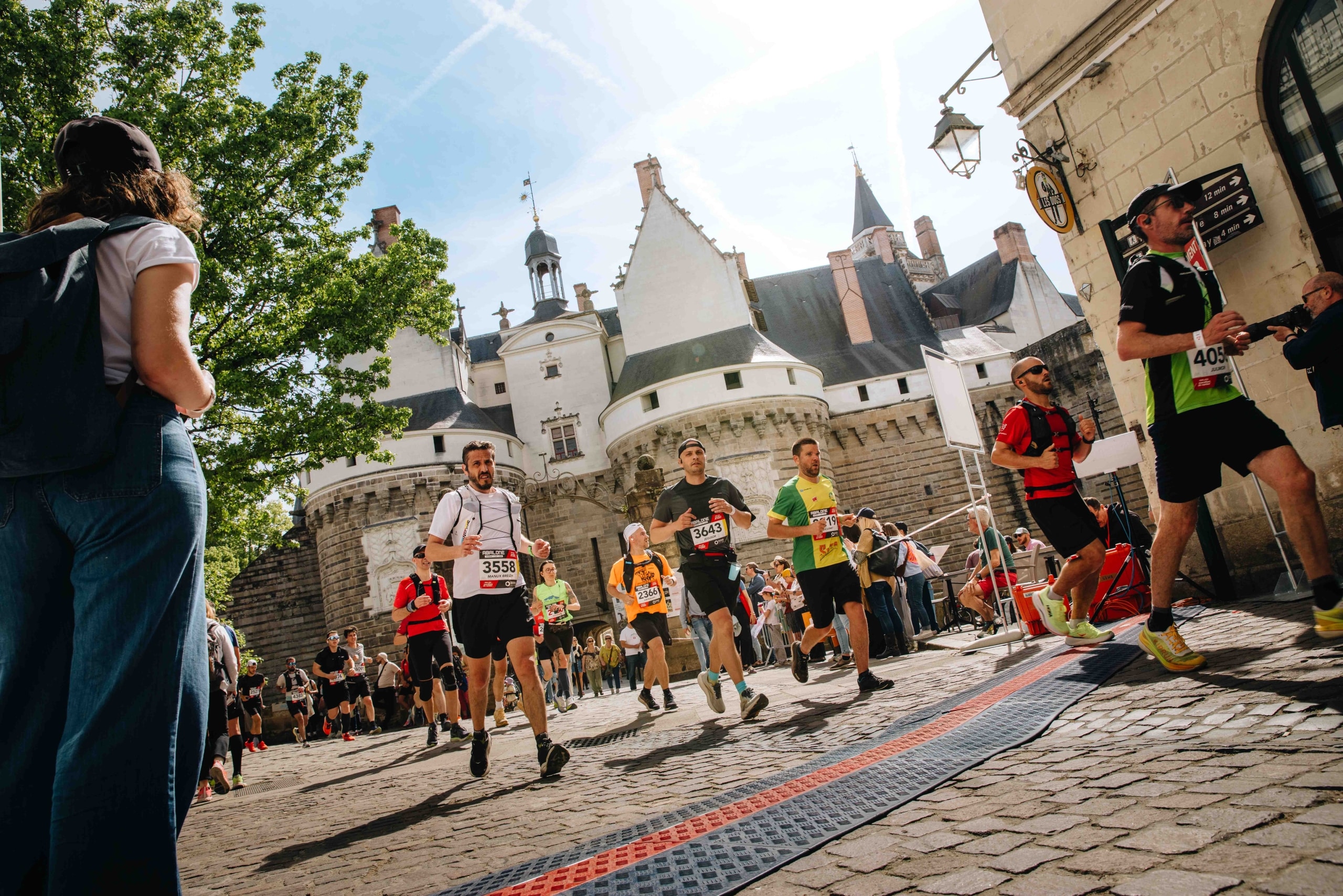
Moroccan runner Hamza Sahli won the 44th edition of the Abalone Nantes Marathon this Sunday in 2:15:19, setting a new course record. Breaking away from the very first meters, he imposed a pace no one could match. In the women’s race, France’s Amélie Sinquin claimed victory in 2:52:33 after a more tactical contest. Bathed in sunshine, the event in the historic city of Nantes confirmed its growing status, combining strong elite performances with mass participation—23,000 runners across all races.
At 9:15 a.m., at Les Nefs des Machines de l’Île, the scene was set. A dense field—7,055 bibs in the Abalone Nantes Marathon alone—but the race never really settled. From the gun, Hamza Sahli dictated the tempo. Fast, decisive, with no feeling-out phase. The gap opened quickly. Behind him, no real organization emerged to respond. A chase group formed, but without cohesion, allowing the Moroccan to run solo at the front.
Nantes’ famously flat course played perfectly into this scenario. Long, flowing sections, minimal interruptions, and a layout built for rhythm. Sahli used it to turn the race into a solo time trial. Kilometer after kilometer, the outcome became increasingly clear—barring incident, the win was his.
| One finish line, one time, one record
The finish inside the XXL Hall at the Beaujoire Exhibition Center created a unique, almost enclosed atmosphere that amplified the sense of control. Alone, composed, Hamza Sahli crossed the line in 2:15:19. The time said it all—the course record had fallen. Pascal Fétizon’s 2:15:44, set in 2000, finally disappeared after 26 years. A 29-second improvement may seem small, but in a marathon, it carries weight. Above all, it rewarded a bold, front-running strategy executed to perfection.
Behind him, local runner Brice Denis (2:24:23) and Julien Cougnaud (2:27:38) completed the podium after more conservative races, never able to close the early gap. The French depth behind the winner remained notable, with several athletes breaking 2:30—evidence of a strong overall level.
| Amélie Sinquin reads the race perfectly
The women’s race unfolded differently. Less aggressive early pacing, more observation, and a hierarchy that took time to emerge. In that context, Amélie Sinquin moved up steadily, staying composed and within reach of the leaders. As the race developed, gaps opened, contenders dropped off, and the path to victory became clearer. Sinquin seized it.
She held her rhythm, managed key moments, and took full control in the second half. Her finishing time of 2:52:33 capped a smart, measured performance. Behind her, Julie Harnie (2:55:18) and Sabrina Paillard (2:57:22) completed a well-balanced podium, all three women finishing under three hours in a race where consistency made the difference.
| “Foulées de l’Éléphant”: a fast start to the weekend
A few hours earlier, the Nantes weekend had already kicked off at full speed. On Saturday evening, 7,093 runners lined up at Les Nefs for the “Foulées de l’Éléphant” 10K, in a packed, energetic atmosphere typical of short-distance racing. From the early kilometers, Romain Mainguy took control. The pace was strong—aggressive but controlled—quickly stretching the lead group. Behind him, Mustapha Salmi and Titouan Gilanton stayed close but never fully bridged the gap.
Mainguy took the win in 30:06, managing his lead comfortably, while “L’Antagoniste” (31:11) and Gilanton (31:12) battled for the remaining podium spots in a tight finish. Just behind, Maxime Montois (31:19) and Louis Desquirez (31:45) highlighted the region’s depth. In the women’s race, Camille Ploteau delivered as expected. Taking the lead early, she never looked back and won in 35:48. Amandine Garnier (36:29) and Marine Limousin (36:54) completed the podium, while Carla Lumeau finished fifth in 37:42, slightly below expectations.
| Half marathon: a race decided by a second
Sunday morning brought a shift in scale—but not in intensity. At 8:00 a.m., nearly 9,000 runners set off on the half marathon, again starting from Les Nefs and finishing at the XXL Hall. In the men’s race, the outcome remained uncertain until the very end. Ethiopia’s Gedamu Getinet Mele and France’s Fabien Boquien battled stride for stride, never separated by more than a few seconds. In the end, Mele edged it in 1:05:39—by just one second. A razor-thin finish in stark contrast to the marathon.
Morocco’s Abdessamad Aoukki (1:06:14) completed the podium, while Maël Laurent (1:08:07) and Aurélien Leprest (1:08:49) reinforced the depth of the top five. In the women’s race, Morocco’s Soukaina Meskine executed her plan perfectly. Gradually increasing her pace, she pulled away smoothly to win in 1:21:43. Behind her, Juliette Chaillou (1:21:48) finished just five seconds back, while Laura Zandronis (1:23:18) took third.
| Nantes delivers across every distance
In total, more than 23,000 participants took part across the weekend’s events, from the 10K to the marathon, including relay races. For its 44th edition, the event once again relied on a strong organizational backbone, with 1,500 volunteers mobilized and a clear rise in attendance—generating over €2.3 million for the local economy.
The course, still fast and flowing, retains its unique features—notably the 324-meter floating bridge over the Erdre River in the closing kilometers. A section that divides opinion, but has become part of the race’s identity. With around 80,000 spectators, Nantes continues to establish itself as a major fixture on the running calendar, blending performance, depth, and atmosphere.
✔ Full results of the 2026 Abalone Nantes Marathon

Dorian VUILLET
Journalist