
London Marathon 2026: Sabastian Sawe Breaks the Mythical Two-Hour Barrier
 © London Marathon Events
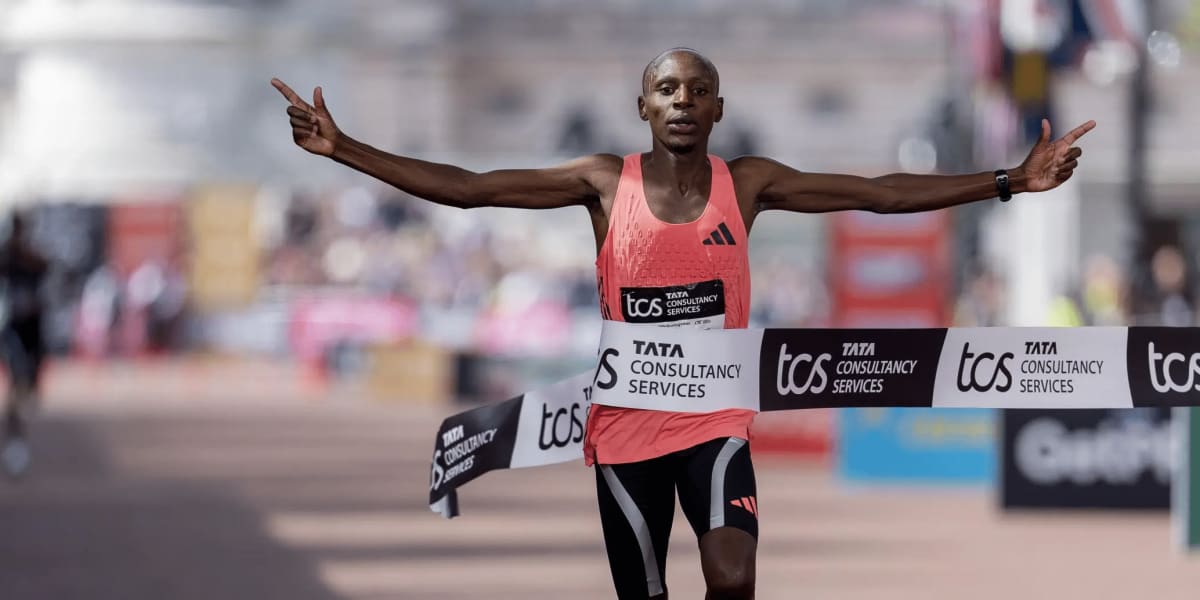
April 26, 2026. A date forever etched in marathon history. There are days when sport changes dimension. Days when the most mythical barriers finally fall—for real. At the 46th edition of the London Marathon, Sabastian Sawe became the first man in history to run an official marathon under two hours. 1:59:30. A time every running fan, expert, and marathon lover had been dreaming of for years. And as if that wasn’t enough, Yomif Kejelcha, in his marathon debut, also broke the barrier in 1:59:41. Something never seen before. Two men under two hours. In the same race. On the same London roads. It’s staggering. And London didn’t stop there. In the women’s race, Tigst Assefa successfully defended her title in 2:15:41, setting a new women-only world record. A total day. Historic. Almost unreal. A performance that pushes the marathon into a new era.
Sabastian Sawe, the First Man Under Two Hours
From the very first kilometers, it was clear this marathon would not be normal. The lead pack went out fast before slightly settling: 14:14 at 5 km, then 28:34 at 10 km. At the front were all the big names: Sabastian Sawe, Yomif Kejelcha, Jacob Kiplimo, Tamirat Tola, Amos Kipruto, Deresa Geleta. An absurd level of depth. Constant tension. Focused faces.
The three pacers did a perfect job, and halfway was reached in 1:00:29. Not yet under two hours, but exactly where it needed to be. The zone where everything remains possible—if the legs are there. The first half of the London course is favorable, with plenty of downhill sections, and the split showed the leaders were running smart and controlled. But everything still had to be done.
It was after 30 km that the race changed. The pacers stepped aside, and Sabastian Sawe took control. He looked easy—almost too calm for what was unfolding. His stride was long, fluid, efficient. Behind him, Yomif Kejelcha hung on. For a marathon debut, what the Ethiopian was doing was almost unbelievable. After his brilliant years on the track, expectations were high for his marathon debut—but seeing him still on Sawe’s shoulder at that point was extraordinary. Jacob Kiplimo, world record holder in the half marathon (57:20), stayed a few seconds behind, but the gap slowly widened.
𝟭𝗵𝟱𝟵'𝟯𝟬''. Record du monde sur le marathon de Londres pour Sabastian Sawe, dans une ambiance assez folle 🙌 pic.twitter.com/Gqy4Uk01Sl
— Eurosport France (@Eurosport_FR) April 26, 2026
Between 30 and 35 km, Sawe and Kejelcha put on a show. They accelerated seriously. Sawe set the pace. Kejelcha followed. The projection became insane. No longer just a world record. No longer just a huge win. The sub-2 started dominating every conversation. The crowd went wild. Nearly 800,000 people lined the streets of London to support the runners.
Approaching Big Ben, Sawe made the decisive move to drop Kejelcha by a few meters. Not much—but enough. What was incredible was that the Kenyan kept pushing, alone at the front, driven by the wildest dream of his life and the energy of London. Around him, everyone started realizing what was happening: we were witnessing a moment that would last forever. With 400 meters to go, he entered the final turn onto The Mall. After a heroic effort and a perfectly executed race (1:00:29 / 59:01), he crossed the line in 1:59:30 shattering both the symbolic two-hour barrier and Kelvin Kiptum’s previous world record of 2:00:35. Eliud Kipchoge had shown it was possible with his unofficial 1:59:40 in 2019. Sabastian Sawe did it in an officially sanctioned marathon. And Yomif Kejelcha? He never gave up. He finished just behind in 1:59:41. Sub-two in his first marathon. Simply stratospheric. He becomes the fastest debut marathoner in history. Jacob Kiplimo took third in 2:00:28. Yes—you read that right. The top three all ran faster than the old world record.
“I knew I was very well prepared for this race. But what happened yesterday is exceptional. It was a moment I will never forget. I mainly came here to win the race and try for the world record. I’m so happy today. Yomif pushed me to go beyond my limits.”
Men’s Results
1. Sabastian Sawe (Kenya) – 1:59:30
2. Yomif Kejelcha (Ethiopia) – 1:59:41
3. Jacob Kiplimo (Uganda) – 2:00:28
4. Amos Kipruto (Kenya) – 2:01:39
5. Tamirat Tola (Ethiopia) – 2:02:59
6. Deresa Geleta (Ethiopia) – 2:03:23
7. Addisu Gobena (Ethiopia) – 2:05:23
8. Geoffrey Kamworor (Kenya) – 2:05:38
9. Peter Lynch (Ireland) – 2:06:08
10. Mahamed Mahamed (Great Britain) – 2:06:14
Sabastian Sawe Wants to Remove Any Doubts About Doping
Naturally, a time like this raises questions. That’s normal. Especially after the Ruth Chepngetich case. Modern marathon running is moving incredibly fast—sometimes too fast. Carbon shoes, optimized nutrition, fast courses, precise race strategies… and of course, the issue of trust and doping. In recent years, the Athletics Integrity Unit (World Athletics’ anti-doping agency) has sanctioned a huge number of Kenyan athletes.
But on this subject, Sawe had already taken action. According to several media reports, his team and sponsor Adidas set up an enhanced testing program, including an annual contribution of $50,000 to the Athletics Integrity Unit to increase testing frequency. Before last year’s Berlin Marathon, sources mentioned around 25 anti-doping tests in two months. That is huge—and far from a detail. In a sport often damaged by these scandals, transparency matters. It doesn’t guarantee everything, of course. But it helps restore trust.
Adidas Hits the Jackpot with the New Adizero Adios Pro Evo 3
And then there’s the shoe question. Sawe wore the new Adidas Adizero Adios Pro Evo 3, a super shoe that inevitably reignites the technological advantage debate. Kejelcha wore it too. Assefa as well. The German brand hit the jackpot, and its stock price has risen sharply since Sunday. Some call it a revolution. Others call it technological doping.
What is certain is that the shoes comply with World Athletics regulations. The debate won’t disappear. But the performance is real. And in the end, shoes don’t run by themselves. Sawe already had major credentials pointing to a brilliant marathon future: 58:02 in the half marathon, 26:49 over 10 km. That’s not nothing.
Tigst Assefa Sets Another World Record
Even before the earthquake in the men’s race, the women had already pushed London into history. From the gun, the favorites went fast. Very fast. Tigst Assefa, Hellen Obiri, Joyciline Jepkosgei, and Catherine Reline Amanang’ole quickly moved to the front. They passed 5 km in 15:39, 10 km in 31:03. These were outrageous splits—almost world-record pace for a women-only race (without male pacers).
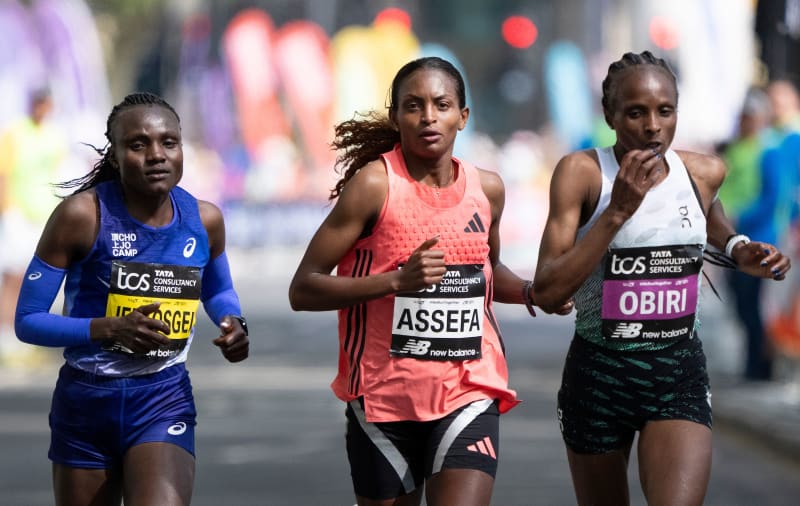
Very quickly, Amanang’ole dropped. For last year’s pacer, the pace was too much. Only three women remained: Assefa, Obiri, Jepkosgei. As expected. Three champions. Three different strides. Three sets of eyes constantly watching each other. Half marathon: 1:06:12. Already massive. The second half became a true battle. No pacers. Just three athletes trading blows. Assefa made a move on a climb near Canary Wharf—even skipping a drink station. Obiri and Jepkosgei responded. No one wanted to be first to crack.
In the final kilometers, everything tightened. Then Assefa launched. Jepkosgei broke first. Obiri tried to stay with her, but the Ethiopian was too strong. She powered away with her arms, her stride full of force, and flew toward The Mall. Tigst Assefa won in 2:15:41 improving her own women-only world record by nine seconds, set here last year. Behind her: Hellen Obiri – 2:15:53 (new PB), and Joyciline Jepkosgei – 2:15:55. Three women under 2:16. Three absurd performances.Unlike last year, conditions were ideal: 10–12°C and a slight tailwind in the final section.
 © London Marathon Events
Women’s Results
1. Tigst Assefa (Ethiopia) – 2:15:41
2. Hellen Obiri (Kenya) – 2:15:53
3. Joyciline Jepkosgei (Kenya) – 2:15:55
4. Degitu Azimeraw (Ethiopia) – 2:19:13
5. Catherine Reline Amanang’ole (Kenya) – 2:21:20
6. Eunice Chumba (Bahrain) – 2:23:44
7. Eilish McColgan (Great Britain) – 2:24:51
8. Julia Paternain (Uruguay) – 2:25:47
9. Rose Harvey (Great Britain) – 2:26:14
10. Marta Galimany (Spain) – 2:27:38
Marathon Enters a New Era
There will clearly be a before and after London 2026. For decades, sub-two was almost sacred. A crazy idea. A laboratory obsession. A dream for physiologists and marathon fans. Eliud Kipchoge made it possible with INEOS 1:59. Kelvin Kiptum brought the line closer in Chicago. Sabastian Sawe erased it. But this race is not just the story of one man. It tells the story of the marathon’s evolution. Athletes are moving to the roads younger. Runners from the 5,000m, 10,000m, and half marathon transition faster to 42 km. Shoes improve. Nutrition improves. Race strategies become surgical. And records no longer fall by seconds. They collapse in entire blocks. Maybe the craziest part? Yomif Kejelcha ran 1:59:41 in his first marathon. Jacob Kiplimo finished in 2:00:28, also under the old world record. The top 6 completely redefined what the fastest times at those positions look like. London didn’t just produce a historic winner. London shifted the entire scale of what is possible.
The 2026 London Marathon will remain a date carved into sports history. Not just running history. Sports history. Sabastian Sawe broke two hours. Yomif Kejelcha followed him into the unimaginable. Tigst Assefa pushed her own record even further. And London, once again, provided the perfect stage for a revolution. No need to look only at Valencia, Chicago, or Berlin anymore. We still don’t know how far this new era will go. 1:58? Maybe. But today, what matters most is understanding what just happened. The marathon changed worlds. And we were lucky enough to watch it live.
✓ Full results of the 2026 London Marathon
April 26, 2026. A date forever etched in marathon history. There are days when sport changes dimension. Days when the most mythical barriers finally fall—for real. At the 46th edition of the London Marathon, Sabastian Sawe became the first man in history to run an official marathon under two hours. 1:59:30. A time every running fan, expert, and marathon lover had been dreaming of for years. And as if that wasn’t enough, Yomif Kejelcha, in his marathon debut, also broke the barrier in 1:59:41. Something never seen before. Two men under two hours. In the same race. On the same London roads. It’s staggering. And London didn’t stop there. In the women’s race, Tigst Assefa successfully defended her title in 2:15:41, setting a new women-only world record. A total day. Historic. Almost unreal. A performance that pushes the marathon into a new era.
Sabastian Sawe, the First Man Under Two Hours
From the very first kilometers, it was clear this marathon would not be normal. The lead pack went out fast before slightly settling: 14:14 at 5 km, then 28:34 at 10 km. At the front were all the big names: Sabastian Sawe, Yomif Kejelcha, Jacob Kiplimo, Tamirat Tola, Amos Kipruto, Deresa Geleta. An absurd level of depth. Constant tension. Focused faces.
The three pacers did a perfect job, and halfway was reached in 1:00:29. Not yet under two hours, but exactly where it needed to be. The zone where everything remains possible—if the legs are there. The first half of the London course is favorable, with plenty of downhill sections, and the split showed the leaders were running smart and controlled. But everything still had to be done.
It was after 30 km that the race changed. The pacers stepped aside, and Sabastian Sawe took control. He looked easy—almost too calm for what was unfolding. His stride was long, fluid, efficient. Behind him, Yomif Kejelcha hung on. For a marathon debut, what the Ethiopian was doing was almost unbelievable. After his brilliant years on the track, expectations were high for his marathon debut—but seeing him still on Sawe’s shoulder at that point was extraordinary. Jacob Kiplimo, world record holder in the half marathon (57:20), stayed a few seconds behind, but the gap slowly widened.
𝟭𝗵𝟱𝟵'𝟯𝟬''. Record du monde sur le marathon de Londres pour Sabastian Sawe, dans une ambiance assez folle 🙌 pic.twitter.com/Gqy4Uk01Sl
— Eurosport France (@Eurosport_FR) April 26, 2026
Between 30 and 35 km, Sawe and Kejelcha put on a show. They accelerated seriously. Sawe set the pace. Kejelcha followed. The projection became insane. No longer just a world record. No longer just a huge win. The sub-2 started dominating every conversation. The crowd went wild. Nearly 800,000 people lined the streets of London to support the runners.
Approaching Big Ben, Sawe made the decisive move to drop Kejelcha by a few meters. Not much—but enough. What was incredible was that the Kenyan kept pushing, alone at the front, driven by the wildest dream of his life and the energy of London. Around him, everyone started realizing what was happening: we were witnessing a moment that would last forever. With 400 meters to go, he entered the final turn onto The Mall. After a heroic effort and a perfectly executed race (1:00:29 / 59:01), he crossed the line in 1:59:30 shattering both the symbolic two-hour barrier and Kelvin Kiptum’s previous world record of 2:00:35. Eliud Kipchoge had shown it was possible with his unofficial 1:59:40 in 2019. Sabastian Sawe did it in an officially sanctioned marathon. And Yomif Kejelcha? He never gave up. He finished just behind in 1:59:41. Sub-two in his first marathon. Simply stratospheric. He becomes the fastest debut marathoner in history. Jacob Kiplimo took third in 2:00:28. Yes—you read that right. The top three all ran faster than the old world record.
“I knew I was very well prepared for this race. But what happened yesterday is exceptional. It was a moment I will never forget. I mainly came here to win the race and try for the world record. I’m so happy today. Yomif pushed me to go beyond my limits.”
Men’s Results
1. Sabastian Sawe (Kenya) – 1:59:30
2. Yomif Kejelcha (Ethiopia) – 1:59:41
3. Jacob Kiplimo (Uganda) – 2:00:28
4. Amos Kipruto (Kenya) – 2:01:39
5. Tamirat Tola (Ethiopia) – 2:02:59
6. Deresa Geleta (Ethiopia) – 2:03:23
7. Addisu Gobena (Ethiopia) – 2:05:23
8. Geoffrey Kamworor (Kenya) – 2:05:38
9. Peter Lynch (Ireland) – 2:06:08
10. Mahamed Mahamed (Great Britain) – 2:06:14
Sabastian Sawe Wants to Remove Any Doubts About Doping
Naturally, a time like this raises questions. That’s normal. Especially after the Ruth Chepngetich case. Modern marathon running is moving incredibly fast—sometimes too fast. Carbon shoes, optimized nutrition, fast courses, precise race strategies… and of course, the issue of trust and doping. In recent years, the Athletics Integrity Unit (World Athletics’ anti-doping agency) has sanctioned a huge number of Kenyan athletes.
But on this subject, Sawe had already taken action. According to several media reports, his team and sponsor Adidas set up an enhanced testing program, including an annual contribution of $50,000 to the Athletics Integrity Unit to increase testing frequency. Before last year’s Berlin Marathon, sources mentioned around 25 anti-doping tests in two months. That is huge—and far from a detail. In a sport often damaged by these scandals, transparency matters. It doesn’t guarantee everything, of course. But it helps restore trust.
Adidas Hits the Jackpot with the New Adizero Adios Pro Evo 3
And then there’s the shoe question. Sawe wore the new Adidas Adizero Adios Pro Evo 3, a super shoe that inevitably reignites the technological advantage debate. Kejelcha wore it too. Assefa as well. The German brand hit the jackpot, and its stock price has risen sharply since Sunday. Some call it a revolution. Others call it technological doping.
What is certain is that the shoes comply with World Athletics regulations. The debate won’t disappear. But the performance is real. And in the end, shoes don’t run by themselves. Sawe already had major credentials pointing to a brilliant marathon future: 58:02 in the half marathon, 26:49 over 10 km. That’s not nothing.
Tigst Assefa Sets Another World Record
Even before the earthquake in the men’s race, the women had already pushed London into history. From the gun, the favorites went fast. Very fast. Tigst Assefa, Hellen Obiri, Joyciline Jepkosgei, and Catherine Reline Amanang’ole quickly moved to the front. They passed 5 km in 15:39, 10 km in 31:03. These were outrageous splits—almost world-record pace for a women-only race (without male pacers).
Very quickly, Amanang’ole dropped. For last year’s pacer, the pace was too much. Only three women remained: Assefa, Obiri, Jepkosgei. As expected. Three champions. Three different strides. Three sets of eyes constantly watching each other. Half marathon: 1:06:12. Already massive. The second half became a true battle. No pacers. Just three athletes trading blows. Assefa made a move on a climb near Canary Wharf—even skipping a drink station. Obiri and Jepkosgei responded. No one wanted to be first to crack.
In the final kilometers, everything tightened. Then Assefa launched. Jepkosgei broke first. Obiri tried to stay with her, but the Ethiopian was too strong. She powered away with her arms, her stride full of force, and flew toward The Mall. Tigst Assefa won in 2:15:41 improving her own women-only world record by nine seconds, set here last year. Behind her: Hellen Obiri – 2:15:53 (new PB), and Joyciline Jepkosgei – 2:15:55. Three women under 2:16. Three absurd performances.Unlike last year, conditions were ideal: 10–12°C and a slight tailwind in the final section.
© London Marathon EventsWomen’s Results
1. Tigst Assefa (Ethiopia) – 2:15:41
2. Hellen Obiri (Kenya) – 2:15:53
3. Joyciline Jepkosgei (Kenya) – 2:15:55
4. Degitu Azimeraw (Ethiopia) – 2:19:13
5. Catherine Reline Amanang’ole (Kenya) – 2:21:20
6. Eunice Chumba (Bahrain) – 2:23:44
7. Eilish McColgan (Great Britain) – 2:24:51
8. Julia Paternain (Uruguay) – 2:25:47
9. Rose Harvey (Great Britain) – 2:26:14
10. Marta Galimany (Spain) – 2:27:38
Marathon Enters a New Era
There will clearly be a before and after London 2026. For decades, sub-two was almost sacred. A crazy idea. A laboratory obsession. A dream for physiologists and marathon fans. Eliud Kipchoge made it possible with INEOS 1:59. Kelvin Kiptum brought the line closer in Chicago. Sabastian Sawe erased it. But this race is not just the story of one man. It tells the story of the marathon’s evolution. Athletes are moving to the roads younger. Runners from the 5,000m, 10,000m, and half marathon transition faster to 42 km. Shoes improve. Nutrition improves. Race strategies become surgical. And records no longer fall by seconds. They collapse in entire blocks. Maybe the craziest part? Yomif Kejelcha ran 1:59:41 in his first marathon. Jacob Kiplimo finished in 2:00:28, also under the old world record. The top 6 completely redefined what the fastest times at those positions look like. London didn’t just produce a historic winner. London shifted the entire scale of what is possible.
The 2026 London Marathon will remain a date carved into sports history. Not just running history. Sports history. Sabastian Sawe broke two hours. Yomif Kejelcha followed him into the unimaginable. Tigst Assefa pushed her own record even further. And London, once again, provided the perfect stage for a revolution. No need to look only at Valencia, Chicago, or Berlin anymore. We still don’t know how far this new era will go. 1:58? Maybe. But today, what matters most is understanding what just happened. The marathon changed worlds. And we were lucky enough to watch it live.