
Why Do You Always Talk About Your Race? Even When Nobody Asked
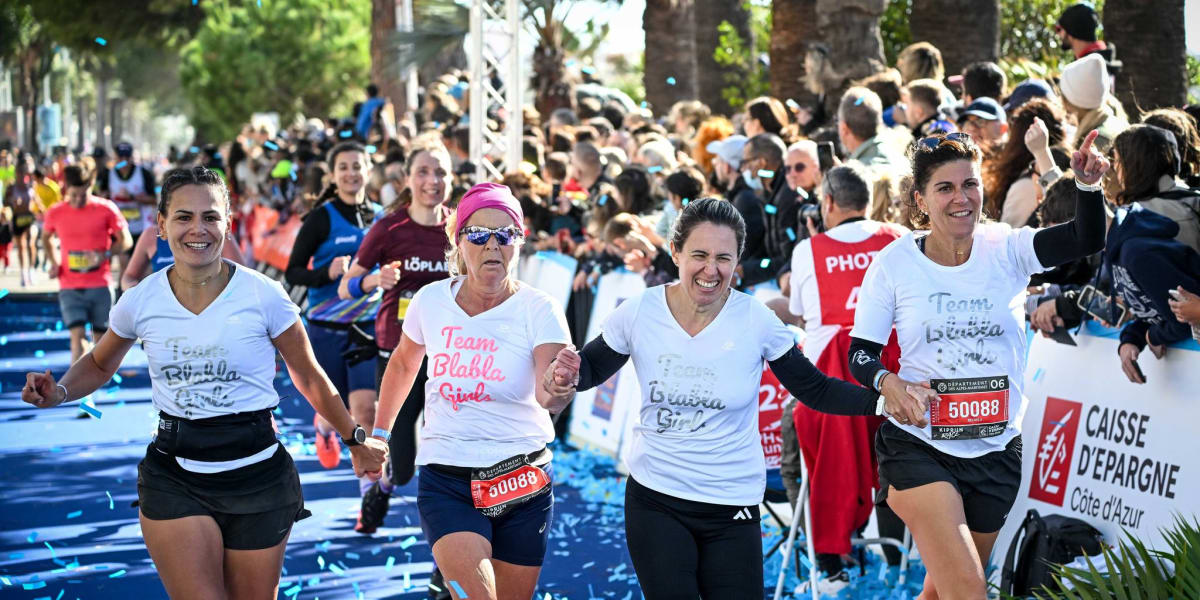 © Azur Sport Organisation
Showing off, insecurity, a need for recognition, or simple pride? Why do runners feel the urge to talk about their marathon almost every time, even when nobody asked? It’s as common as it is unexplained. So we tried to dig into it. Here are a few theories, inevitably subjective, but not entirely without merit.
Theory 1: Nothing else is quite as interesting
Monday morning at the office means the weekend debrief. Cécile talks about visiting her in-laws, Maël gives a detailed account of his video game marathon, and Pascale is delighted to have sold a chest of drawers on Le Bon Coin. But you ran an actual marathon. So naturally, when the inevitable question comes: “And you, how was your weekend?” There’s no resisting. And off you go: “I was in Nice for the marathon. Perfect conditions: sunny, but not too hot. Great organisation, quality aid stations, except at 35K when I got a cramp, and guess what? No cooling spray anywhere. Still, I hung in there. Then, just before the finish, a woman collapsed right in front of me… But I finished strong, really feeling good.” By then, nobody is listening. Everyone has gone back to their emails. And you return to your desk with a knowing smile. Because yes, you know your weekend was still a little more epic than everyone else’s.
Theory 2: It’s (a little) about showing off
The stated goal: break three hours for the full 42.195 km. Three months of intense training with a coach, monk-like discipline, long runs at dawn. Then, at the finish, the jackpot: 2:59:07 on the clock. So naturally, the news doesn’t stay secret for long. “Oh yeah, I went sub-three in my last marathon. Honestly, it was pretty easy.” And that little sentence becomes a badge of honour, produced at the slightest opportunity. Even, and especially, when nobody asks. “Hi! Nice to meet you. By the way, have you ever run a marathon? No? Oh, because I have. Sub-three, you know…”
Theory 3: A passion for essay writing
Introduction, central question, three-part structure, conclusion and opening perspective. That’s the runner’s method for answering “How was your race? Did it go well?”, if only the person asking knew… The answer awaiting them is anything but brief. From the journey to race-number pickup, not forgetting the mishaps, the expired gel, the race itself, the fall at 38K, the finish line, the medal, the oversized finishers’ T-shirt and even the ride back. In short, the answer resembles a double-sided exam paper, with “What if the finish line were merely an illusion, a decoy designed to give meaning to the effort?” as its subject. You have four hours.
Theory 4: Sharing a passion for sport
They didn’t ask, but they’re sporty friends, so obviously… they’ll be interested. At least that’s what the runner tells themselves as they enthusiastically launch into their marathon story. Except that, in reality, one plays chess, another plays golf, Emma rides horses and Jérémy goes skydiving. In other words, passionate debates about sticky oranges at the aid station, the struggle with a badly fastened race bib or pace per kilometre probably won’t spark much excitement. But the runner perseveres, convinced that sport unites everyone deep down. Even as people around the table start talking about the latest episode of a TV series or Aunt Monique’s bridge tournament.
Theory 5: Running is a drug
After the marathon comes enforced rest. No runs, no intervals, not even a little recovery jog. The body is regenerating, but the mind is still running at full speed. So, to fill the void, theory replaces practice. If you can’t run, you talk about running. On repeat. The perfect opportunity to replay your latest race kilometre by kilometre: light legs at the start, the climb at 27K, the cramp at 35K, the final sprint, the medal. One way or another, it eases the withdrawal. Because deep down, running is a bit of an addiction, and telling the story means carrying on running, only with words.
Theory 6: Fulfilling a dream is something to be proud of
The Paris Marathon was the challenge of 2025. Quite a challenge, just one year after taking up running. The bet was accepted, the challenge conquered: a marathon, 42.195 kilometres. It’s impossible to hold back the joy, or the urge to tell everyone, without really knowing why.
Theory 7: The social media effect
Between Instagram and Strava, the race recap is a pretty big deal. You’ve thought about it so much that you know the post caption by heart. So when it’s time to talk about your achievement, you simply recite it.
The runner telling their race story isn’t always showing off. Often, they’re trying to give it meaning, build a connection or assert their existence in a world that moves fast, where even effort seems to need justification and validation.