
 © Tinder
Is running the new dating app?

What if real chemistry no longer began in a crowded bar or behind a hesitant swipe, but on a shared Strava segment? As dating apps increasingly embrace sport, and runners’ favorite app quietly turns into a place for flirting, an unexpected trend is taking shape: relationships that begin in running shoes.
Table of contents
- Tinder, the dinosaur discovering gentle exercise
- Tinder takes up running with the “Solemates” challenge
- Bumble, the queen bee of sports dating
- Happn and location-based flirting… on the run
- Fitafy, Kippo, Teamr and the rest: highly targeted outsiders
- Strava, the Tinder that doesn’t know it’s Tinder
- Where the worlds merge
- So what does it look like in real life?
- Sometimes one run beats every swipe
What if the real match of 2025 was Strava? With well-placed Kudos, shared segments and comments that gently flirt, runners’ favorite app is quietly turning into a dating ground. While some people still meet on Tinder or Bumble, others are taking a more… cardio-focused approach. No bio, no swipe, just a long run together and post-race conversations that say a lot. And it works. So much so that traditional dating apps are starting to react: sports categories on profiles, running-friendly interests, group events… Sport has become a strategic advantage. Welcome to a match within the match: the one between traditional dating apps and good old Strava, which never asked for any of this but may well steal the spotlight.
Tinder, the dinosaur discovering gentle exercise
Among the established dating apps, the shift toward “sport and healthy lifestyles” is well underway. Tinder is the heavyweight of the category, the app that made swiping a generational reflex. And while it still has a huge user base, it has clearly sensed that the times are changing. Gone is the slightly trashy “hook-up app” image of its early days: Tinder now wants to be more serious, more committed, more… sweaty?
In 2023, the platform launched a campaign called It Starts With a Swipe with a clear aim: to celebrate real stories, real encounters. Many of the couples featured said they met… while doing something. Sport, travel, shared activities. And although Tinder still doesn’t offer a “running addict” filter, the app is making more room for active hobbies in bios and interests. In other words: the 2025 match is more about the Nikes than the favorite cocktail.
Tinder takes up running with the “Solemates” challenge
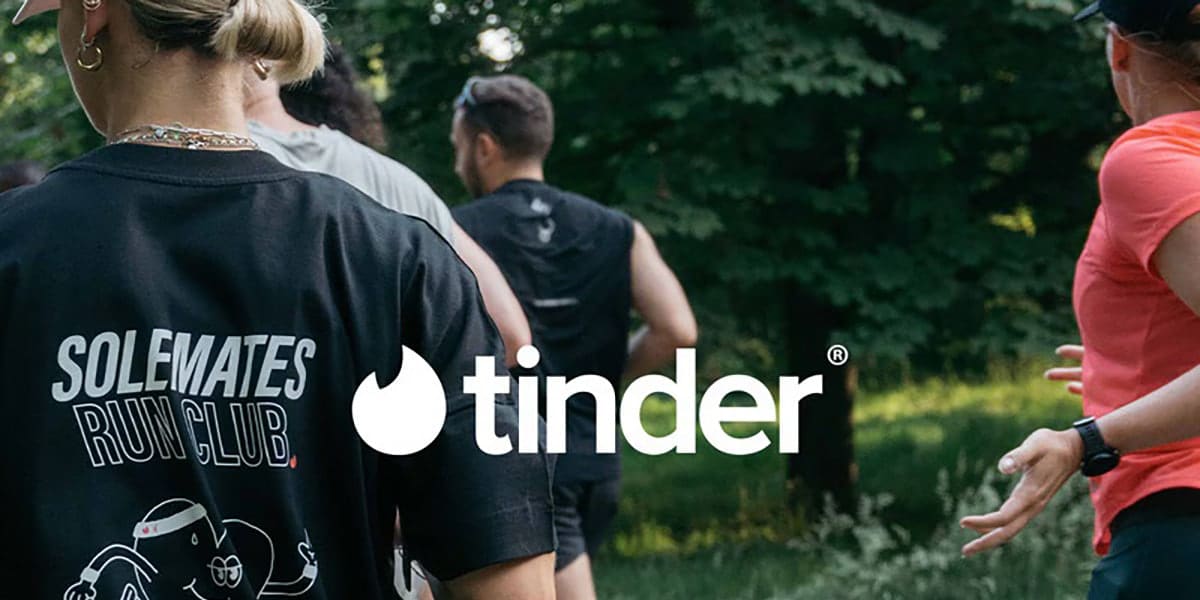
To appeal to a generation looking for genuine connections, Tinder launched the “Tinder Solemates Challenge” in the UK in partnership with Strava. The idea: walk or run 21 km with a partner between April 19 and May 17, 2025, record the activity on Strava, tag the “Tinder Solemates Run Club” and confirm your participation for the chance to win prizes. Prizes included Runlimited vouchers, meals at Big Mamma or Amie Wine Studio, sauna wellness sessions and even a year of Tinder Gold.
The initiative is part of a strategy designed to move beyond the digital world and rebuild connections in real life, in line with the expectations of a young generation looking for more natural, authentic encounters. The challenge was also incorporated into the Hackney Moves half marathon, sponsored by Tinder on May 18, where runners could enjoy an immersive “The Solemate Takeover” space with DJ trucks, personalized sportswear and chill-out areas designed to encourage post-race connections. By partnering with Strava, Tinder is targeting an active, connected community, repositioning the brand at the heart of urban social life and creating opportunities for spontaneous encounters, one stride at a time.
Bumble, the queen bee of sports dating
Bumble, meanwhile, has fully embraced the shift. From the outset, the app aimed to offer something healthier, more respectful and more in tune with modern values. Women make the first move, but that’s not all: sport has become a strategic playing field. Users can list their interests in the filters, and guess what? Running, hiking, cycling and weight training are all near the top. Better still, Bumble encourages members to meet in real life through active pursuits. A yoga class, a walk in the woods or a bike ride. The message is clear: sweating together is already a way of opening up.
Happn and location-based flirting… on the run
Happn, for its part, plays the fate-crossing card. You match with someone you passed in the street, at a café or… while running in the same place. And the app has understood that potential. It has also launched sporting events for its members: boot camps, outdoor yoga and group runs. The idea is to replace hesitant messages with a real-life meeting, adding a little cardio to break the ice. The result: no need to wonder “what should I message them?” Just warm up and get moving.
Fitafy, Kippo, Teamr and the rest: highly targeted outsiders
Then there are the smaller apps that no longer bother with mixed messages. Fitafy is the leading example, often described as Tinder for active people. Everything is clear from the start: you want to meet someone who gets moving, who sweats, who builds their week around training sessions. The interface borrows all the familiar dating-app codes, but the bios proudly announce “early runner” or “CrossFit lover.” It’s niche, but it’s thriving in some countries. Along the same lines, Kippo targets gamers, Teamr is aimed at team-sport athletes, and Strava… well, Strava acts as if nothing is happening, but everyone gets it. The opportunity is there. Love in motion is the new creed.
Strava, the Tinder that doesn’t know it’s Tinder
Speaking of Strava… While dating apps are getting into sport, the favorite app of elevation lovers keeps bringing people together quietly. One Kudo, one comment, a quick note about a great performance… and contact is made. Sometimes, a shared run becomes a habit. A shared segment becomes an excuse to talk. And there you have it. The rest follows. It’s no coincidence that some people refer to it as “Strinder” either jokingly or completely seriously.
It’s not an official strategy from the platform, which maintains its image as a well-organized sports social network. But in practice, there’s romance in the air. And it’s often more sincere than a midnight DM on Instagram. That’s the appeal: it feels natural. No need to sell yourself. No need to write the perfect bio. The information is there, but it’s lived rather than staged. An activity history, consistency, performances, a route… they can say far more than a poorly written promotional pitch.
Where the worlds merge
Some apps didn’t wait to jump headfirst into this grey area between dating and sport. Fitafy, for example, offers a fully blended concept somewhere between Strava and Tinder: you meet active people who want to match over a lifestyle rather than a look. And it’s not alone. Other, more discreet platforms are betting on “train & date”, embracing shared effort as the basis for connection. Less small talk, more shared moments. A philosophy that appeals especially to people used to building their weeks around long runs.
Strava, on the other hand, could eventually embrace its social role more openly. For now, the app remains true to its line. But given the number of clubs turning into genuine local communities, events ending in after-parties and Kudos evolving into something more meaningful, all it needs is a “Run together” button to complete the circle.
So what does it look like in real life?
Behind this trend, there are mostly stories. Real ones. Like the couple who crossed paths by chance on a segment, then kept finding each other through a steady exchange of Kudos. Or the friendship that began during a local club run and shifted unexpectedly after a 10K where everything clicked effortlessly. And others who tried a running date after matching on Bumble, thinking, “we might as well combine business with pleasure.” Not all of them end up together, of course. But in every case, the encounter happens. It’s alive. It feels good. And in a world where algorithms want to predict everything, running side by side remains one of the best ways to find out whether something might click.
Sometimes one run beats every swipe
The real shift may be here: in this desire for authenticity. People turning to sport to meet someone aren’t looking for the perfect filter, a flattering photo or a polished one-liner. They’re looking for a shared breath. A pace. A shared desire to move in the same direction.
It may be less glamorous on paper, but it’s often more real. And if it doesn’t click? No big deal. Your fitness will have improved. And there will always be that little segment where it all began.
More articles
Women’s races are showing no signs of slowing down
Women-only races have surged in recent years. With stronger institutional backing, they are attracting more and more participants.
Wed, September 9, 2026

Running Catharsis: Myth or Effective Method?
Running to purge your worries: does it really work, or are you fooling yourself into thinking every stride solves your problems?
Wed, September 9, 2026

Gravel running: the urban runner’s latest escape route?
Gravel running isn’t replacing road or trail. It’s a third lane: closer to home, freer, and less obsessed with the clock.
Wed, August 5, 2026