 © La Flèche Tarnaise
La Flèche Tarnaise: the runner telling France’s history one jog at a time
Jérémy is 28, has an all-consuming love of general knowledge, and a phone camera permanently angled into the light. In just six months, he has become one of the most distinctive voices in French running content on TikTok. No need to run at 4:50/km to stand out — just something to say.
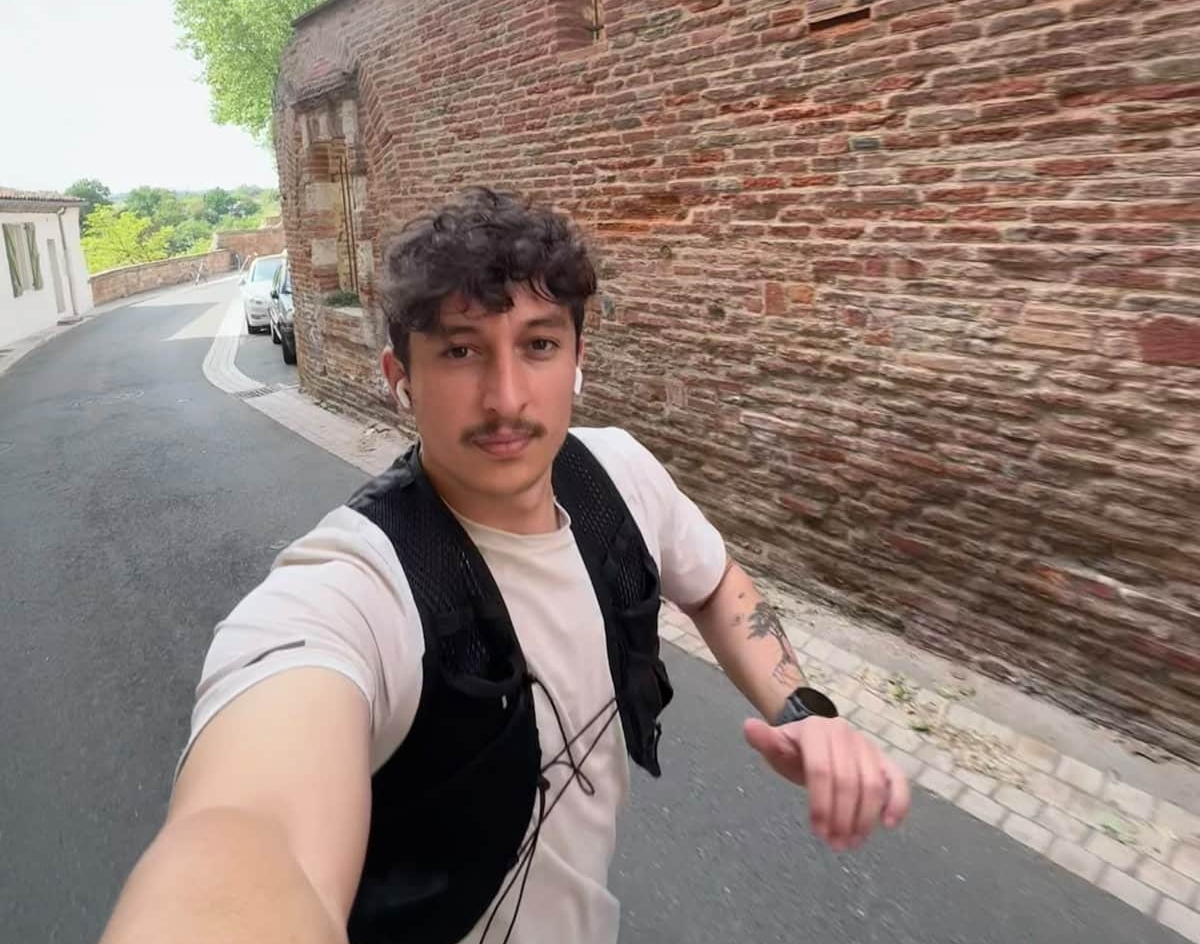
Picture a guy heading out for a Sunday run in the Tarn region of southern France, along the vineyards of Gaillac — one of the country’s oldest wine regions — filming himself explaining how wine was already being produced here before the Romans ever set foot in Gaul. Not a teacher. Not a tour guide. Just a runner in a T-shirt, cruising in zone 2 heart rate, talking to his phone with a smile. That’s La Flèche Tarnaise, aka laflechetarnaise on TikTok and Instagram. Behind the name is a childhood nickname given by his father for his “nonsense” more than his report cards. His real name is Jérémy, 28, a financial strategy consultant in Toulouse, originally from Lavaur. Not exactly the profile you’d expect in the running content creator scene. And yet.
| Two ACL tears, and a sport by default
Before running shoes, Jérémy played tennis — until a second ACL surgery ended the story. “I tore my ACL playing tennis, it happened twice. After that I told myself I had to stop, because every time you lose a year of sport. It was too complicated to keep going,” he explains. Running then enters his life almost by accident, alongside cycling and swimming. The first sessions are brutal.
“It was five kilometres of hell. I was thinking about going home every minute.” A body trained for tennis, not endurance, has to start from scratch. Nothing glamorous. But slowly, something clicks — especially a natural “diesel engine” developed through years of cycling with his father, an ease in zone 2–3 effort that would later become the perfect pace for storytelling.
For two and a half years, he runs just for the sake of running. Then boredom kicks in. “After three years of running, you kind of get bored if you don’t add something to it.”Trails, events, goals — anything to give meaning to training. Then one evening, a friend says: “Just start a channel.” La Flèche Tarnaise is born.
| Knowledge as fuel
What sets Jérémy apart from the crowded world of running creators isn’t speed, gear, or technique. It’s curiosity — something he’s had since childhood. “I was the kid talking to adults, trying to understand what they were saying. I’ve had basic economics notions since I was 12, not really understanding everything, just wanting information.” For him, general knowledge is not a list of facts. It’s a way of understanding the world.
And running offers something no other sport really does: physical access to history. You pass cathedrals, battlefields, ancient vineyards, Roman traces. You run along paths used 1,800 years ago by messengers and soldiers. “You realize both cities already existed back then. It’s incredible. In the US, buildings are 400 years old. Here, we’ve got 2,000-year-old history. That blows my mind.” That sense of time — spoken mid-run, at 6:15/km pace — hits differently than any textbook ever could.
| Planning a video in zone 2
Behind the relaxed style lies a real process. Everything starts with a file where Jérémy lists races and trails he wants to explore. For each destination, the same routine: “I start by covering the basics with ChatGPT, then I dig into everything that happened in the area. But I don’t rely only on that — I want to bring real value.”
Then come articles, YouTube videos from local enthusiasts, sometimes even books about regional history. Research time? About 30 minutes for a simple Sunday video, up to two hours for more complex ones. He sums it up through the 80/20 rule: “Twenty percent of effort for 80 percent of the information — that’s basically how my life works.” Next: mapping the route, identifying key spots, memorising landmarks rather than scripted sentences.
« Before I go running, I have 1211 in mind — the date of the Cathar battle. I know the cathedral name, the key figures, and it naturally comes out while I’m speaking. »
Jérémy aka La Flèche Tarnaise
The editing then strips everything unnecessary. What’s boring disappears. What works stays. The hardest part isn’t breathing. “I can run 25 km without any breathing or muscle issues at the same pace.” The real challenge is memory under fatigue — and sometimes the camera itself. “Sometimes I get home and realise the video is unusable because of backlight or a missed shot.” So he goes again. And again.“My videos will never be perfect, but I try to get as close as possible.”
| The Tarn as a playground of history
Even for someone who runs there often, the Tarn still surprises him. “I was completely wrong about a lot of things,” he admits.
“I didn’t know Gaillac was one of the oldest vineyards in France.” Or that Albi’s Sainte-Cécile Cathedral is the largest brick cathedral in Europe. Or that, while running, he is literally passing over layers of medieval history. “It drives me crazy. I’m running above all this history without even realising it.”
@laflechetarnaise Est ce que tu savais que Gaillac est l’un des plus vieux vignoble de France #running #culturegenerale #sport #histoire ♬ son original – laflechetarnaise
The idea is simple: not Paris, not viral hotspots — but the Tarn, its small towns, its Roman roads, its overlooked heritage. And when you search “Gaillac” on TikTok, you deserve more than shaky clips. “People search for Gaillac and find poorly made videos. I wanted to change that — show the town, its history, its atmosphere.”
| A different image of running
In a social media world dominated by splits, intervals, and sub-4/km efforts, Jérémy sits at 6:15/km — and fully owns it. Some followers tell him that’s exactly why they watch. “You’re not about performance. You show easy runs at 6:15/km — and that feels achievable.” For him, it’s about bringing fun back into running.
“When I played tennis, we were having fun. Today, a lot of training content online feels like people only last two weeks.” Running doesn’t need to hurt to matter — that’s the idea. In 2026, running has become more than a sport: tourism, health, storytelling, social media. “Run tourism” — running to explore rather than to perform — is growing fast. La Flèche Tarnaise fits right into that shift. Not a brand, not a concept. Just a runner, a phone, and 30 minutes of research on a Sunday morning.
| And in five years?
It’s a question Jérémy often asks others — but never really applied to himself. Maybe leaving the Tarn. Expanding to Aveyron, the Basque Country, Nice. Running with people who have stories to tell. Making longer videos, stopping in old bakeries, covering major French races. “I’d love to run with incredible people and visit extraordinary places with them,” he says. He even admits there’s something close to journalism in it. “It’s almost journalism — digging, asking the right questions.” But without pressure. No monetisation strategy. No constraints. “If I want to stop tomorrow, I stop tomorrow.”
A thousand followers on TikTok. A region starting to notice. Local organisations offering race entries. And above all, total freedom: post when there’s something to say, run when there’s somewhere to go. In a saturated running media landscape obsessed with performance, La Flèche Tarnaise offers a reminder: the best stories are already under our feet — you just have to look up at the right moment.

Dorian VUILLET
Journalist