 © La Route du Louvre
The Route du Louvre 2026: pacer Anthony Kimtai turns the marathon on its head
A pacer who ends up winning the race, a courageous Bahraini athlete battling Achilles tendon pain, young runners already dipping under 16 minutes for 5K, and more than 15,000 participants racing between slag heaps and museum halls. The Route du Louvre once again blended elite performance, mass participation and scenes you simply don’t see anywhere else. In Lens, some runners were raising their arms after 42 kilometers. A few minutes later, they were standing in front of museum paintings, medal around their necks, legs still shaking.
The Route du Louvre remains a unique race on the French calendar. For its 21st edition, more than 15,000 participants across all events lined up between Seclin and Lens, finishing in the iconic gardens of the Louvre-Lens museum. The main marathon, a World Athletics “Silver Label” event, kept its point-to-point format over 42.195 km, passing through urban areas, open roads across the former mining basin, and several UNESCO-listed sites before the final stretch to the museum.
The first half is known for being fast, but things get significantly tougher after 30 km, with rolling terrain and repeated accelerations all the way to the finish. And on Sunday, one man who was supposed to simply guide others to fast times ended up taking the win himself. It was the kind of story that fits the Route du Louvre perfectly. In the middle of its slightly surreal atmosphere, Anthony Kimtai delivered the race of the weekend. The Kenyan wasn’t even supposed to compete for victory.
| Anthony Kimtai, from pacemaker to winner
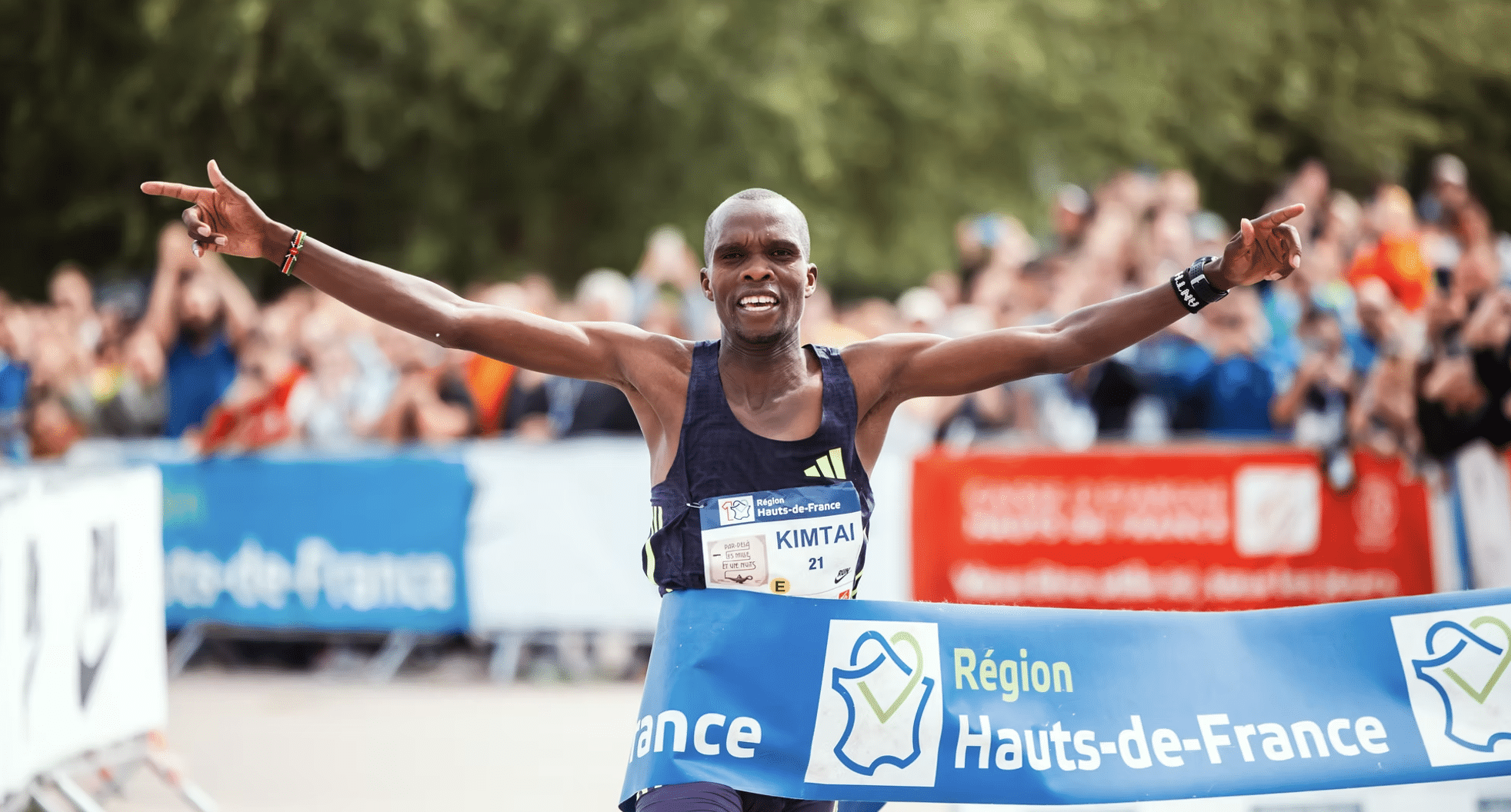
For much of the race, Kimtai did exactly what he had been assigned to do. Smooth, consistent, and relaxed, the 27-year-old Kenyan led the front pack at a very strong pace. Organizers were hoping to see course records fall — set in 2023 by Kenyan Fredrick Kibii (2:08:05) in the men’s race and Ugandan Rael Kinyara (2:28:48) in the women’s.
A tailwind on exposed sections clearly helped the athletes maintain high speeds. But gradually, the lead group thinned out. Some contenders started to struggle. Not him. Around 12 km from the finish, race director Jean-Pierre Watelle gave him a line that changed everything: “You can finish it if you want.” Kimtai smiled… and kept going.
Not a sudden surge, but a very Kenyan-style gear change — smooth, efficient, almost effortless. Behind him, Ethiopia’s Girma Dereje tried to respond. Kenyan Festus Kipkemoi stayed in contention. But the momentum had shifted: the pacer had become the race leader. On the final rolling stretches toward the Louvre-Lens museum, Kimtai held firm and powered to his first major marathon win in 2:09:31. Dereje finished second in 2:09:56, with Kipkemoi third in 2:11:02 — a surreal podium considering his initial role.
| Impressive African depth across the field
The men’s race had a distinctly international, high-level feel throughout. Behind the top three, Kenyan Elijah Kibet Saurey took fourth in 2:11:14, ahead of Ethiopia’s Daniel Tola Boke in 2:11:25. Veteran Kenyan Joel Kipsang Kositany completed the race in 2:12:19.
The top 10 was packed with Kenyan and Ethiopian athletes, including Workeye Takele, Samuel Limo Naibei, Dominic Kiptarus and Vincent Kipyegon Ronoh. The first French finisher, Thomas Deleu, placed 14th in 2:26:19 representing Athlé Halluin-Val-de-Lys. A solid performance on a course that, despite its fast reputation, becomes deceptively demanding in the second half.
| Roselidah Jepketer holds on despite injury
In the women’s race, Bahraini athlete Roselidah Jepketer started as the clear favorite. Despite persistent pain in her left Achilles tendon, she held on to secure victory. Organizers had been targeting a time around 2:28. She ultimately won in 2:30:48 — a performance made even more impressive given her physical condition after the finish.
Behind her, the gaps were significant. Kenyan Rose Cherop finished second in 2:56:17, while French runner Alice Duytsche claimed third in 2:59:22. Poland’s Aleksandra Kacprzak took fourth in 3:12:09.
| Fast racing over 10K
The 10 km race also delivered strong performances, especially in the men’s field. Antoine Viertaix took the win in 30:32 after a close duel with Valentin Ornon, just 11 seconds behind. Thibaut Wajda completed the podium in 32:40. In the women’s race, Eloïse Evain dominated from start to finish, winning in 37:18. Anne-Sophie Demagny (39:23) and Mathilde Guéant (41:34) completed the podium.
| A new generation shines over 5K
The 5 km race looked like a showcase for the next generation. Antonin Delehaye won in 15:30 ahead of Félix Pouilly (15:39) and 16-year-old Antoine Mito (15:48), born in 2007. Several teenagers also broke into the top 10, including Baptiste Wailly, Damien Dembski, Noa Opigez and Léo Duquenne — highlighting the growing appeal of short-distance road racing among younger athletes.
In the women’s race, Maëlle Balaine took victory in 17:05. Azura Sonneville, born in 2009, impressed with second place in 18:35. Even more striking, Capucyne Terby (born in 2012) also made the top 10 — a remarkable sign of how early the new generation is already competing at a high level.
| Relive the 2026 Route du Louvre edition
✔ Results of the 2026 Route du Louvre

Dorian VUILLET
Journalist