 © Transhumance Classic
“I wanted to organize the race I dreamed of running”: the Transhumance Classic downhill race that brings the Aubrac plateau back to life
16/06/2026 16:08On the open, sun-scorched roads of the Aubrac plateau, the Transhumance Classic doesn’t fit into any conventional box. A downhill 10K, a village atmosphere, and a simple promise: run without pressure, and stay for everything else. Behind the idea, Théo Mazars and his team are reviving a fading tradition and bringing a festive spirit back to running.
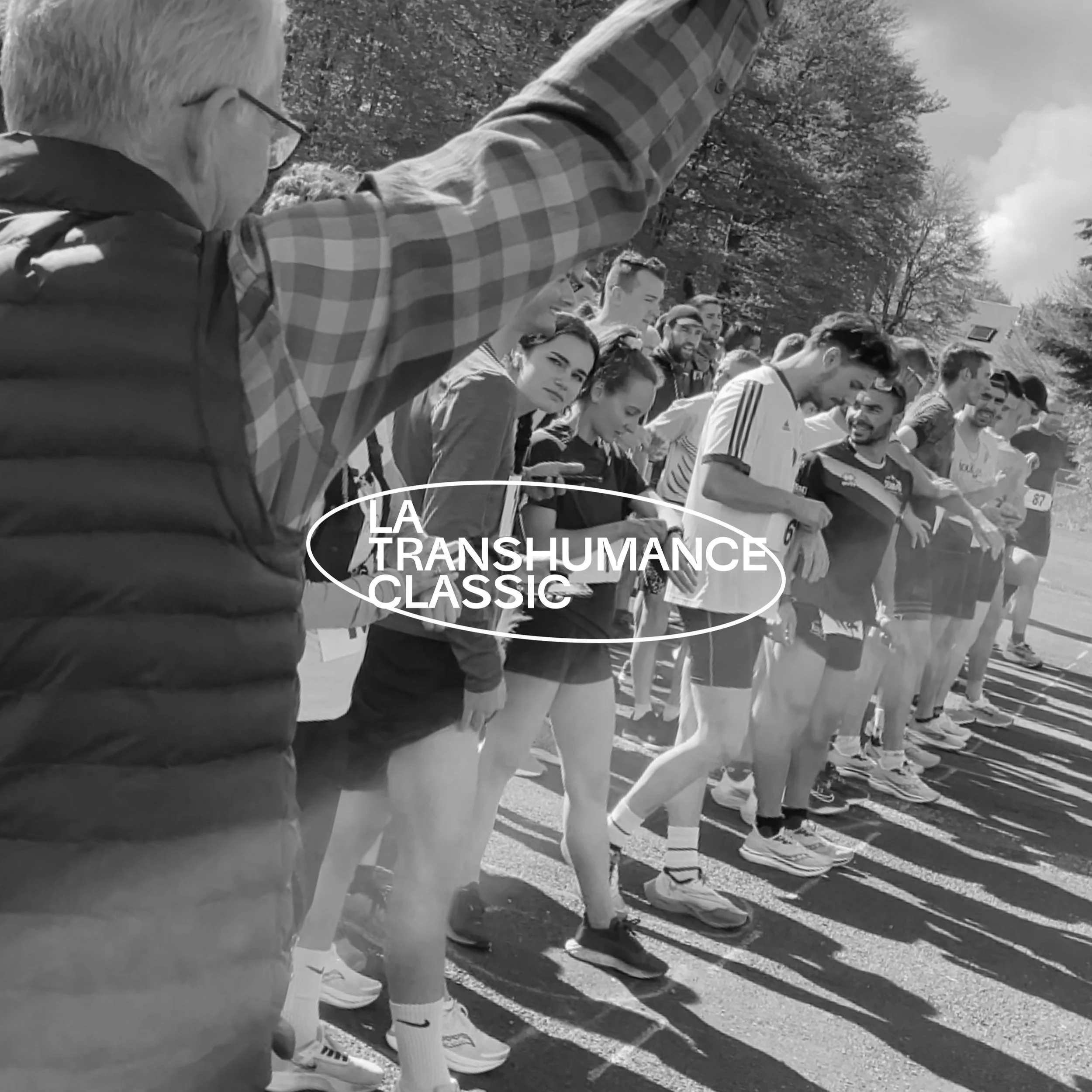
On paper, the concept sounds almost too simple. Ten kilometers. A downhill road. A village finish. But in an era where road racing is increasingly structured, certified, and standardized, the Transhumance Classic deliberately goes against the grain. No TV-optimized course, no elite start pens. Just a start line, a pack of runners, and a road that flows downhill. A steady gradient of around 3%, gentle enough to let runners fly, strong enough to unlock fast times without forcing the effort.
At the end of May, the iconic Aubrac cattle head up to the summer pastures, symbolically marking the start of the season on the plateau. A few weeks later, the Transhumance Classic follows the same rhythm. On Saturday, June 27, it won’t just be hoofprints on the roads—running shoes will take over.
“There’s really everything here to run fast, but it has to be taken with a bit of perspective,” says race organiser Théo Mazars. The label “France’s fastest 10K” is catchy, intriguing, and undeniably attractive. And on the ground, it’s not entirely wrong. Runners who usually finish around 34–35 minutes can sometimes take two to three minutes off their times here. A different way of experiencing effort—less punishing, almost exhilarating. But reducing the Transhumance Classic to a personal-best hunting ground would miss the point entirely.
| Back to the essence of village races
It all starts from a simple, almost nostalgic observation, though without bitterness. “When I was a kid, there were still quite a lot of village races in summer,” recalls the president of Aux Courses Running Club. “As I grew up, they disappeared.” In just a few years, the landscape changed: trail running exploded, major events took over, and small local races gradually vanished from the map. So the idea emerged: recreate a race where it all still makes sense—Laguiole (Aveyron), the village of his grandparents, famous for its knives, in the heart of the Aubrac. Not a replica of the past, but a modern interpretation of it.
“The goal was for everyone to be able to start without stress, without overthinking it,” explains one of the founders of Caviar, a media outlet focused on football culture and society. No performance pressure, no implicit expectations. Just an invitation. And the result quickly went beyond expectations: seasoned runners line up alongside people who had never worn a bib before. Some even discover running for the first time. “We’ve had quite a few participants who had never run a race before and who, since then, have started running regularly.”
| A downhill course that changes the experience
The course becomes a tool—not just to attract attention, but to open doors. The descent makes the race more accessible and more engaging. It changes the relationship with effort: you don’t suffer the pace, you ride it. “It’s an average 3% downhill, very consistent,” says the 28-year-old runner. “You can really push without destroying your knees.” A technical detail, but a crucial one. Unlike more brutal descents, this one remains smooth. Legs turn quickly, sensations stay controlled. Until the final kilometers, when effort inevitably makes itself felt again. At the finish line, few talk about suffering. Most talk about the pleasure of running differently.
But the Transhumance Classic doesn’t end at the finish line. It almost begins there. In the village square, the atmosphere shifts. Running shoes give way to shared tables. The aid station becomes a celebration: local brioche, cured meats, cheese, beer—everything sourced from the village or nearby. “The idea is really 100% local, from partners to products to volunteers.” The project doesn’t sit alongside the territory—it is part of it. And in return, it brings it to life. For a weekend, the village changes scale. With visitors and supporters, the population almost doubles. “Last year, we had nearly a thousand people over the weekend in a village of 1,200 residents.” Running becomes, once again, something collective.
| “I want it to stay a village race”
The growth is real: 150 runners in the first edition, over 300 the next, and around 400 expected this year on June 27. A strong progression, especially in a region like Aveyron where attracting participants is never easy. But ambition has clear limits. “Beyond 500 runners, it becomes a different kind of organisation,” says the Millau native, now based in Marseille. “And I want it to stay a village race.”
« It’s more of a race to enjoy yourself, to finish, maybe for Strava, rather than for an official performance ranking. »
Théo Mazars, organiser of the Transhumance Classic
No desire for scale for its own sake. No attempt to turn the event into a machine. The goal is a fine balance: grow without losing identity. Keep the closeness, the simplicity, the feeling that everything remains within reach. Even the economic choices follow that logic. “We could make a profit, but that’s not the goal. We’d rather invest in quality and experience.” Affordable entries, local partners, short supply chains—the model could generate more, but that’s not the priority.
“It’s more of a race to enjoy yourself, to finish, maybe for Strava, rather than for an official performance ranking.” A freer approach to running, where performance matters, but doesn’t dominate. Strava is there, but not in charge. In the end, everything stems from a simple, personal idea: “I wanted to create the race I dreamed of running.” A downhill that frees the legs. A village that makes you want to stay. And between the two, a race that reminds us that running doesn’t need to do more to mean more.
➜ All the information about the Transhumance Classic
Dorian VUILLET
Journalist