 © MARATHONS.COM
Yohan Durand’s 5 final tips before the Paris Marathon
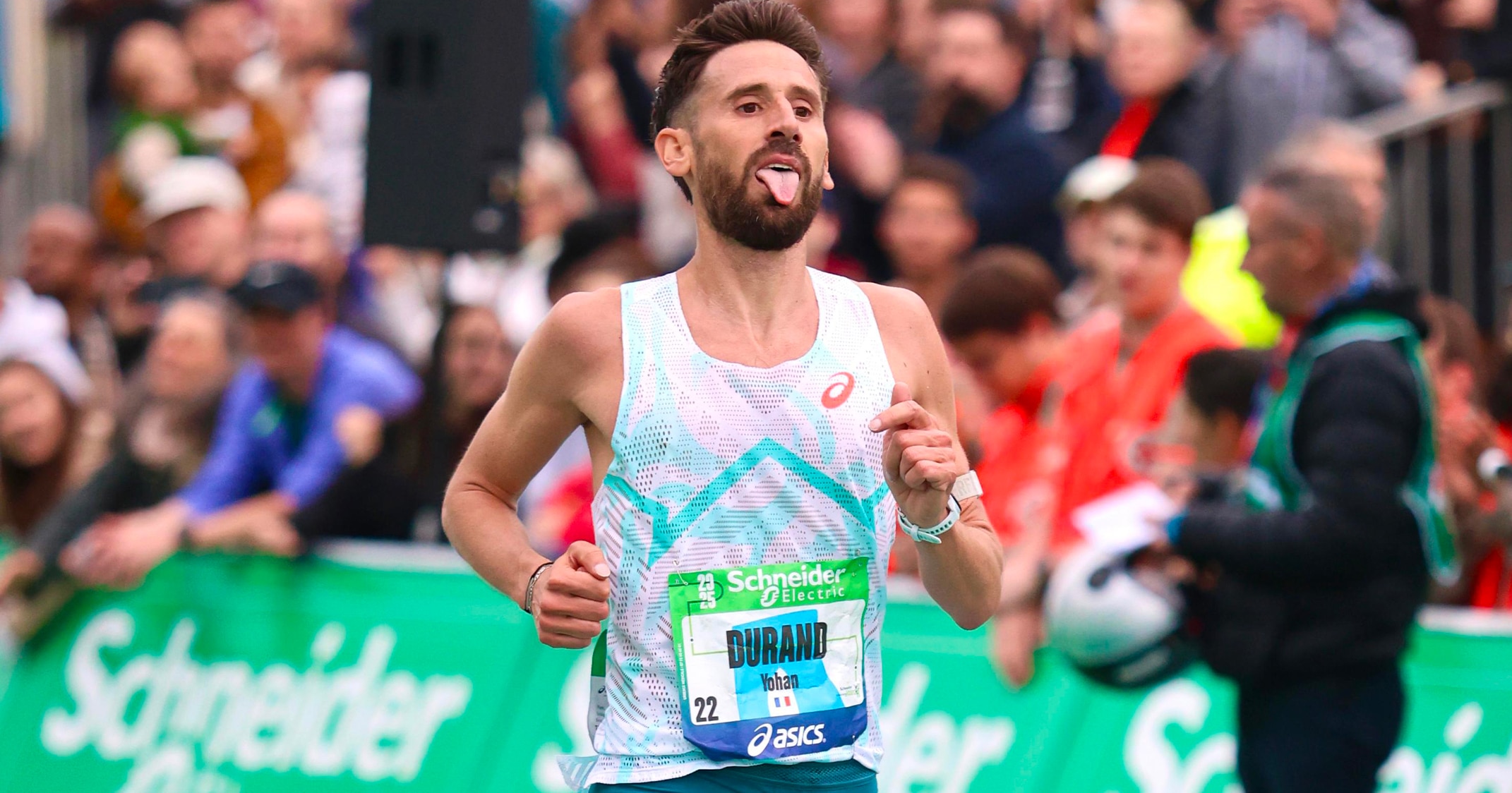
The Paris Marathon is fast approaching. The final weeks before race day can bring plenty of doubts and questions. To help navigate this last stretch, Marathons.com turned to French international runner Yohan Durand, who ran 2:09:21 in Paris in 2021.
Nutrition, hydration, final preparations — the build-up to the Paris Marathon, set for April 12, is coming to an end. Mileage is dropping and the anticipation is building. You’ve likely already completed your last long run and chosen your race-day shoes. You might be checking the weather every day and counting down the days to the start. And above all, you can’t wait to be there. The perfect moment to share Yohan Durand’s final advice, a specialist of the distance, to approach race day in the best possible conditions.
| 1. Stick to your routine and plan ahead
“The number one rule is not to change what you’re used to doing,” insists the 2021 French half marathon champion. For him, it’s best to stick to your routine: don’t try a new pre-race breakfast on race day or break in a new pair of shoes the day before. “All of these situations should be avoided. The risk of issues related to these kinds of experiments, such as discomfort, can be detrimental to your race,” explains the experienced runner.
Likewise, your race-day nutrition and hydration strategy should be tested beforehand in training. “It’s important to get used to all of this during your long runs, several weeks before race day — whether it’s your shoes, your hydration plan, or your nutrition.”
The Dordogne Athlé athlete adds that the final weeks are the perfect time to fine-tune your preferences. The last adjustments can be made about two weeks out during a specific session. Gels, chews, bars, handheld flasks, or carbohydrate drinks — the strategy is highly individual. On race day, both your plan and nutrition strategy should be fully set. You need to know exactly what you’ll take, and when.
This year, there will be no bottles or cups provided, so you’ll need to plan your own hydration and train under those conditions in advance. “Even if it’s unlikely to be very hot, hydration remains essential,” he emphasizes.
When it comes to breakfast, there’s no universal rule — each runner has to find what works best for them. The distance specialist favors Gatosport, “the equivalent of a pasta dish in terms of carbohydrates, but easier to digest than a traditional breakfast,” he explains. An important consideration, especially if you’re relying on a hotel meal. “Two hours of digestion is a bit tight,” warns the seasoned traveler. “Personally, I prefer to be self-sufficient by bringing my own food. I finish eating about 2:30 to 3 hours before starting my warm-up, so roughly 3:30 before the race start.”
| 2. Keep your pace as steady as possible
“The course in the capital isn’t an easy one, with over 250 meters of elevation gain, and the second half is particularly demanding,” reminds Yohan Durand.
“My advice is to stay fairly conservative in the first part of the race and not take too many risks. It’s better not to go out too fast in Paris, as you can pay a heavy price for it in the final kilometers.”
Yohan Durand
That’s a specific feature of the Paris race, unlike flatter marathons such as Valencia, where the final seven kilometers are slightly downhill. “In Paris, if you crack, you won’t be able to make up for it with a favorable course profile. It’s therefore wiser to take a conservative approach over the first half,” he adds.
It’s possible to build a slight buffer early in the race, as the first half is more favorable. “But no more than three seconds per kilometer. I wouldn’t recommend being more than one to one and a half minutes ahead at halfway compared to your target split,” the athlete cautions.
| 3. Carbohydrate intake is key
Replenishing your carbohydrate stores is essential in the three days leading up to the race. Yohan Durand’s tip: increase your intake of starchy foods (rice, pasta, potatoes) while avoiding heavy sauces and high-fiber foods that could cause digestive issues — starting from Thursday all the way to race day. “Carbohydrates should make up about 70% of your plate, alongside lean protein such as white meat, fish, or eggs,” he advises.
As for the Scandinavian dissociated diet — depleting carbohydrate stores before loading them again ahead of the race — it can be risky, especially for a first marathon. The runner suggests trying it first in a shorter build-up, such as for a half marathon, or opting for a lighter version. “You can keep a small amount of carbohydrates early in the week, then gradually increase from Thursday onward. Cutting them out completely can create stress and discomfort.” Professional guidance is still recommended.
| 4. Don’t forget the warm-up
Often overlooked in the marathon: the warm-up. With early access to the starting corrals, it sometimes takes a back seat. “I’d recommend an easy jog for fifteen to twenty minutes, then staying active and keeping warm for as long as possible in the start corral. With temperatures around 12 to 13°C, or even as low as 6°C, it can feel quite chilly at the start.”
“Ideally, you warm up, enter your start corral, keep moving, and only take off your layers at the last moment,” adds Yohan Durand. Classic drills like high knees, butt kicks, and other running exercises are a good way to avoid starting cold. The first few kilometers can also serve as a gradual build-up.
| 5. Set your pace before the race
Stick to your race plan — nothing should be improvised on race day.
“Throughout your preparation, you’ve built a goal and tested your pace during long runs. If you’re aiming for 3:30 but can’t hold that pace over sessions like 3 × 5 km, it might be wiser to adjust your target to 3:45 — or the other way around if everything has gone well.”
Yohan Durand
The final week is the time to clearly define your race plan. “If you have a precise goal, like 3:00, you can rely on pace setters. Some prefer to run by feel, others by heart rate or pace — the key is to trust your strategy and stick to it.” The most common mistake is often going out too fast in the early kilometers. Keep in mind that “the marathon really begins at kilometer 30 — and in Paris, that section is particularly demanding.”
| 6. Bonus tip: take care of your post-race recovery
In the days following the race, it’s best to focus on low-impact activities such as cycling or swimming. “In the three days after, keep hydrating well and avoid stretching,” the specialist points out. “A good protein intake is also beneficial to support muscle repair and optimize recovery.”
Taking on the marathon is committing to a finely tuned preparation and mastering a wide range of variables. Hydration, nutrition, gear, warm-up, pacing, and recovery all need to be planned ahead to arrive ready on race day. Now it’s time to enjoy covering 42.195 km through the streets of Paris, as the city comes alive to the rhythm of the race.
➜ Découvrez le calendrier des marathons

Emma BERT
Journaliste