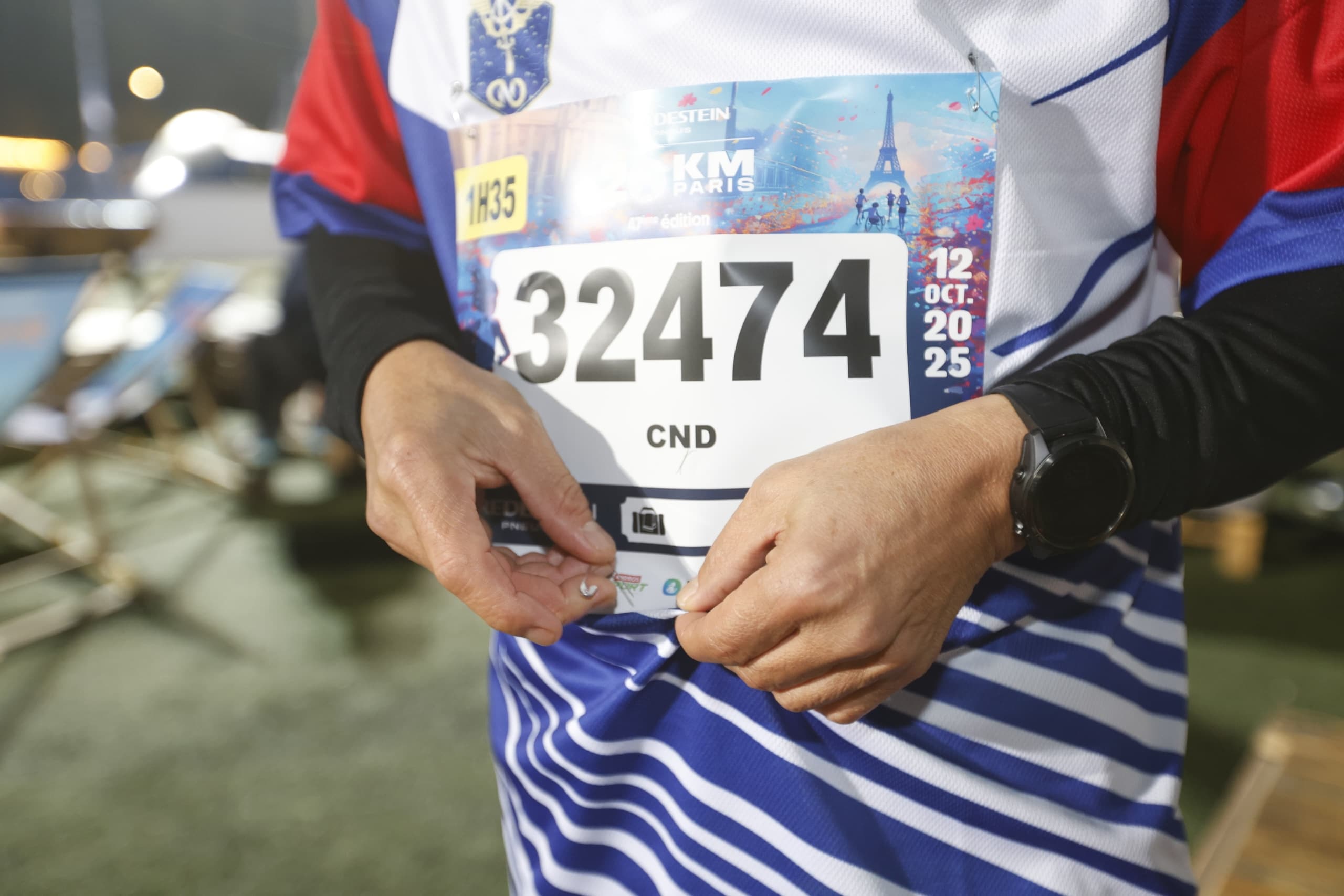
 © MARATHONS.COM
Charity Bibs: The Alternative Way Into Sold-Out Races
For runners who missed out on a race entry, alternatives do exist. One of them, charity bibs, has become increasingly popular. They require a double commitment from participants, but often provide an experience worth far more than its monetary value.
Running has never been more popular. Whether to stay fit, follow the trend among colleagues, or take on a personal challenge, more and more people are lacing up their shoes. Running is booming, and race bibs have become a scarce commodity. In this context, the seemingly miraculous solution of charity bibs has gained momentum over the past few years. Within ASO, the organizer of the Adidas 10K Paris, the Hoka Semi de Paris, and more recently the Schneider Electric Marathon de Paris, running in support of a cause is nothing new. “We started working with certain charities eight or nine years ago,” explains Thomas Delpeuch, Director of Mass Participation Events at the company.
nspired by Anglo-Saxon fundraising traditions, the concept took time to establish itself in France, where such initiatives have historically been less common. Gradually, however, it gained traction. “Charities became more familiar with the model, and the fundraising platform iRaiser helped us develop it in France,” adds the man behind some of Paris’s most iconic races. During the 49th edition of the Paris Marathon, 8,500 runners participated through charity bibs, compared with 6,000 the previous year.
This growth reflects organizers’ desire to expand the model. “Getting people to run is great. Closing down entire cities for a day is great. For enjoyment, for sport, for physical activity—that’s one thing. The second is being useful to society by creating a wonderful event while raising significant funds,” he continues. Yet while organizers embrace this vision, runners do not always see charity bibs as a gift. Although many are happy to support a cause, raising the required funds can be challenging, and some ultimately end up contributing substantial amounts from their own pockets.
| The Charity Bib Boom
“Between April and early June, all our bibs were gone,” Thomas Delpeuch says of the Paris Marathon. Races are selling out in record time. To understand why, one must look back a few years. In 2000, 17% of French people practiced running. The figure remained unchanged in 2017. Then everything accelerated: by 2019, 24% of the population was running, a trend further amplified by the Covid-19 pandemic. Today, according to the Running Observatory conducted by Union Sport & Cycle (USC) for the French Athletics Federation (FFA), nearly one in four French people runs regularly. That represents 13 million runners, compared with 7.4 million in 2017. As a result, in 2024, 62% of runners reported difficulty securing a race bib.
Faced with this enthusiasm, race organizers have tried to keep up. They have increased race capacities while also developing alternatives such as charity entries. At the Adidas 10K Paris, charity bibs number in the hundreds. At the Semi de Paris, they are even more numerous, as longer distances tend to generate greater support and engagement from family and friends. Runners can choose from nearly 250 charities. “Once all standard bibs had sold out, we made a significant effort to direct interested runners toward charity entries and fundraising initiatives,” explains the organizer of the Paris Marathon.
At events such as the UTMB, the logic is similar. Given the difficulty of obtaining a bib through the lottery system, some pragmatic trail runners turn to charities to secure their place in the legendary 170-kilometer race. “I only had two Running Stones, so I was almost certain not to be selected,” says Pascal Rollin, a finisher of iconic races such as the Marathon des Sables and the Diagonale des Fous. “If I went through a charity, it was simply to make sure I got a bib. I did a good deed, but my primary goal was still to run the race.”
| From a “Default Option” to a Desire to Repeat the Experience
Both beginners and experienced runners often turn to charity bibs when they realize that standard entries are already sold out. For some, it is a discovery. “As a complete beginner, I had no idea race bibs would sell out so quickly,” says former elite handball player Manon Demortier. For others, it is simply a matter of timing. They were not quick enough to register. Sometimes, it is pure coincidence. “We had planned a weekend in Paris with my partner and realized it was the same weekend as the half marathon. We really wanted to run it, but everything was sold out,” recalls running enthusiast Dorothée Baverel.
Initially chosen as a substitute for unavailable entries, the charity-bib system often ends up winning runners over. “We’ve noticed that runners are quite loyal. Once they’ve done it, they often return to the charities and ask whether they are involved in other events,” observes Thomas Delpeuch. At the Paris Marathon, Justine Vidal found a cause that resonated deeply with her. The charity Enfants du Mékong, linked to her Cambodian roots, felt like an obvious choice. “I want to do it again—it all went by too fast,” she says.
Manon Demortier experienced something similar at the Adidas 10K. Although she initially chose a charity bib because no standard entries remained, the experience left her wanting more. “I ran for the charity ‘Un abri qui sauve des vies’ and we managed to raise €150. Thanks to that, I was able to take part in an incredible race. This year, I didn’t rush to buy a bib because I knew there was a backup solution that suited me.” She is currently raising funds for RoseUp, an organization supporting women affected by cancer. The reaction does not surprise Thomas Delpeuch. “It provides extra motivation, knowing they are running for a worthwhile cause.”
« This year, I didn’t rush to secure a race entry, knowing there was a fallback option that suited me. »
Manon Demortier, Adidas 10K Paris runner
| The Economics of Charity Bibs
For some runners, however, the “good cause” is not the main priority, and they make no secret of it. While the idea of supporting a charity may sound appealing in theory, the experience does not always leave a lasting impression. “The people from the Haute-Savoie Food Bank charity were nice when I arrived to collect my bib. They were waiting for me, and we took a photo together. But since then, nothing,” says Pascal Rollin, who finished the UTMB in 2025. “They sent me a thank-you email and a few photos, but that’s about it.”
That said, supporting charitable causes is something he genuinely appreciates. He had already done so voluntarily during the Marathon des Sables, and this time he did not mind doing it again. In practice, however, the experience felt quite different. His eagerness to take part in the event—especially as a Masters 4 athlete who no longer considers himself particularly young—led him to opt for a charity bib. “I logged on the minute registration opened. I picked the first charity that interested me, but it was already full. I wanted to support something related to hospitalized children, but there were no spots left. So I went with the Haute-Savoie Food Bank. To be honest, I’m not a huge fan. I had zero contact with them before the race, and zero afterward.”
The lack of meaningful interactions with charities, limited feedback on how the funds are used, and the opacity surrounding the amounts raised can be frustrating, especially when fundraising proves difficult. “I don’t like feeling as though I’m asking people for money,” says Dorothée Baverel, who completed the Paris Half Marathon in 2:03. Manon, who is taking part in the experience for a second time, shares the same feeling: “Honestly, it’s not easy. Last year, I tried posting about it on social media and, this year, my fundraising page still hasn’t really taken off either.” In some cases, runners have no choice but to make up the shortfall themselves. Dorothée says she would have done so had she not eventually won two half-marathon entries through a giveaway. “We managed to reach the target, but we also had to make donations ourselves,” Manon reveals.
At the Aix-les-Bains 10K and the UTMB, however, the system works differently. There is no pressure to raise funds before a deadline and no awkwardness from repeatedly asking friends and family for donations on social media. The downside is that some of the meaning can be lost. Some runners barely know where their money goes. “I don’t even know which charity this charity-bib option was supporting,” admits Benjamin Bouteille, who took part in the 10K and simply had to pay an additional €50 on top of the standard entry fee. The money is donated to the Rotary Club, which supports projects in the public interest. At the iconic Chamonix trail-running event, the amount rises to €2,200, tax-deductible. It is a figure that both impresses and raises questions: does supporting a charitable cause require financial privilege?
Running for a Cause. In the end, many runners find themselves embracing this mantra. The experience becomes even more meaningful when it is about something bigger than oneself—perhaps even more so when it is a conscious choice rather than a necessity. And once immersed in this charitable spirit, some runners have no desire to leave it behind.

Sabine LOEB
Journaliste
 17/05/2026
 17/05/2026
 16/05/2026