 © BMW BERLIN-MARATHON
How Far Can Sabastian Sawe Go in the Marathon? Why His 1:59:30 Might Only Be the Beginning
A few years ago, the question seemed absurd. Running an official marathon under two hours belonged to the realm of collective imagination. Then came the 2026 London Marathon, and everything changed. Sabastian Sawe in 1:59:30. Yomif Kejelcha in 1:59:41. A barrier shattered. A historic race. The Kenyan covered the second half in 59:01 after already running more than 21 kilometers at a pace that still felt unrealistic just a few years ago. But instead of closing a chapter, that performance opened a new one. Because Sawe himself has already said he believes he can eventually run 1:58. His coach Claudio Berardelli also believes there is still room for improvement. And when you take a closer look at his profile, experience, training and even the context in which he produced that time, one question starts to emerge: What if the best of Sabastian Sawe is still yet to come?
| Sabastian Sawe is only at the beginning of his marathon story
This may be the most fascinating part of the story: Sabastian Sawe has run only four marathons in his career. Yes, four. In a sport where experience is often essential to performance, that number immediately stands out. The marathon is uniquely demanding. Talent and a huge physiological engine are not enough. You need to learn how to manage effort, nutrition, terrain changes, sensations, muscular damage and mental fatigue.
For a long time, great champions followed a fairly traditional path. First the track. Then the roads. The blueprint is well known in athletics: develop speed over the 1500m, 5000m or 10,000m before gradually moving toward longer distances and eventually the marathon. The goal? Build a complete profile: track speed combined with the endurance and muscular resilience required to survive the marathon. Eliud Kipchoge became Olympic champion over 5000m before dominating the marathon. Kenenisa Bekele ruled the track before becoming one of the greatest road runners ever. Sawe followed a slightly different path. People around him quickly understood that his greatest potential was on the longer distances, so he moved toward the marathon earlier. Everything suggested he was still in a learning phase…
| Four marathons and already an extraordinary trajectory
Here is the record from his first four marathons:
Valencia Marathon 2024: 2:02:05
First marathon. Already among the world’s best. Second-fastest debut in history behind Kelvin Kiptum. The time was astonishing and the hype exploded.
London Marathon 2025: 2:02:27
Six months after his debut, he dominated London against one of the strongest fields ever assembled featuring Jacob Kiplimo, Mutiso, Tola, and Eliud Kipchoge.
Berlin Marathon 2025: 2:02:16
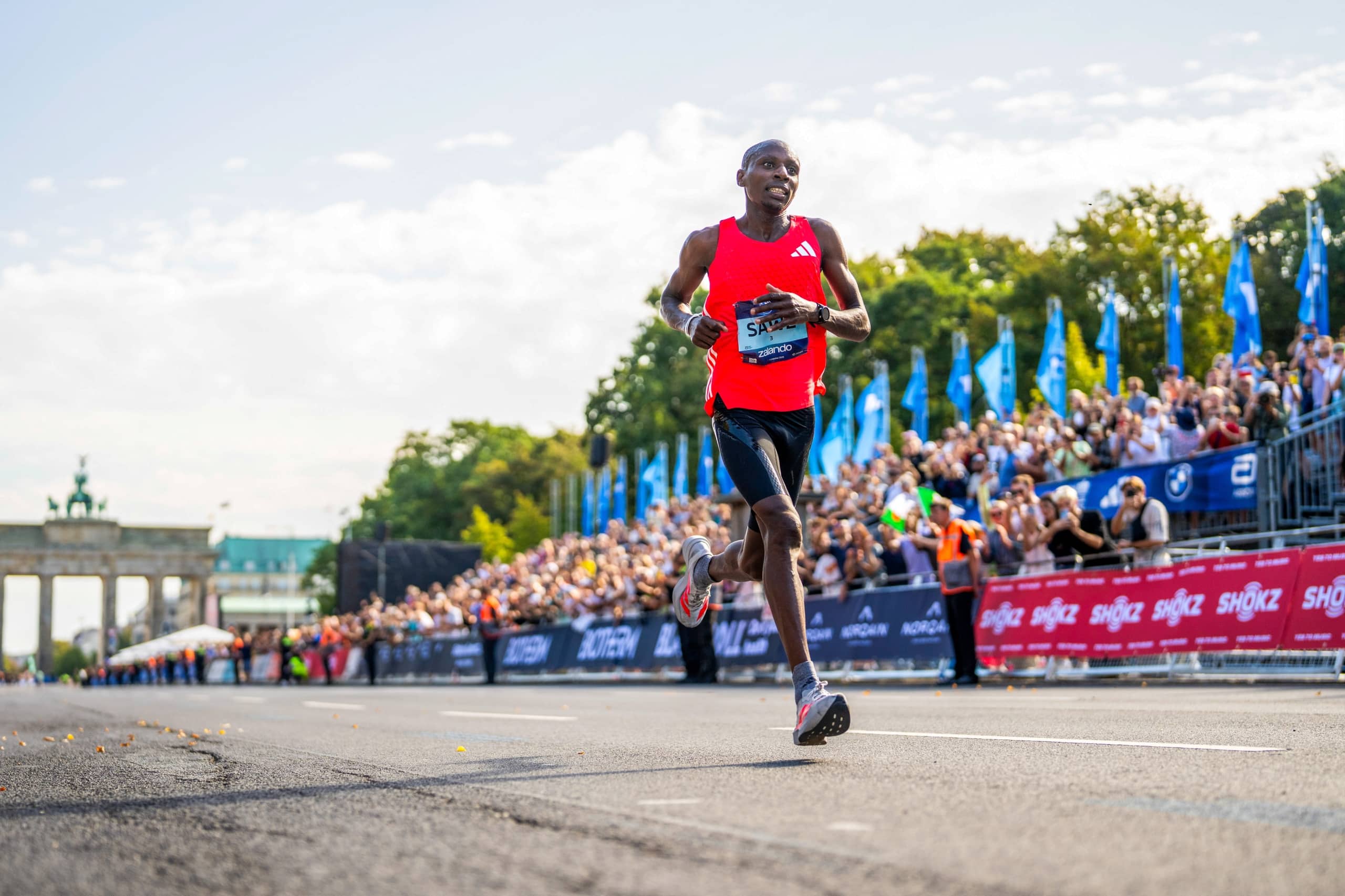
For his third marathon he lined up on one of the fastest courses in the world. Huge ambitions and a race profile designed for him. He reached halfway in 1:00:16, but the heat eventually slowed him down. He still won in 2:02:16.
Many observers viewed the performance as underrated because of how much the weather altered the race. Some were already talking about untapped potential that had not fully expressed itself that day in Berlin.
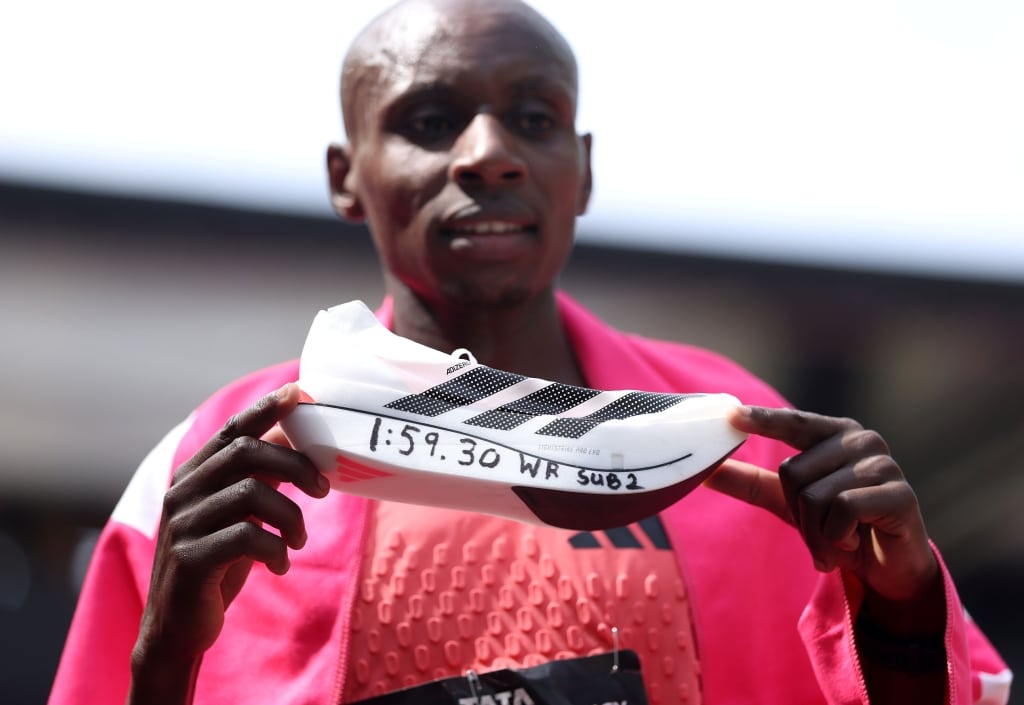
London Marathon 2026: 1:59:30
This time everything aligned. A controlled opening and a phenomenal finish with a 59:01 second half. Kejelcha was heroic and also broke two hours. In London, a new chapter of marathon history opened.
Four marathons. Four victories. And spectacular progression. In only two years, Sawe became the new king of the marathon.
| Elite physiology and unusual maturity
Before becoming an exceptional marathon runner, Sawe had already shown elite speed.
➜ 10 km: 26:49 in 2023
➜ Half marathon: 58:02 in 2022
Those performances tell us something important: Sawe is not only incredibly durable. He also has speed. Today his career seems entirely focused on the marathon, but based on current form, he could probably improve his shorter-distance records too. Still, everything points toward the same conclusion: he has found his event. The marathon appears to be where his profile reaches its highest potential.
| London is not necessarily the perfect marathon for a record
1:59:30. The world is still in shock. People mostly remember the final time. But many forget the course. London is an incredible marathon. One of the most prestigious Majors. Historic. Amazing atmosphere. But not necessarily the perfect course for the fastest possible performance. Yes, the opening section features a net downhill profile that helps save energy, but it can also damage your legs. And the course includes close to 120 meters of elevation gain.
Marathoners usually seek something else: an ultra-flat, extremely consistent course. Because every acceleration, every change in rhythm and every hill slightly increases energy cost. In that regard, courses like Berlin, Valencia and Chicago remain more favorable. Still, there was something magical in London that day. Weather conditions were excellent: around 12°C, a slight tailwind late in the race and that famous long finishing straight through central London. But beyond the conditions, one detail remains fascinating: His second half in 59:01. Finishing that strongly after an already fast opening half sometimes suggests something simple: Maybe he still had a little left.
And that perfectly highlights the science of the negative split. This pacing strategy consists of running slightly slower during the first half to save energy before finishing much stronger. That is exactly what happened in London. And Kelvin Kiptum followed the same approach during his world record in Chicago (1:00:48 / 59:45). Another reminder that the greatest marathons are often run with negative splits.
| Berlin could be the perfect place… but
Sawe has already confirmed his return to the Berlin Marathon next September. And it is difficult to imagine a better setting. Berlin is almost like a giant track drawn through a city. Ultra-flat. Around 65 meters of elevation gain over 42.195 km. Fast. Smooth. Consistent. The place where Eliud Kipchoge built part of his legacy. The place where records constantly fall.
Sawe already knows the race. Last year, despite extreme heat, he still dared to attack world-record pace. This time, the context could be different and all running fans are hoping for weather conditions more suited to fast performances. The adidas athlete will once again arrive as the main attraction.
But Berlin may lack one huge X-factor. Kejelcha has already confirmed Valencia in December. Until Berlin officially announces its elite field, there is a strong chance Sawe could find himself alone during the final part of the race. And we know solo efforts can be brutally demanding in the marathon. Even more interesting: in marathon history, no athlete has ever broken the world record in back-to-back attempts. The challenge looks enormous. But not impossible when your name is Sabastian Sawe.
| Supershoes are changing the game too
For a long time, marathon performance relied mostly on the body and mind. Today the equation has changed. In London, Sawe, Yomif Kejelcha and Tigst Assefa all wore the new adidas Adizero Adios Pro Evo 3. Less than 100 grams. The lightest road racing shoe on the market. A small detail with huge consequences. The lighter the shoe, the lower the energy cost with every stride. Modern supershoes have completely transformed the sport. Ultra-responsive foam, aggressive geometry, carbon structures and improved running economy now play a major role.
But there is also a psychological element. When athletes believe they have access to the best technology available, it can change the way they approach racing. They allow themselves to dream. And that is often where great performances begin.
| Depth: ally or trap?
People constantly talk about the incredible depth of marathon racing today. In London, Kejelcha and Sawe ran together for almost the entire race, and it worked perfectly. Two men under two hours. But assembling many great runners does not automatically produce a world record. Sometimes depth creates chaos. We saw that in Chicago in 2025, when Kiplimo and Korir repeatedly attacked early and eventually exhausted each other.
For world records, the marathon often requires something else: Perfectly even pacing. Reliable pacers. Precise fueling. Absolute focus. If a large enough group forms to share the workload, that can become the X-factor. As long as everyone cooperates.
In London, Sawe did a huge amount of the work. Kejelcha, inexperienced over the distance, mostly stayed on his shoulder. Berlin will probably look different. But the real question begins after 30 km: How will he handle being alone?
| Nutrition is another modern marathon revolution
People talk endlessly about shoes. But perhaps the biggest revolution is nutrition. In Berlin, Sawe absorbed around 105 grams of carbohydrates per hour. In London: around 115 grams. Numbers that sounded ridiculous just a few years ago.
For months, he trained his digestive system with products from Maurten to make these intakes possible. Because in the marathon, the challenge is not only producing energy. It is continuing to supply enough energy to sustain the effort. Finishing a second half in 59:01 does not happen by accident. It is the result of years of teamwork and planning.
For years, breaking two hours felt impossible. Then came the INEOS project with Kipchoge. Now we have Sawe. There is a well-known phenomenon in sports: once a psychological barrier falls, everything changes. Roger Bannister ran the first sub-four-minute mile. Others quickly followed. The marathon may now be entering that same era. Kipchoge opened the door. Sawe may have turned it into a highway, with Kejelcha right behind him. And maybe the real question is no longer whether somebody can run 1:58. Maybe it is simply: When? See you in Berlin on September 27, 2026.
Clément LABORIEUX
Journalist
 17/05/2026
 16/05/2026
 13/05/2026