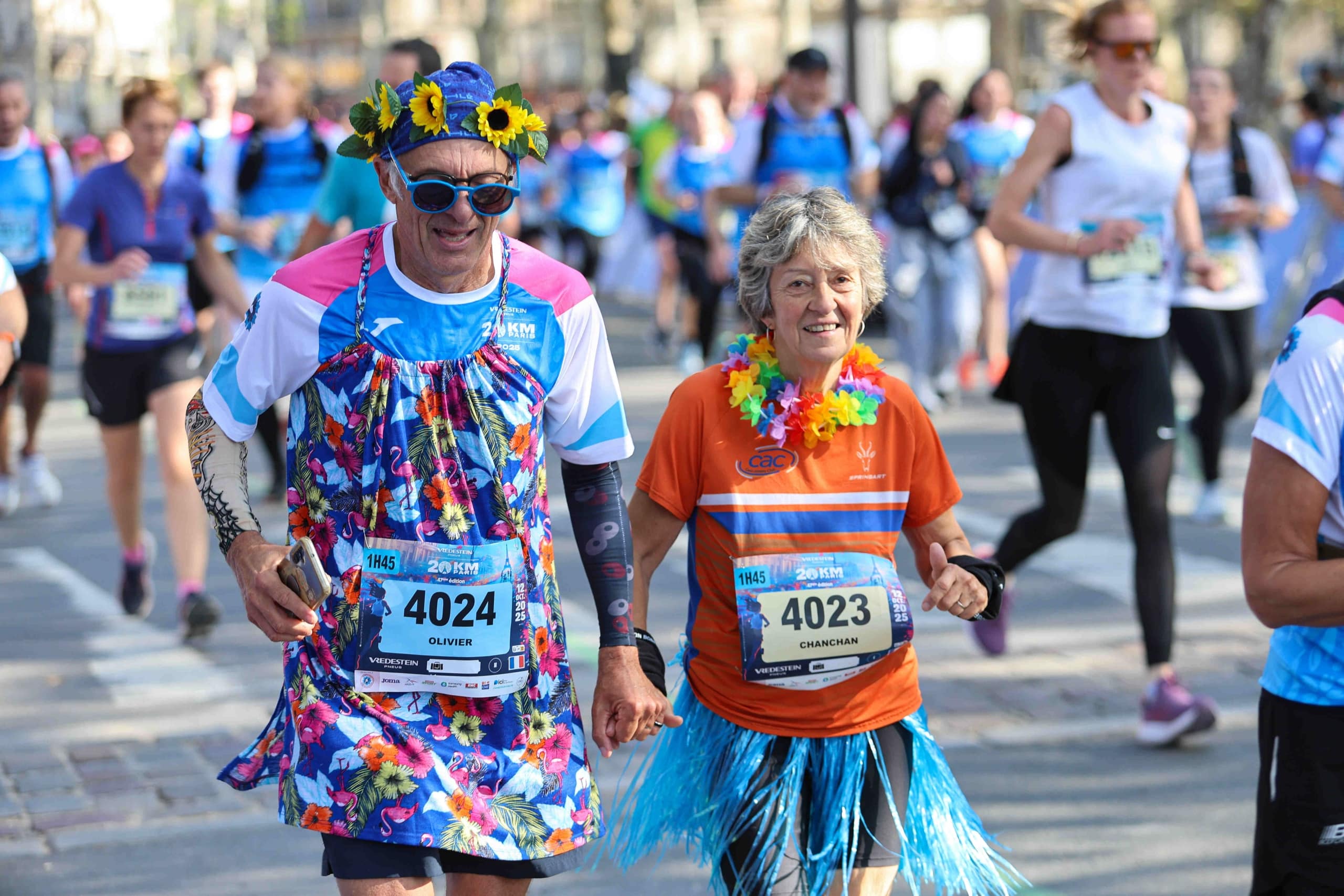
 © Antoine Decottignies / MARATHONS.COM
What if starting running later in life was the best way to keep going?
They started running after the age of 40, 50, or even 70. Far from the pursuit of pure performance, these late-starting runners are redefining their relationship with effort, their bodies, and time. A different way of growing older — by staying in motion.
✓ Analysis with sports medicine doctor Yann Schmitt, an expert with La Clinique du Coureur.
Who could have imagined discovering a natural talent for running at the age of 40? Probably no one—and yet Nathalie Mauclair did exactly that. On her 40th birthday, she ran her first marathon. Not in five hours, like many first-time marathoners, but like an experienced runner. She crossed the finish line in 2:54, her debut mark over the distance. Today, at 55, the ultra-trail champion has also taken up triathlon, while continuing to include running in her training routine.
Of course, not everyone shares the extraordinary destiny of Nathalie Mauclair, who found success in running later in life. But regardless of achievements, the impact of running lies elsewhere for these men and women whose lives were already well established before they laced up their first pair of running shoes. Many took up running later in life, driven by a variety of motivations. Some display remarkable longevity, still competing in marathons at an advanced age. What is the secret behind these Masters athletes who remain in such impressive shape? Several factors come into play, including, perhaps, the fact that they started later. One thing is certain: there is no age limit for starting—and especially for continuing.
| The late-life running breakthrough
“It happened when I already had my job, my house, my husband, my children… I was almost reaching the point where I would have free time and nothing to do with it,” Nathalie Mauclair recalled on the Athlètes Mondiaux podcast, reflecting on how she started running at 40. She is not alone in discovering running at a stage in life when everything seems to be in place, yet something still feels missing. Children grow up, become more independent, and leave space behind. A space that needs to be reinvented.
Sometimes the spark comes from unexpected places. After spending years attending her children’s athletics training sessions, Marie Hanriot eventually found herself drawn into the sport. “My son said to me, ‘Come do the recovery run with me,’” she remembers. “Then his coach took me under his wing and started giving me training plans.” Alix Revenu, now 80, also discovered the joy of running by chance when she was 40. “We were staying in the Landes region. Every morning my husband went for a run. One day I joined him. It was a revelation—the scent of the pine trees, my husband running gently beside me. The next day I told him: ‘Let’s do it again.’” Running quickly became part of her routine. “When we lived in Paris, we would go running at 6 a.m. My husband worked, and I had the children too. We’d run through the Tuileries. Later, when I went alone, I’d run all the way to Pantin and beyond.”
Others are motivated by a desire to inspire. “I wanted my children to experience it too,” says Julie Lajeunesse, who started running in her thirties and recently set a new personal best at 45. For Michael Bettocchi, the admiration he sees in the eyes of his three-year-old son when he crosses a finish line is priceless. After accompanying his father to races, the little boy now enjoys his own moment in the spotlight. “At La Marlienne, there was a race for toddlers. It was just one lap of the track, and he did it,” says the proud father. “Whatever happens, he’ll want to play sports.” These stories often share common ingredients: a more stable stage of life, family influence, a desire to share experiences, and a renewed focus on health and well-being. “Masters athletes are often people whose lives are settled,” explains Yann Schmitt, sports physician and ultra-trail runner. “They have stable jobs and established routines. Their kids are eight years old, they can leave them at home or have them ride a bike alongside while they run.”
| A More Sustainable Approach to Running
“People who start running at 40 don’t approach it the same way they would at 20,” says Schmitt. As runners age, their running economy—the amount of energy required to maintain a given pace—changes. “They have more life experience, they run with greater maturity, and they pace themselves more thoughtfully,” he explains. Even when pursuing ambitious goals, most mature beginners tend to listen more carefully to their bodies. Two years before the 2026 Paris Marathon, Michael Bettocchi secured an entry to the race. A decision that might sound ambitious considering he was living with severe obesity at the time. Yet he never stopped progressing at his own pace. “There was definitely this mindset of ‘you’ve signed up, now you finish it,’ but also a determination not to destroy myself or get injured,” he says.
In general, adults are less impatient. They improve gradually, with patience and consistency. There is less pressure, more attention to sensations, and greater awareness of the body’s signals. The first time Alix Revenu went running, she already had ambitious plans. “Wait, I’ll come with you. I’ll run for 15 or 20 minutes,” she told her husband. Others begin even more cautiously. Koichi Kitabatake, now 92, remembers his first outings twenty years ago: “At first, I could only walk. But I quickly realized that jogging was actually easier than fast walking.”
The social aspect also plays a crucial role in long-term consistency. Those who started running with colleagues or friends often enjoy the shared experience as much as the exercise itself. “I coach athletes who have been running for thirty years purely out of passion,” says Schmitt. “Their goal is to run during the week so they can enjoy their weekend outing with friends.” When you’re new to running, every step matters—especially after 40. Performance is secondary, and even though it is a driving force for some athletes — such as Marie, who was dependent on this activity during her first years, or Alix, who ran marathon after marathon without worrying — it is approached differently. “It is later on that you start hearing people say: ‘Careful, I don’t want to run too much because I need to protect my recovery phase,’” explains the specialist.
From a physical standpoint, the older we get, the more recovery we need. “A young person can do more intense races, closer together. After a demanding session, an older person may simply need a little more time to recover. That is what you have to pay attention to: the appearance of injuries,” continues the healthcare professional. When they are younger, athletes are less cautious about preserving themselves, especially when performance is at stake. “One of my sons was the French 1500-meter champion; he was jogging, they heard a ‘crack,’ and he had a fracture,” recalls Marie, who is realistic about the paths her sons have taken — they have since become more like casual weekend runners. This is still preferable to stopping sport altogether, as is the case for many former licensed athletes who, after prioritizing intensity, eventually give up. In adulthood, the approach is therefore more measured. But does it really allow people to keep going long-term?
« I have very little doubt that a young person who runs for pleasure will enjoy long-term health. »
Yann Schmitt, sports medicine doctor and ultra-trail runner
| To keep going over the long term
“I mainly want to finish in good shape,” says Alix Revenu, before setting off on her 45th marathon, on the occasion of her 80th birthday, after a ten-year break from running. It is a goal she was able to set for herself because she is still physically capable of achieving it. This is not the case for everyone, including her husband, who is no longer able to even go for a jog by the seaside in Cascais, where the couple has lived for the past ten years.
Growing older does not necessarily mean giving up on performance; rather, it means redefining it. “Some people no longer look at the stopwatch, but instead look at their age-group rankings and are very proud to say: ‘I was the top female finisher in the Masters category.’” Others challenge themselves in ways that have nothing to do with the final result, telling themselves: “I want to run my marathon at 60,” explains Schmitt. Without necessarily anticipating the effort required to achieve it, they set their sights on different milestones. For his 36th marathon, Koichi Kitabatake simply wanted “to enjoy the atmosphere,” already happy just to be able to cover 42.195 km at the age of 92.
Some remain very active within their athletics clubs, such as the oldest member, Rodrigues Diamantino, who is 82. He is more of a road runner, a fan of 10 km races, and started running at the age of 58. “When I stopped drinking,” he specifies, before adding with a smile: “I don’t regret it, because when I see some people who can barely stand up anymore because they have been running since their youth…” His comments raise a question: does running when you are young damage your health? Dr. Schmitt puts things into perspective: running badly, certainly. But “a young person who runs recreationally — I have very little doubt about their long-term health.” There is no danger in running as you age; quite the opposite. The benefits are numerous: improved cardiovascular health, reduced risks of hypertension, heart attacks, certain cancers and recurrences, better cognitive function, preservation of joints and muscles, and improved bone health. Not to mention sleep and overall well-being. This is why Diamantino trains three to four times a week: “Because I started late, I realized that in terms of health and fitness, it really pays off.”
The key, regardless of age: adapt your practice, reduce the workload if necessary, and prioritize consistency. “I would rather you run fifteen minutes every day than do one huge Sunday session that destroys your knees. In the end, in terms of weekly volume, you come out ahead and you protect your health,” says Schmitt, emphasizing the importance of strength training, which is essential for running — “especially at that age, because muscle loss happens quite quickly, and it is slowed down through weight training.”
Starting running late in life does not guarantee longevity. But running while listening to your body does. It may be the only way to keep running throughout your life and continue to age well, especially at an advanced age. “People who engage in physical activity do not age in the same way at all as those who do not,” concludes Dr. Schmitt.
Sabine LOEB
Journaliste
 17/05/2026
 17/05/2026
 13/05/2026