 © ASO
© ASO
“The first 500 meters feel like a tunnel”: why the opening mile of a marathon often catches runners off guard
Many marathoners experience it without always being able to explain it: the opening minutes of a race are not necessarily the easiest. Breathing struggles to settle, the legs hesitate, and the planned pace takes time to click into place. Behind that sometimes uncomfortable first kilometer lie very real reasons, from physiology and pack dynamics to the pressure of the start.
People often talk about the infamous “wall” at mile 18–20. The one that derails personal best dreams and turns a promising race into a long grind. But much less about the first kilometer. “A marathon rarely starts the way you planned. The fear of going out too fast, the worry of going out too slow… all of that creates tension that doesn’t disappear when the gun goes off,” explains Grégoire Millet, a French exercise physiologist and professor at the University of Lausanne in Switzerland.
That first kilometer is the moment when nothing quite feels in place. Legs can feel heavy, the target pace still feels more like an idea than a reality, and while some runners go out too fast, others are just trying to find their rhythm. Paradoxically, those first few minutes can be among the most uncomfortable of the entire race. Runners talk about it often, but rarely understand why. Yet behind that strange sensation are very real mechanisms—physiological, mechanical… and mental.
| A start that’s always a little chaotic
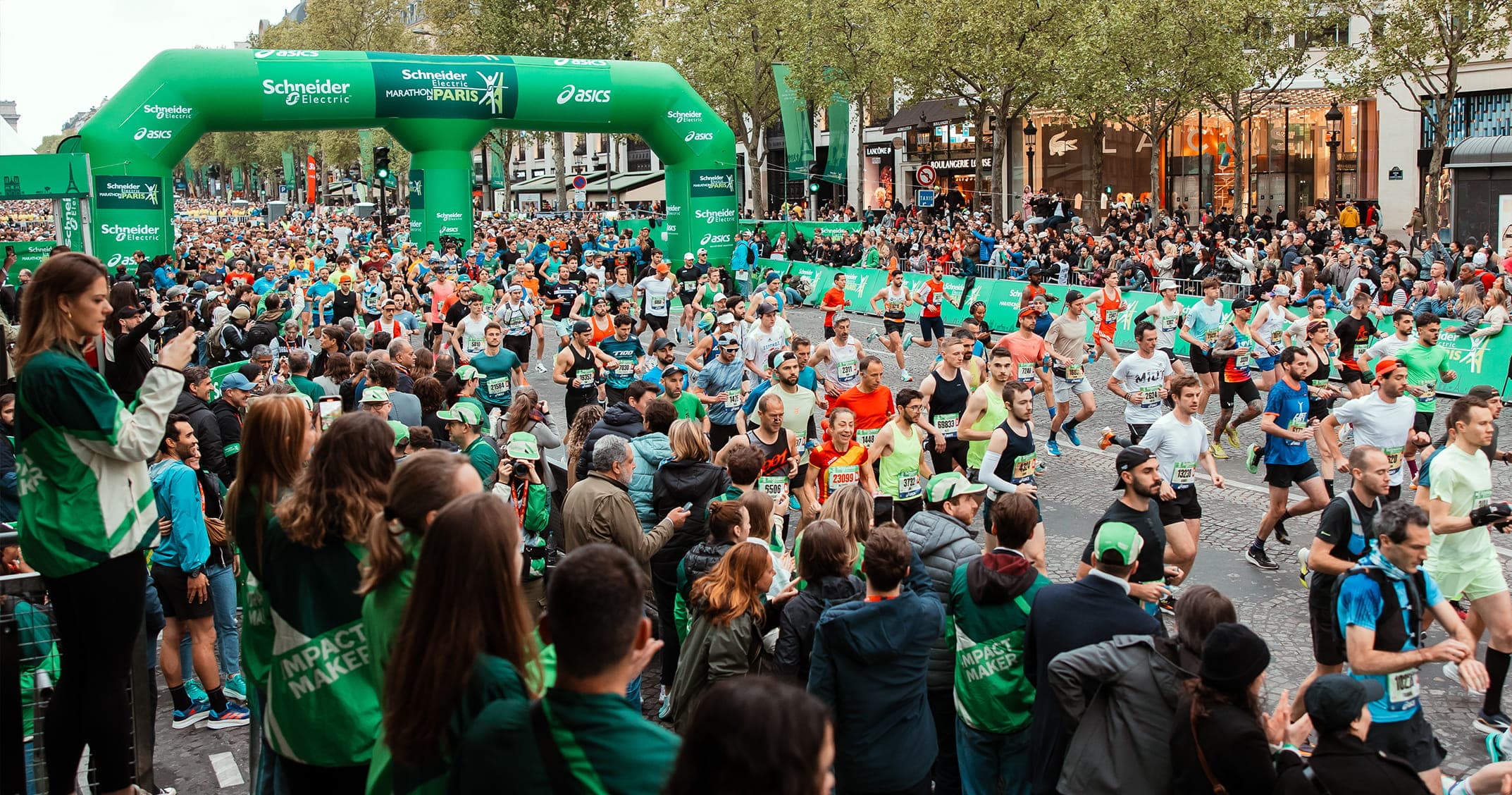
In theory, a marathon begins when the pack starts moving. In reality, it often begins in mild chaos. Dense crowds. Surges and slowdowns. Imperfect lines. The pace rehearsed for weeks suddenly becomes hard to execute.
As Millet points out, the start immediately imposes constraints many runners underestimate. “We often talk about the wall at 30K, but I think it’s just as interesting to look at the first meters—or the first kilometer. There are several factors at play, including the fact that you can’t always run exactly at your planned pace.”
In other words, the marathon rarely begins as expected. The fear of going out too fast. The worry of going out too slow. The density of the pack. All of this creates what physiologists call pre-race stress. “Pre-competition stress has been well studied,” Millet explains. “And it doesn’t vanish at the start—it fades progressively.” Those first minutes are often just about calming down.
« When you start exercising, it takes about two and a half minutes for the average person to reach a steady state of oxygen consumption »
Grégoire Millet, professor of exercise physiology at the University of Lausanne
| The body isn’t ready as fast as you think
A marathon start is nothing like a time trial. Even in fast races, the opening kilometer often feels like group navigation. You weave, slow down, accelerate again. That mechanical instability can disrupt your rhythm.“There can be phases of acceleration and deceleration,” says Millet, a former French triathlete and national champion in 1986. “Your stride can’t always be as controlled as you’d like. And the denser the pack, the more these constraints matter.”
For mid-pack runners targeting around 3:30 or 4:00, this phase can last several minutes. A perfectly even stride is impossible. Yet the body is already working hard. The most interesting explanation, however, lies elsewhere—in VO₂ kinetics. In simple terms, how quickly your body can deliver oxygen to meet the demands of exercise. When you start running, your muscles immediately demand energy, but your aerobic system takes time to catch up. “When you begin exercising,” Millet explains, “it takes about two and a half minutes for most people to reach a steady oxygen consumption.”
Two and a half minutes—essentially most of that first kilometer. During that time, the body operates with a gap between demand and supply. “We call it an oxygen deficit. Energy demand rises instantly, but aerobic supply takes time to adjust. That mismatch is physiologically uncomfortable.” Elite runners shorten that phase significantly. “At the highest level, stabilization can happen in 40 to 50 seconds.” Diesel engine versus turbo.
| “Diesel” runners and the role of the warm-up
This also explains a familiar feeling for many marathoners: the so-called “diesel” profile. Those who need several kilometers to truly settle into their pace. Contrary to popular belief, that’s not a myth. “Some people mobilize their aerobic energy faster than others,” says Millet. “Endurance-trained athletes tend to have faster kinetics.” As a result, some runners feel comfortable almost immediately, while others need several minutes. That first kilometer becomes a transition phase.
There is, however, a simple way to improve it: warming up properly. In reality, many amateur marathoners reach the start line barely warmed up. A few stretches. A short jog. Then 10–15 minutes standing still in the corral. Not ideal. “A moderate warm-up doesn’t significantly speed up VO₂ kinetics,” Millet explains. “But adding some higher-intensity efforts can accelerate the process.” In other words, a few strides can help your body deliver energy more quickly.
« When you’re well prepared, you’ve already done the mental work. Everything is set so that from the first kilometer, you’re in it. There’s even a kind of euphoria that takes over »
Julien Devanne, a former French marathon champion (2019) turned coach
Elite runners almost always do it. Amateurs far less so. Former high-level marathoner turned coach Julien Devanne observes exactly the same pattern on starting lines. In his view, the difference often comes down to how runners handle the minutes before the gun. “When you’re well trained, you’ve already done the mental preparation. Everything is set so that from the first kilometer, you’re in it. There’s even a kind of euphoria that takes over.”
Among elites, everything is structured to arrive fully ready at the exact moment of the start. “On the start line, you can still do accelerations right up to a few minutes before the gun. You stay active, you keep the body switched on so it’s ready.” in the mass-start corrals, the reality can be very different. “People spend months preparing the race, but very few really think about the one or two hours before the start,” notes the coach from western France.
| The overlooked role of muscle temperature
Another key factor is muscle temperature. Warm muscles work better. Blood flow increases, oxygen exchange improves. “Maintaining a high muscle temperature facilitates vasodilation and oxygen exchange,” Millet notes. That reduces early discomfort. That’s why so many runners wait at the start wearing old sweatshirts or even garbage bags. It may look odd, but it makes sense. Devanne recalls stories from runners at the New York City Marathon: “They told me they waited four hours on the start island wearing shorts and a T-shirt with a garbage bag over their shoulders. In those conditions, I can’t even imagine the first kilometer… or the first five.”
| Adrenaline and a mind already racing
But the first kilometer isn’t just about physiology. The brain plays its part too. A marathon start is a unique moment: thousands of runners, long waiting times, and often a deeply personal goal. Tension builds. “Half an hour before the start, you’re thinking about everything,” says Devanne. “Your preparation, the fear of falling, the group you want to follow.”

Adrenaline can push runners to go out too fast. “If you look at splits, the early kilometers are often the fastest,” he notes. “People go from zero to 120 bpm when their target effort should be closer to 90.” The group effect is massive. Training alone all year and then suddenly being surrounded by thousands of runners creates a completely different level of stimulation.
Even when things go smoothly, the brain is already busy. Competitive runners think about their time. Others wonder if they’ll even finish. In both cases, tension can lead to unnecessary tightness—raised shoulders, stiff arms, uneven breathing. All small details that cost energy. “It’s important to stay relaxed, especially in non-locomotor muscles like the shoulders and arms.”
| Breathing as a reset button
There is, however, a simple tool to manage that stress: breathing. Deep diaphragmatic breathing, with slightly longer exhalations, helps activate the parasympathetic nervous system—the one that calms the body. “Breathing techniques can help reduce stress and maintain better heart rate variability,” Millet explains. Simple. Accessible. Often effective.
The first kilometer isn’t necessarily the hardest physically. But it is often the most unstable. The body searches for rhythm. The mind settles into the effort. The environment imposes its constraints. A marathon doesn’t truly begin with a pace. It begins with an adjustment. Julien Devanne sums it up perfectly: “For the first 500 meters, it’s like a tunnel where no one is really thinking. The race only starts to stabilize between the second and third kilometer.” In the end, those first strides serve one purpose: finding your place in the race. The marathon itself is still waiting.
➜ Discover the marathon calendar

Dorian VUILLET
Journalist
 17/05/2026
 11/05/2026
 29/04/2026